
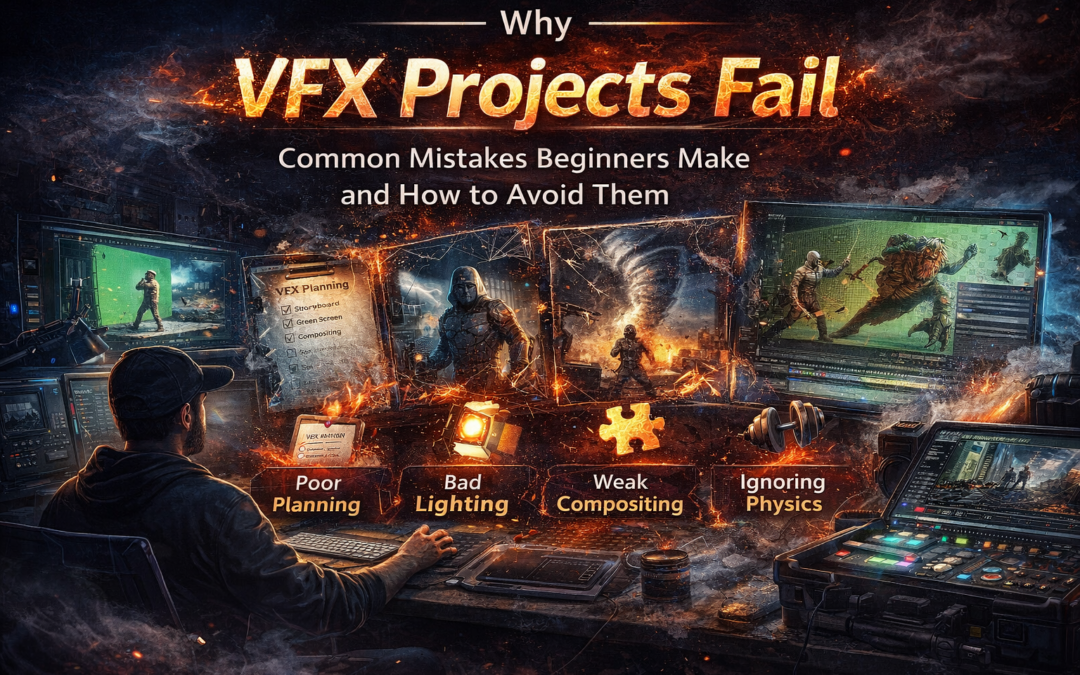
Why VFX Projects Fail: Common Mistakes Beginners Make and How to Avoid Them
Introduction
Visual effects have become a crucial part of modern content creation, from films and advertisements to YouTube videos and digital campaigns. While the final output often looks seamless and impressive, creating high-quality visuals requires strong technical skills, planning, and attention to detail.
Many beginners enter the field with enthusiasm but struggle to deliver professional results. The truth is, most VFX Projects fail not because of lack of creativity, but due to common mistakes in execution, planning, and understanding of fundamentals.
In this blog, we will explore why VFX Projects fail, the most common mistakes beginners make, and how you can avoid them to create high-quality work.
Lack of Proper Planning in VFX Projects
One of the biggest reasons why VFX Projects fail is poor planning. Beginners often jump directly into software without fully understanding the requirements of the project.
Without planning, issues such as mismatched shots, missing elements, and inconsistent visuals arise during post-production.
How to Avoid This
- Always plan your shots before shooting
- Create a clear storyboard
- Understand the final output before starting
Proper planning ensures that your VFX Projects start on the right foundation.
Ignoring Real-World Lighting and Shadows
Lighting plays a major role in making visual effects look realistic. Many beginners ignore how light behaves in real environments, which leads to unrealistic results.
When lighting doesn’t match the background, the entire scene looks fake.
How to Avoid This
- Study real-world lighting conditions
- Match shadows and reflections
- Observe how light interacts with objects
Understanding lighting is essential for successful VFX Projects.
Poor Green Screen Usage
Green screen is widely used in VFX, but improper usage can ruin the final result.
Common mistakes include:
- uneven lighting
- shadows on the screen
- improper camera angles
These issues make it difficult to remove the background cleanly.
How to Avoid This
- Use even lighting on the green screen
- Maintain proper distance between subject and background
- Avoid shadows and wrinkles
Clean green screen footage is critical for smooth VFX Projects.
Weak Understanding of Compositing
Compositing is the process of combining different visual elements into a single scene. Many beginners struggle with blending elements naturally.
As a result, objects may look out of place or disconnected from the scene.
How to Avoid This
- Learn basic compositing techniques
- Match colors and lighting
- Focus on depth and perspective
Strong compositing skills can significantly improve your VFX Projects.
Overusing Effects
Beginners often try to add too many effects to make their work look impressive. However, overusing effects can make the scene look unrealistic and cluttered.
Professional VFX focuses on subtlety and realism.
How to Avoid This
- Use effects only where necessary
- Focus on enhancing the scene, not overloading it
- Keep visuals clean and balanced
Simplicity often leads to better VFX Projects.
Ignoring Real-World Physics
Another common mistake is ignoring how objects behave in the real world.
For example:
- unrealistic movement
- incorrect gravity
- unnatural motion
These issues break the illusion and reduce the quality of the project.
How to Avoid This
- Observe real-world motion
- Study physics basics
- Apply realistic timing and movement
Realistic motion is key to successful VFX Projects.
Lack of Software Workflow Knowledge
Many beginners learn tools but don’t understand the proper workflow. This leads to confusion, errors, and inefficient processes.
Without a structured workflow, it becomes difficult to manage complex projects.
How to Avoid This
- Learn step-by-step workflows
- Practice project-based learning
- Understand how different tools work together
Efficient workflows improve the quality and speed of VFX Projects.
Poor Attention to Detail
VFX requires precision. Small mistakes like mismatched edges, incorrect shadows, or color differences can ruin the entire scene.
Beginners often overlook these details.
How to Avoid This
- Zoom in and check every detail
- Compare with real-world references
- Take time to refine your work
Attention to detail makes a big difference in VFX Projects.
Not Taking Feedback Seriously
Feedback is essential for improvement, but many beginners ignore it or take it negatively.
Without feedback, it becomes difficult to identify mistakes and grow.
How to Avoid This
- Seek feedback from experienced artists
- Be open to suggestions
- Use feedback to improve your skills
Learning from feedback helps you create better VFX Projects over time.
Unrealistic Expectations
Many beginners expect quick results without understanding the complexity of VFX work. This leads to frustration and incomplete projects.
VFX requires patience, practice, and continuous learning.
How to Avoid This
- Set realistic goals
- Focus on learning step by step
- Practice regularly
Consistency is the key to mastering VFX Projects.
Skills Required to Succeed in VFX
To avoid common mistakes and improve your work, you need to build strong foundational skills.
Important skills include:
- creativity and visualization
- compositing techniques
- lighting and color understanding
- software knowledge
- problem-solving ability
Tools like Adobe After Effects, Nuke, and Blender are widely used in professional workflows.
Final Thoughts
Creating high-quality visuals is not just about using advanced software. It requires planning, understanding of fundamentals, and attention to detail. Most VFX Projects fail because beginners skip these essential steps.
By avoiding common mistakes such as poor planning, incorrect lighting, weak compositing, and unrealistic expectations, you can significantly improve your work.
For students and aspiring artists, learning from these mistakes is the fastest way to grow. With practice, patience, and the right approach, you can create professional-level VFX Projects and build a successful career in the industry.
Recent Comments