
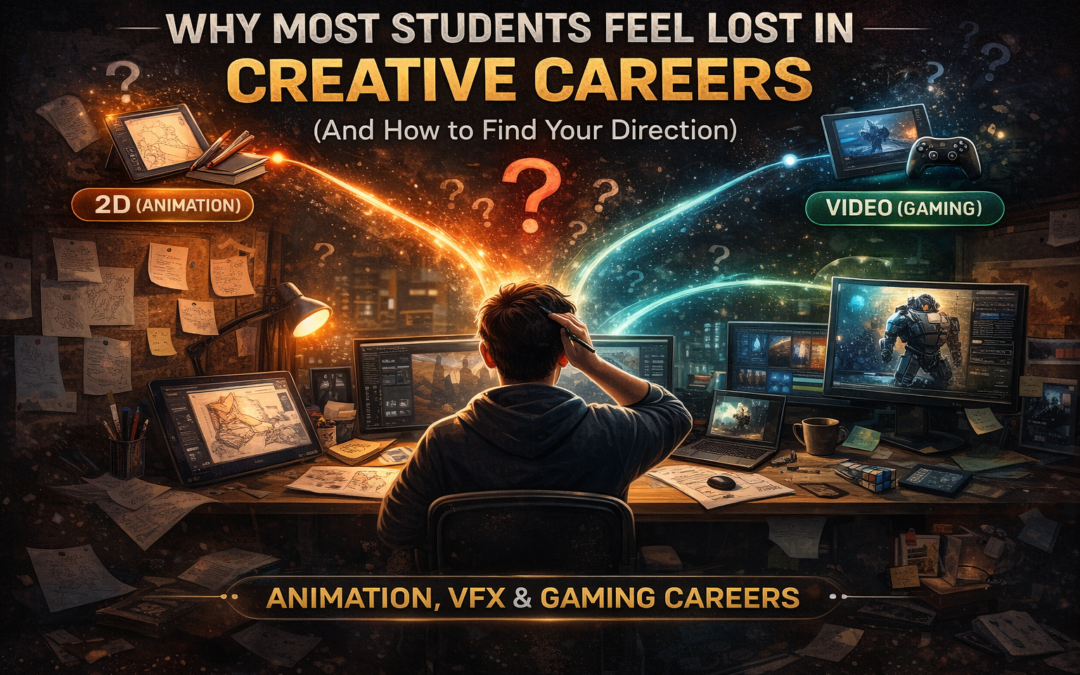
Why Most Students Feel Lost in Creative Careers (And How to Find Your Direction)
Introduction
In today’s digital world, Animation VFX Gaming Careers are becoming some of the most exciting and in-demand career options. From movies and OTT platforms to games and digital content, creative industries are growing rapidly.
But here’s the reality—despite so many opportunities, most students feel lost.
They start with excitement, watch inspiring content, and dream big. But soon, confusion takes over. They begin to question their choices, compare themselves with others, and struggle to find a clear direction.
If you’re feeling this way, it’s completely normal.
In this blog, we will explore why students feel lost in Animation VFX Gaming Careers and how you can find clarity, confidence, and the right path.
Too Many Options Create Confusion
One of the biggest reasons students feel lost in Animation VFX Gaming Careers is the overwhelming number of choices.
You can choose from:
- 2D animation
- 3D animation
- VFX compositing
- video editing
- game design
- UI/UX
- motion graphics
At first, this seems exciting. But very quickly, it becomes confusing.
Students often think:
👉 “What if I choose the wrong field?”
👉 “What if I waste my time learning something that doesn’t work?”
This fear creates hesitation, and instead of moving forward, many students keep switching paths.
Lack of Clear Guidance
Unlike traditional careers, Animation VFX Gaming Careers don’t come with a fixed roadmap.
There is no single path like:
👉 School → College → Job
Instead, students rely on:
- random tutorials
- social media content
- incomplete advice
This scattered learning creates more confusion than clarity.
Without proper guidance, students don’t know:
- what to learn first
- how much time to give
- when they are ready for jobs
And this uncertainty makes them feel lost.
Comparing with Others
Comparison is one of the biggest reasons students struggle in Animation VFX Gaming Careers.
They see others on Instagram, YouTube, or LinkedIn who are:
- creating amazing designs
- working in big studios
- posting high-level projects
And they think:
👉 “I’m not good enough.”
👉 “I’m already behind.”
But what they don’t see is the journey behind that success.
Every professional started as a beginner. Comparing your beginning with someone else’s success only increases confusion and self-doubt.
Learning Without Direction
Many students keep learning tools but don’t have a clear goal.
They jump from:
- Photoshop → Blender → After Effects → Unity
But they don’t master any of them.
In Animation VFX Gaming Careers, learning without direction leads to frustration. Students feel like they are working hard but not making real progress.
The problem is not effort—it’s lack of focus.
Fear of Failure
Fear plays a big role in making students feel stuck.
Common fears include:
- fear of choosing the wrong field
- fear of not getting a job
- fear of wasting time
Because of this fear, students delay decisions and avoid taking action.
In Animation VFX Gaming Careers, growth comes from trying, failing, and improving. Avoiding failure only slows down progress.
Unrealistic Expectations
Social media often shows only the success side of Animation VFX Gaming Careers.
Students think:
👉 “I’ll learn this in 3 months”
👉 “I’ll start earning quickly”
But the reality is:
- skills take time
- growth is gradual
- success requires consistency
When expectations don’t match reality, students feel disappointed and lost.
Lack of Practical Experience
Another major issue is focusing only on theory.
Students watch tutorials but don’t create real projects.
In Animation VFX Gaming Careers, practical work is everything.
Without projects:
- confidence remains low
- portfolio stays empty
- growth becomes slow
Real learning happens when you actually create something.
How to Find Your Direction
Now that we understand the problem, let’s talk about the solution.
Step 1: Explore Before You Decide
Instead of rushing, take time to explore different areas within Animation VFX Gaming Careers.
Try:
- basic animation
- simple VFX projects
- beginner game design
This helps you understand what you enjoy the most.
Step 2: Choose One Direction
Once you explore, choose one field to focus on.
Don’t try to learn everything at once.
In Animation VFX Gaming Careers, depth is more important than breadth.
Focus brings clarity and faster growth.
Step 3: Build Real Projects
Start creating projects instead of just learning.
For example:
- design a poster
- create a short animation
- build a simple game
Projects give you confidence and help you build a strong portfolio.
Step 4: Stop Comparing Yourself
Everyone’s journey is different.
Instead of comparing, focus on your own progress.
In Animation VFX Gaming Careers, consistency matters more than speed.
Small improvements every day lead to big results.
Step 5: Follow a Structured Learning Path
Avoid random learning.
Follow a clear roadmap:
- basics → intermediate → advanced
- practice → projects → portfolio
Structured learning reduces confusion and builds confidence.
Step 6: Seek Guidance
Find mentors, courses, or communities that provide direction.
Right guidance can:
- save time
- reduce mistakes
- accelerate growth
In Animation VFX Gaming Careers, learning from experienced people is very valuable.
Step 7: Be Patient and Consistent
Success doesn’t happen overnight.
Creative skills take time to develop.
Stay consistent, keep learning, and trust the process.
Skills That Help You Stay on Track
To succeed in Animation VFX Gaming Careers, focus on:
- creative thinking
- problem-solving
- storytelling
- discipline
- patience
Tools like Blender, Adobe After Effects, Unity, and Autodesk Maya are important—but skills matter more.
Final Thoughts
Feeling lost in Animation VFX Gaming Careers is not a weakness—it’s a phase.
Almost every creative professional has gone through this stage.
The key is not to avoid confusion, but to move forward despite it.
By exploring, focusing, practicing, and staying consistent, you can find your direction and build a successful career.
Remember, clarity doesn’t come from thinking—it comes from doing.
Recent Comments