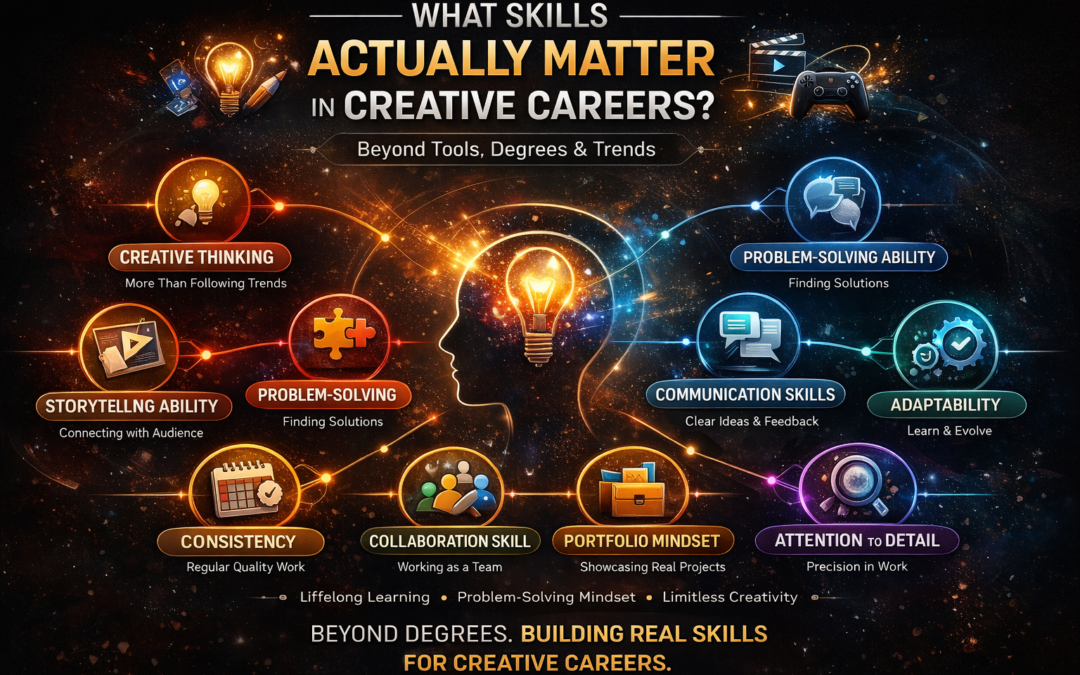
What Skills Actually Matter in Creative Careers? Beyond Tools, Degrees & Trends
Introduction
In today’s fast-growing digital world, creative industries are expanding rapidly. From graphic design and animation to VFX, filmmaking, and game development, opportunities in Creative Careers are more diverse than ever. However, many students and beginners often believe that learning software tools or earning a degree is enough to succeed.
The reality is quite different.
While tools and certifications are important, they are not the deciding factors in long-term success. What truly matters are deeper, transferable skills that define how you think, create, and solve problems.
In this blog, we will explore the real skills that matter in Creative Careers, going beyond tools, degrees, and trends to understand what makes someone truly successful in this field.
The Myth: Tools and Degrees Define Success
One of the biggest misconceptions about Creative Careers is that mastering tools automatically guarantees success. Many students focus only on learning software like Photoshop, Blender, or After Effects.
Similarly, degrees are often seen as the main path to a good career.
However, in reality:
- Tools keep changing
- Software evolves quickly
- Degrees alone don’t guarantee skills
Professionals who rely only on tools often struggle when industry demands shift. This is why focusing only on technical learning is not enough for sustainable Creative Careers.
Skill 1: Creative Thinking
Creative thinking is the foundation of all Creative Careers. It is the ability to generate new ideas, think differently, and approach problems from unique perspectives.
A designer or artist with strong creative thinking can:
- develop unique concepts
- solve design challenges
- stand out from competition
Creativity is not about copying trends—it’s about creating something original and meaningful.
Skill 2: Problem-Solving Ability
Every project in Creative Careers involves solving a problem. Whether it’s designing a logo, editing a video, or creating a game environment, the goal is to communicate effectively.
Strong problem-solving skills help professionals:
- understand client requirements
- find practical solutions
- improve project outcomes
Creative work is not just about visuals—it’s about solving real-world challenges.
Skill 3: Storytelling
Storytelling is one of the most powerful skills in Creative Careers. Whether it’s a film, advertisement, or game, every project tells a story.
Good storytelling helps in:
- engaging the audience
- creating emotional connection
- making content memorable
Professionals who understand storytelling can create content that resonates deeply with viewers.
Skill 4: Communication Skills
Many people underestimate the importance of communication in Creative Careers. However, it plays a crucial role in professional success.
Creative professionals need to:
- explain their ideas clearly
- understand client feedback
- collaborate with teams
Strong communication skills ensure that ideas are executed correctly and efficiently.
Skill 5: Adaptability
The creative industry changes rapidly. New tools, technologies, and trends emerge constantly. This makes adaptability a key skill in Creative Careers.
Adaptable professionals:
- learn new tools quickly
- adjust to industry changes
- stay relevant over time
Those who resist change often struggle to survive in competitive environments.
Skill 6: Attention to Detail
Small details can make a huge difference in creative work. Whether it’s color alignment, animation timing, or sound design, precision is essential.
Attention to detail helps in:
- improving quality
- avoiding errors
- delivering professional work
In Creative Careers, even minor mistakes can impact the final result.
Skill 7: Consistency and Discipline
Success in Creative Careers is not about one good project—it’s about consistent performance over time.
Consistency involves:
- regular practice
- continuous learning
- meeting deadlines
Discipline ensures that you stay focused and committed, even when motivation is low.
Skill 8: Portfolio Building Mindset
In creative industries, your portfolio matters more than your resume. A strong portfolio showcases your skills, creativity, and experience.
Professionals in Creative Careers focus on:
- building real projects
- showcasing diverse work
- improving quality over time
A good portfolio can open more opportunities than any degree.
Skill 9: Collaboration and Teamwork
Most creative projects involve teamwork. Films, games, and large design projects require multiple professionals working together.
Collaboration skills help in:
- sharing ideas
- working efficiently in teams
- achieving better results
Understanding teamwork is essential for success in Creative Careers.
Skill 10: Learning Mindset
The most successful professionals in Creative Careers are lifelong learners. They continuously upgrade their skills and stay updated with industry trends.
A strong learning mindset includes:
- curiosity
- willingness to improve
- openness to feedback
Learning never stops in creative fields.
Tools Still Matter—But Not Alone
While this blog focuses on skills, tools are still important. Software like Adobe Photoshop, Blender, After Effects, and Unity are essential for execution.
However, tools are just instruments.
Without the right skills, even the best tools cannot produce great results. This is why professionals in Creative Careers focus more on thinking and creativity than just software.
Real Industry Perspective
In real-world hiring, companies rarely ask only about tools. Instead, they look for:
- problem-solving ability
- creativity
- portfolio quality
- communication skills
This proves that success in Creative Careers depends more on how you think rather than what tools you know.
Why Students Should Focus on Skills First
Students entering Creative Careers should prioritize skill development over everything else.
Instead of asking:
👉 “Which software should I learn?”
They should ask:
👉 “How can I improve my creativity and thinking?”
This shift in mindset leads to better long-term success.
Future of Creative Careers
The future of Creative Careers is evolving with technologies like:
- artificial intelligence
- virtual reality
- real-time rendering
These advancements will change tools, but core skills will remain valuable.
Professionals who focus on creativity, adaptability, and storytelling will continue to succeed.
Final Thoughts
Success in Creative Careers is not defined by tools, degrees, or trends. It is defined by skills, mindset, and the ability to create meaningful work.
While learning software is important, it is only one part of the journey. The real growth comes from developing creativity, solving problems, and continuously improving.
For students and aspiring professionals, focusing on these core skills is the key to building a strong and successful career in the creative industry.
Recent Comments