
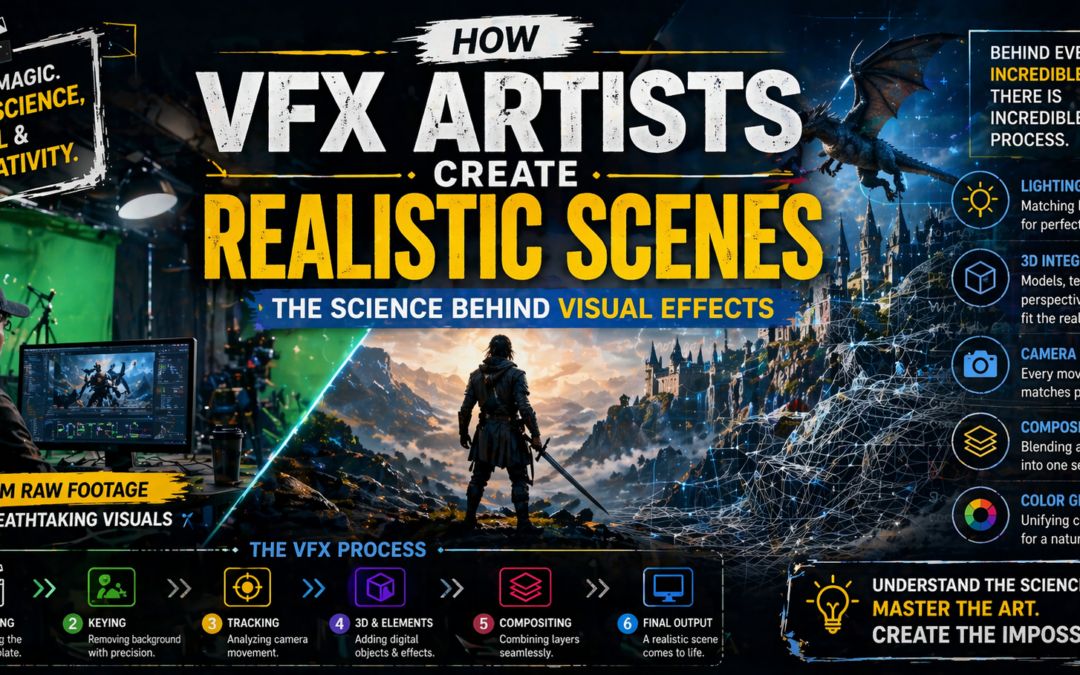
How VFX Artists Create Realistic Scenes: The Science Behind Visual Effects
Introduction
In today’s film and digital industry, visual effects have become an essential part of storytelling. From massive explosions to fantasy worlds, everything is made possible through VFX. But what truly separates average work from professional output is the ability to create Realistic VFX Scenes.
Many people believe VFX is just about adding effects on top of footage. In reality, it is a complex process that combines creativity, physics, lighting, and technical precision.
In this blog, we will explore how VFX artists create Realistic VFX Scenes and understand the science behind making visuals look believable.
What Makes Realistic VFX Scenes Look Real?
The human eye is very sensitive to inconsistencies. Even small errors in lighting, shadows, or motion can make a scene look fake.
To create convincing Realistic VFX Scenes, artists must focus on:
- accurate lighting
- realistic shadows
- proper scale and perspective
- natural motion
The goal is simple: the audience should not notice the VFX at all.
Understanding Lighting in Realistic VFX Scenes
Lighting is one of the most important factors in creating Realistic VFX Scenes.
If lighting does not match between real footage and added elements, the illusion breaks immediately.
VFX artists carefully analyze:
- direction of light
- intensity
- color temperature
For example, if a scene is shot during sunset, added elements must have warm tones and long shadows.
Lighting consistency makes VFX elements blend naturally into the scene.
Role of Shadows and Reflections
Shadows and reflections add depth and realism.
In Realistic VFX Scenes, every object must interact with light correctly. This includes:
- casting shadows
- reflecting light
- reacting to surroundings
Missing or incorrect shadows instantly make visuals look artificial.
That’s why VFX artists spend a lot of time adjusting these details.
Green Screen and Chroma Keying
One of the most common techniques used in VFX is green screen.
Chroma keying allows artists to remove the background and replace it with a new environment.
However, creating Realistic VFX Scenes using green screen is not as simple as removing a color.
Artists must handle:
- edge blending
- color spill removal
- matching background lighting
A poorly keyed scene looks unnatural, while a well-done one feels seamless.
Camera Tracking and Motion Matching
To create believable Realistic VFX Scenes, digital elements must move exactly like the camera.
This is done using camera tracking.
Tracking helps VFX artists:
- match camera movement
- align 3D objects
- maintain perspective
Without proper tracking, objects appear to float or slide unnaturally.
3D Modeling and Integration
Many VFX scenes involve 3D elements like buildings, creatures, or environments.
These elements are created using tools like Blender, Autodesk Maya, and Houdini.
To make them realistic, artists focus on:
- accurate proportions
- textures and materials
- realistic lighting
Proper integration ensures that 3D elements look like part of the real world.
Physics and Real-World Behavior
One of the secrets behind Realistic VFX Scenes is physics.
Objects must behave as they would in real life.
This includes:
- gravity
- motion
- impact
- fluid dynamics
For example, explosions, water simulations, and falling objects must follow natural laws.
Ignoring physics makes VFX look fake.
Compositing: The Final Blend
Compositing is where everything comes together.
It involves combining:
- real footage
- 3D elements
- effects
- color grading
Tools like Nuke and Adobe After Effects are commonly used.
In this stage, artists ensure that all elements match in:
- color
- lighting
- depth
Compositing plays a key role in achieving Realistic VFX Scenes.
Color Grading for Realism
Color grading helps unify the entire scene.
Even if all elements are correct, mismatched colors can break realism.
For Realistic VFX Scenes, artists adjust:
- contrast
- saturation
- tones
This creates a consistent look across the scene.
Why Some VFX Looks Fake
Not all VFX looks realistic.
Common mistakes include:
- incorrect lighting
- poor compositing
- lack of detail
- unrealistic motion
These mistakes break immersion and make scenes look artificial.
Understanding these errors helps artists improve their work.
Skills Required to Create Realistic VFX Scenes
To create professional-level Realistic VFX Scenes, artists need:
- strong observation skills
- understanding of light and physics
- attention to detail
- technical knowledge
- creativity
VFX is both an art and a science.
Real-World Applications of VFX
VFX is used in many industries:
- movies and web series
- advertisements
- gaming
- virtual production
The demand for skilled artists who can create Realistic VFX Scenes is increasing rapidly.
Future of Realistic VFX Scenes
With advancements in technology, VFX is becoming more powerful.
Trends include:
- real-time rendering
- AI-assisted VFX
- virtual production
These innovations will make Realistic VFX Scenes even more advanced and efficient.
Final Thoughts
Creating Realistic VFX Scenes is not just about using software—it’s about understanding how the real world works.
From lighting and shadows to physics and compositing, every detail matters.
For students and aspiring artists, focusing on fundamentals and observation is the key to mastering VFX.
When done correctly, VFX becomes invisible—and that’s what makes it truly powerful.
Recent Comments