
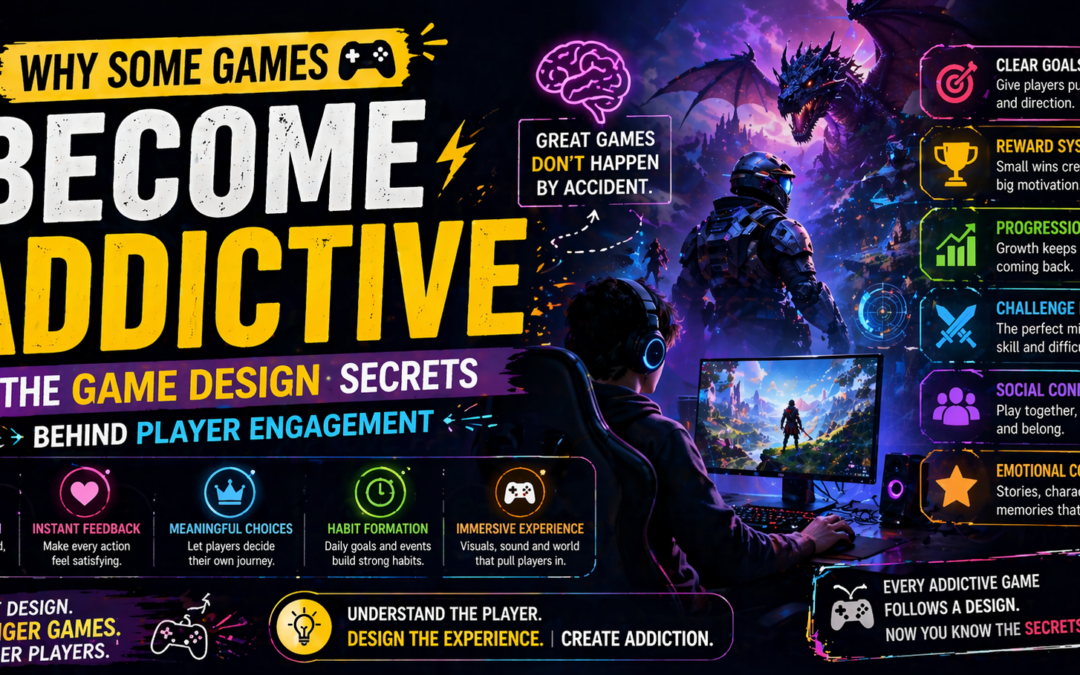
Why Some Games Become Addictive: The Game Design Secrets Behind Player Engagement
Introduction
Have you ever opened a game for a few minutes and ended up playing for hours? This is not an accident. Successful games are carefully built using smart psychology, progression systems, reward loops, and immersive experiences. These hidden methods are part of powerful Game Designing Secrets used by professional developers.
From mobile puzzle games to open-world adventures, the most successful titles understand how to capture attention and keep players engaged. Great games are not only about graphics or coding—they are about experience design.
In this blog, we will explore why some games become addictive and uncover the most effective Game Designing Secrets behind player engagement.
What Are Game Designing Secrets?
Game Designing Secrets are the strategies developers use to make gameplay enjoyable, rewarding, and memorable.
These include:
- clear goals
- balanced challenges
- rewards and progression
- emotional storytelling
- social interaction
- satisfying feedback systems
When these elements work together, players naturally want to continue playing.
Clear Goals Are Core Game Designing Secrets
Players enjoy games when they know what to do next.
Examples:
- finish missions
- unlock new areas
- defeat bosses
- collect rewards
Clear objectives create direction. Without purpose, players quickly lose interest.
One of the oldest Game Designing Secrets is simple: always give players a reason to keep moving forward.
Reward Systems and Motivation
Rewards are one of the most powerful tools in gaming.
Games often give players:
- coins
- skins
- trophies
- new weapons
- level unlocks
These rewards create excitement and anticipation.
This effort-to-reward cycle is one of the most effective Game Designing Secrets because it keeps motivation high.
Progression Systems Keep Players Returning
People love progress.
That is why many games include:
- XP systems
- ranks
- skill upgrades
- unlockable content
Progress makes time feel valuable.
Strong progression is among the most important Game Designing Secrets because players return to continue what they started.
Challenge Balance in Game Designing Secrets
If a game is too easy, it becomes boring. If it is too hard, players quit.
Great developers carefully balance challenge with player skill. This creates a “flow state,” where the game feels exciting but fair.
Balanced difficulty is one of the smartest Game Designing Secrets used in successful games.
Instant Feedback Feels Satisfying
Games constantly respond to player actions.
Examples:
- hit sounds
- score pop-ups
- screen effects
- vibration
- combo indicators
This immediate reaction makes actions feel meaningful.
Responsive systems are valuable Game Designing Secrets because they make gameplay satisfying.
Storytelling Builds Emotional Connection
Many players stay because they care about the story.
They want to know:
- what happens next
- how characters evolve
- how conflicts end
Narrative creates emotional investment.
Storytelling remains one of the strongest Game Designing for long-term engagement.
Social Features Increase Retention
Players love connection and competition.
Games use:
- multiplayer modes
- leaderboards
- guilds
- co-op gameplay
- friend challenges
These features make games more dynamic.
Social systems are modern Game Designing Secrets because players often stay for community as much as gameplay.
Customization Creates Ownership
Players enjoy personalizing their experience.
Examples:
- character skins
- outfits
- vehicles
- weapon styles
- base decoration
Customization builds attachment.
This is one of the emotional Game Designing Secrets that turns casual players into loyal players.
Daily Rewards and Habit Loops
Many games encourage return visits through:
- daily login rewards
- streak bonuses
- limited-time events
- rotating missions
These systems build habits over time.
Habit-building mechanics are common Game Designing Secrets used especially in mobile and live-service games.
Why Mobile Games Feel So Addictive
Mobile games are designed for convenience and repetition.
They often feature:
- short sessions
- fast rewards
- simple controls
- easy restart loops
Because of this, mobile developers rely heavily on Game Designing focused on accessibility and habit formation.
Visuals and Audio Matter Too
Even strong mechanics need good presentation.
Successful games use:
- polished UI
- smooth animations
- exciting sound effects
- memorable music
Presentation improves immersion.
Audio-visual polish supports Game Designing Secrets by making gameplay more enjoyable.
Why Some Games Fail
Not all games keep players engaged.
Common mistakes include:
- repetitive gameplay
- weak onboarding
- unfair difficulty
- poor rewards
- confusing UI
Ignoring core Game Designing often causes players to quit early.
What Students Should Learn About Game Designing Secrets
If you want a career in game design, study more than tools.
Focus on:
- player psychology
- level design
- reward systems
- balancing mechanics
- UI/UX
Tools like Unity, Unreal Engine, and Blender help build games, but design thinking creates success.
Ethical Use of Game Designing Secrets
There is a difference between engagement and manipulation.
Responsible developers should focus on:
- fun gameplay
- fair progression
- player respect
- healthy challenge systems
The best Game Designing Secrets create enjoyment, not unhealthy dependency.
Future of Game Designing Secrets
Gaming is evolving with:
- AI personalization
- adaptive difficulty
- VR immersion
- live events
- community-generated content
These trends will create even deeper experiences using smarter Game Designing Secrets.
Final Thoughts
Some games become addictive because they are carefully designed around motivation, progress, challenge, and emotion.
From rewards and progression to story and competition, these Game Designing Secrets help players stay engaged.
For gamers, this explains why some titles are hard to stop playing.
For students, it reveals that successful games are not random—they are intentionally designed experiences.
Recent Comments