
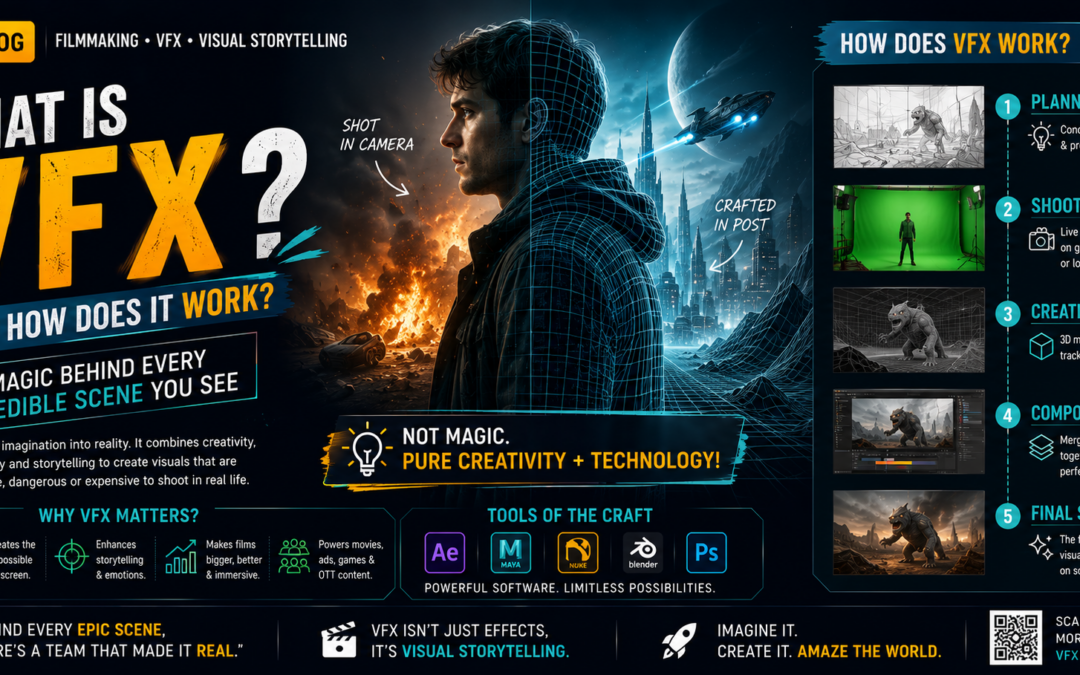
What Is VFX and How Does It Work? The Creative Process Behind Visual Effects in Movies
Introduction
Movies today can take audiences anywhere. A filmmaker can show superheroes flying through cities, giant creatures walking through entire landscapes, planets exploding in space, or futuristic worlds that feel incredibly real. Many of these scenes would be impossible—or extremely expensive—to create physically. This is where Visual effects plays an important role.
Visual effects, commonly called VFX, have completely transformed modern filmmaking. They help directors bring imagination to life by blending real footage with digital elements. From Hollywood blockbusters to web series, advertisements, gaming cinematics, and OTT content, VFX has become one of the most important parts of modern visual storytelling.
A lot of viewers enjoy spectacular scenes on screen but often wonder—how was this created? Was it real? Was it computer-generated? How do artists make everything feel believable?
In this blog, we’ll understand What Is VFX and How Does It Work, explore the creative process behind visual effects, and see why VFX has become one of the most exciting career paths in filmmaking and digital media.
What Is VFX and How Does It Work?
Visual effects (VFX) means creating or enhancing visual scenes using digital tools and techniques after or during filming.
It helps filmmakers create visuals that are difficult, dangerous, expensive, or impossible to shoot in real life.
VFX is used for:
- explosions
- fantasy creatures
- weather effects
- futuristic cities
- superhero action scenes
- environment extensions
- cinematic destruction
- magical elements
The main goal of VFX is to make everything feel believable and visually immersive.
That is the simplest answer to What Is VFX and How Does It Work—it combines creativity and technology to create visuals beyond normal filming.
Why VFX Is Important in Filmmaking
Filmmakers often imagine scenes that real locations or practical shooting cannot easily create.
For example:
- flying superheroes
- giant monsters
- historical worlds
- sci-fi planets
- dangerous explosions
Creating these physically can be expensive or unsafe.
VFX helps solve this by allowing artists to create visuals digitally.
This is why understanding What Is VFX and How Does It Work is so important in modern filmmaking.
Difference Between VFX and CGI
People often confuse VFX and CGI.
They are related—but different.
VFX
Enhances or combines filmed footage using digital effects.
Example:
- removing wires
- adding fire
- replacing backgrounds
CGI
Computer-generated imagery.
Creates digital objects from scratch.
Example:
- creatures
- buildings
- animated worlds
CGI is often part of VFX.
So when people ask What Is VFX and How Does It Work, CGI becomes one of the important parts of the answer.
Pre-Production: Planning the VFX
VFX starts long before editing.
Planning includes:
- storyboards
- scene references
- creative direction
- technical breakdown
Directors and VFX teams decide:
- what will be real
- what will be digital
- how actors interact with effects
Good planning makes the VFX workflow faster and more realistic.
Green Screen and Chroma Key
One of the most recognized VFX techniques is green screen.
Actors perform in front of a green background.
Later, artists replace that green color with:
- city environments
- fantasy worlds
- skies
- action scenes
This process is called chroma key.
It is widely used in films, ads, and studio production.
Green screen is one of the easiest ways to understand What Is VFX and How Does It Work.
Motion Tracking
Sometimes digital elements need to move naturally with the camera.
This is where motion tracking helps.
Artists track camera movement and connect digital objects to live-action footage.
Examples:
- adding graphics to buildings
- placing creatures into scenes
- matching camera movement perfectly
Motion tracking makes VFX feel realistic and seamless.
Compositing: Blending Everything Together
Compositing combines multiple visual elements into one final scene.
Artists merge:
- filmed footage
- green screen layers
- digital effects
- CGI objects
- lighting corrections
The goal is to make viewers believe everything was captured in one shot.
Compositing is one of the biggest answers to What Is VFX and How Does It Work because this is where scenes feel complete.
3D Modeling and Animation in VFX
Many VFX scenes require 3D assets.
Artists create:
- creatures
- buildings
- vehicles
- weapons
- digital environments
Then they animate movement.
This is where tools like:
- Autodesk Maya
- Blender
- Cinema 4D
are widely used.
3D creation is a major part of What Is VFX and How Does It Work.
Lighting and Realism
A digital object only feels real when lighting matches the filmed scene.
Artists carefully match:
- shadows
- reflections
- sunlight direction
- brightness
- environmental color
Even a perfect 3D object can feel fake if lighting looks wrong.
Lighting is extremely important in VFX.
Simulation Effects
Many VFX scenes use simulations.
Examples include:
- fire
- smoke
- water
- destruction
- dust
- explosions
These are created using digital physics systems.
Simulation helps scenes feel more natural and dynamic.
Matte Painting and Environment Creation
Not every location exists in real life.
Artists create digital environments like:
- futuristic cities
- historical kingdoms
- fantasy landscapes
- damaged buildings
This technique is called matte painting.
It helps expand scenes beautifully.
VFX in Movies
Modern films use VFX almost everywhere.
Examples include:
- superhero films
- sci-fi movies
- action sequences
- fantasy storytelling
- large-scale battle scenes
Sometimes audiences do not even realize VFX was used.
Invisible effects are often the most impressive.
This is why What Is VFX and How Does It Work is so interesting—it can be obvious or completely hidden.
VFX in OTT and Streaming Content
Streaming platforms use VFX heavily.
Used in:
- web series
- fantasy shows
- crime recreations
- title sequences
- digital set extensions
OTT content has increased demand for VFX professionals.
VFX in Advertising
Brands use VFX for:
- product reveals
- cinematic ads
- luxury commercials
- impossible camera shots
Creative advertising depends heavily on visual effects.
Common Challenges in VFX
VFX artists often face:
- tight deadlines
- complex scenes
- realistic lighting challenges
- rendering time
- heavy computer performance needs
It takes patience and attention to detail.
Skills Needed for VFX
Students learning VFX should focus on:
- observation
- creativity
- lighting understanding
- composition
- patience
- software skills
- storytelling
Technical knowledge matters—but visual thinking matters too.
Career Opportunities in VFX
Learning VFX can lead to careers in:
- film studios
- animation studios
- OTT production
- gaming cinematics
- ad agencies
- freelance content creation
Roles include:
- compositor
- rotoscope artist
- matchmove artist
- lighting artist
- VFX editor
- CGI artist
Demand continues growing rapidly.
Future of VFX
The future of VFX includes:
- AI-assisted workflows
- real-time rendering
- virtual production
- LED wall filmmaking
- advanced motion capture
Technology is improving quickly.
But creativity will always remain the most important part.
Final Thoughts
Visual effects have changed filmmaking forever.
They allow directors to show impossible worlds, cinematic action, and believable fantasy experiences.
The answer to What Is VFX and How Does It Work is simple—VFX combines imagination, planning, technology, and creativity to create visuals audiences remember.
For students interested in filmmaking, animation, gaming, or digital content creation, learning VFX opens exciting creative opportunities.
Because behind many unforgettable movie moments… there is a talented VFX artist making imagination look real.
Recent Comments