
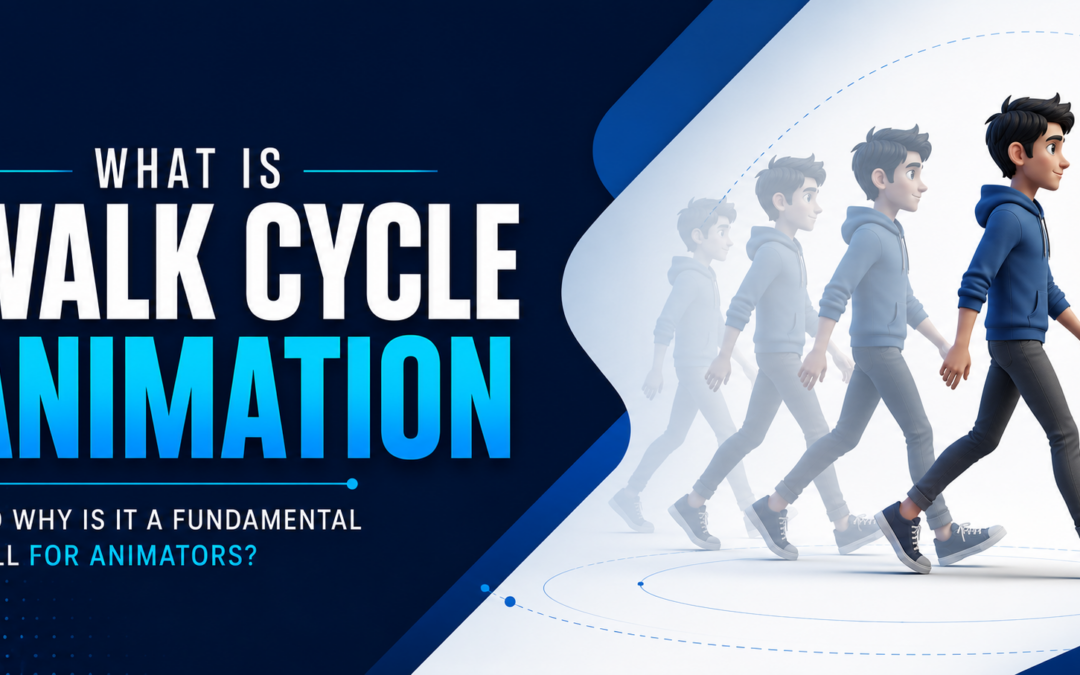
What Is Walk Cycle Animation and Why Is It a Fundamental Skill for Animators?
Introduction
Every animated character that walks across a screen, whether in a movie, video game, advertisement, or television series, relies on one of the most important techniques in animation: Walk Cycle Animation.
Walking may seem like a simple everyday action, but recreating it convincingly in animation requires a deep understanding of movement, timing, balance, and character performance. A well-crafted walk cycle can reveal a character’s personality, mood, confidence, age, and even emotional state without a single line of dialogue.
This is why Walk Cycle Animation is considered one of the most fundamental exercises for animation students and one of the most essential skills for professional animators.
In this blog, we will explore what walk cycle animation is, why it is important, how it works, and why mastering it is a crucial step toward becoming a successful animator.
What Is Walk Cycle Animation?
Walk Cycle Animation is a sequence of repeated movements that creates the illusion of a character walking.
Rather than animating every step from scratch, animators create a cycle that can loop seamlessly. This repeated sequence allows characters to walk naturally while maintaining consistency throughout a scene.
A walk cycle typically includes:
- Body Movement
- Leg Movement
- Arm Swing
- Weight Shifts
- Head Motion
- Balance Adjustments
When combined correctly, these elements create realistic and believable character movement.
Why Is Walk Cycle Animation Important?
Walking is one of the most common actions performed by animated characters.
Because audiences observe walking every day in real life, they can quickly notice when animated movement feels unnatural.
This makes Walk Cycle Animation an excellent way for animators to develop essential skills such as:
- Timing
- Spacing
- Weight Distribution
- Body Mechanics
- Observation
- Character Performance
Many animation studios use walk cycle exercises as a benchmark for evaluating animation talent.
The Role of Walk Cycles in Character Animation
A walk cycle does more than move a character from one location to another.
It helps communicate:
Personality
A confident character walks differently from a nervous character.
Emotion
Happy, tired, angry, or excited characters each have unique movement styles.
Age
Children, adults, and elderly characters move differently.
Physical Characteristics
Weight, height, and body structure influence movement patterns.
This is why Walk Cycle Animation is often considered a storytelling tool rather than just a technical exercise.
Understanding the Basic Walk Cycle Positions
Professional animators typically build walk cycles using several key poses.
Contact Position
The moment when one foot touches the ground while the other prepares to move forward.
Down Position
The body’s weight settles onto the supporting leg.
Passing Position
One leg passes the other as the body moves forward.
Up Position
The body rises slightly before the next step begins.
These poses form the foundation of most Walk Cycle Animation workflows.
How Walk Cycle Animation Works
Creating a walk cycle involves careful planning and observation.
Animators begin by studying real-world movement and then create key poses that define the character’s motion.
The general process includes:
Step 1: Planning Key Poses
Important positions are created first.
Step 2: Blocking the Animation
Major movements are established.
Step 3: Refining Motion
Transitions between poses are improved.
Step 4: Adding Secondary Movement
Additional details such as head movement and arm swings are included.
Step 5: Polishing
The animation is adjusted to create smooth, natural movement.
This workflow helps ensure that the final Walk Cycle Animation feels believable and engaging.
Walk Cycle Animation and Animation Principles
Several animation principles are heavily used when creating walk cycles.
Timing
Controls the speed of movement.
Spacing
Determines how objects move between frames.
Anticipation
Prepares audiences for movement.
Follow Through
Adds realism to secondary body parts.
Arcs
Creates natural movement paths.
Understanding these principles is essential for mastering Walk Cycle Animation.
Common Types of Walk Cycles
Different characters require different walking styles.
Normal Walk Cycle
Used for everyday movement.
Run Cycle
A faster variation of the walk cycle.
Sneak Walk
Often used in action and adventure scenes.
Happy Walk
Features energetic and exaggerated movement.
Tired Walk
Includes slower movement and reduced energy.
Character-Specific Walks
Designed to reflect unique personalities.
Professional animators often create multiple walk styles for a single character.
Walk Cycle Animation in 3D Animation
In modern production environments, Walk Cycle Animation plays a significant role in 3D character animation.
Animators use character rigs to control:
- Legs
- Arms
- Spine
- Head
- Facial Features
By adjusting keyframes and timing, they create realistic movement that supports storytelling and gameplay experiences.
Walk Cycle Animation in Gaming
The gaming industry relies heavily on walk cycles.
Players spend a significant amount of time controlling characters, making movement quality extremely important.
Game developers use walk cycles for:
- Player Characters
- NPCs
- Creatures
- Enemies
Smooth movement contributes significantly to player immersion and overall gameplay quality.
Common Mistakes Beginners Make
Students learning Walk Cycle Animation often encounter several challenges.
Stiff Movement
Characters appear robotic and unnatural.
Incorrect Weight Distribution
Movement lacks realism.
Poor Timing
Characters move too quickly or too slowly.
Lack of Observation
Ignoring real-world movement references.
Limited Body Motion
Forgetting secondary movement elements.
Recognizing these mistakes helps students improve their animation skills more effectively.
Software Used for Walk Cycle Animation
Professional animators use industry-standard software to create walk cycles.
Popular tools include:
- Autodesk MAYA
- Cinema 4D
- Blender
- 3ds Max
- Cinema 4D
These applications provide advanced tools for character animation and motion refinement.
Why Every Animation Student Should Learn Walk Cycle Animation
Learning Walk Cycle Animation provides a strong foundation for future animation work.
Students develop:
- Observation Skills
- Animation Principles
- Character Performance Techniques
- Timing and Spacing Knowledge
- Body Mechanics Understanding
These skills are essential for success in animation studios, gaming companies, and visual effects production environments.
Career Opportunities in Animation
Students who master character animation and walk cycles can pursue careers such as:
Character Animator
Creates performances for animated characters.
3D Animator
Works on films, games, and digital content.
Gameplay Animator
Develops movement systems for games.
VFX Animator
Creates realistic animated performances for visual effects projects.
Motion Graphics Artist
Applies animation principles to digital content.
A strong understanding of Walk Cycle Animation is valuable across all these roles.
The Future of Character Animation
The animation industry continues to evolve with technologies such as:
- AI-Assisted Animation
- Real-Time Rendering
- Motion Capture
- Virtual Production
- XR Experiences
Despite technological advancements, the fundamentals of movement remain unchanged.
This means Walk Cycle Animation will continue to be a core skill for animators in the future.
Final Thoughts
Every great animator begins by mastering the fundamentals, and Walk Cycle Animation is one of the most important foundations of character animation.
By teaching animators how to create believable movement, understand body mechanics, and communicate personality through motion, walk cycles play a critical role in animation education and professional production.
Whether creating animated films, video games, advertisements, or digital content, animators rely on walk cycles to bring characters to life.
For aspiring animation professionals, learning Walk Cycle Animation is not just an exercise—it is a crucial step toward mastering the art of character animation.
Recent Comments