
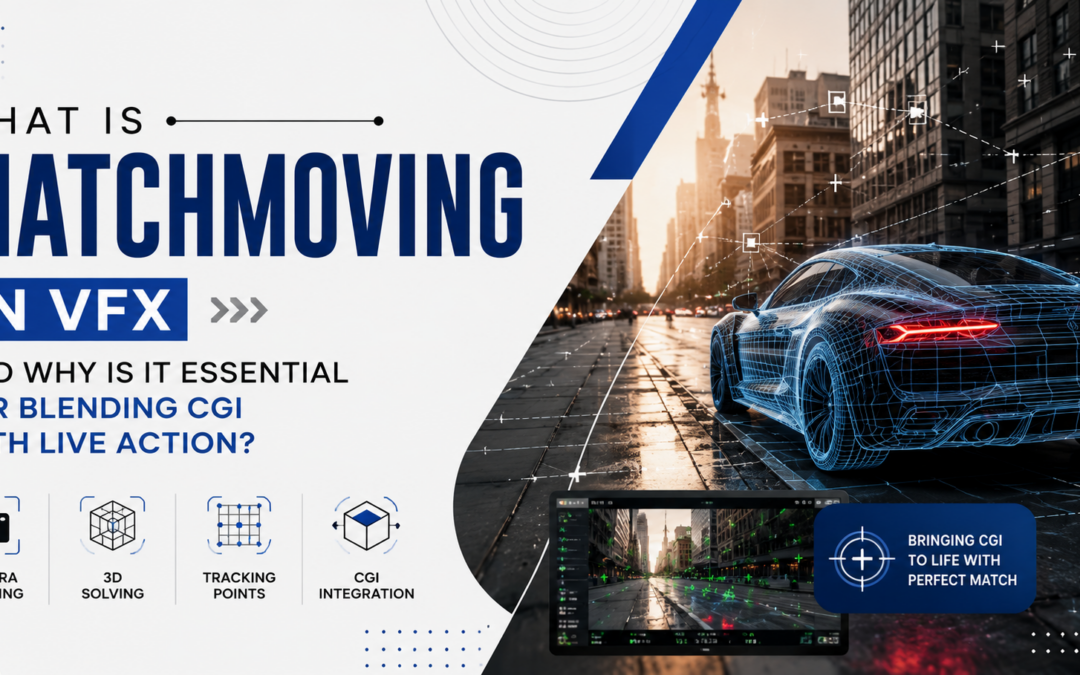
What Is Matchmoving in VFX and Why Is It Essential for Blending CGI With Live Action?
Introduction
Have you ever watched a movie featuring a giant creature walking through a city, a superhero flying between buildings, or a futuristic vehicle racing through a real-world environment and wondered how it all looks so realistic?
The answer often begins with a crucial VFX process called Matchmoving in VFX.
Modern films, web series, advertisements, and OTT productions frequently combine live-action footage with computer-generated imagery (CGI). However, creating CGI elements is only part of the process. To make those elements appear naturally within a filmed scene, artists must ensure that digital objects move exactly as the real camera moved during filming.
This is where matchmoving becomes essential.
Without accurate matchmoving, CGI characters, environments, and effects would appear disconnected from the scene, instantly breaking the illusion.
In this blog, we’ll explore what Matchmoving in VFX is, how it works, why it is important, and how it helps create seamless visual effects that audiences experience every day.
What Is Matchmoving in VFX?
Matchmoving in VFX is the process of tracking the movement of a live-action camera and recreating that movement in a 3D environment.
In simple terms, matchmoving allows VFX artists to understand exactly how a camera moved while filming so they can place CGI elements accurately into the scene.
The process creates a virtual camera that mimics the movement of the real camera.
This virtual camera can then be used by:
- Animators
- 3D Artists
- Compositors
- VFX Supervisors
to integrate digital assets into live-action footage.
Why Is Matchmoving Important?
Imagine adding a CGI robot into a filmed street scene.
If the camera moves left, right, up, or down, the robot must react to those movements exactly as a real object would.
Without proper Matchmoving in VFX:
- Objects may appear to float.
- CGI may slide unnaturally.
- Perspective may look incorrect.
- Visual effects may feel disconnected.
Matchmoving ensures that digital elements remain locked into the scene naturally.
This creates believable visual effects that audiences accept as real.
Understanding the Relationship Between CGI and Live Action
Modern VFX relies heavily on combining digital content with real-world footage.
Examples include:
- Superhero Films
- Fantasy Movies
- Science Fiction Productions
- Automobile Advertisements
- Television Commercials
- OTT Series
In all these projects, Matchmoving in VFX serves as a bridge between live-action footage and CGI.
It provides the technical foundation needed for seamless integration.
How Does Matchmoving Work?
The process involves analyzing footage and identifying tracking points.
These tracking points may include:
- Building Corners
- Road Markings
- Windows
- Poles
- Environmental Details
Specialized software follows these points throughout the shot.
By studying their movement, the software calculates:
- Camera Position
- Camera Rotation
- Lens Information
- Scene Perspective
The result is a virtual camera that accurately replicates the original camera movement.
The Role of Camera Tracking
Camera tracking is a major component of Matchmoving in VFX.
It involves determining how the physical camera moved during filming.
Artists use tracking data to reconstruct:
- Camera Motion
- Camera Path
- Camera Angle
- Scene Depth
This information allows 3D elements to move naturally within the scene.
Without accurate camera tracking, CGI integration becomes extremely difficult.
What Happens After Matchmoving?
Once matchmoving is completed, the tracking data moves to other departments.
3D Modeling
Artists create digital objects.
Animation
Characters and assets are animated.
Lighting
CGI lighting is matched to real-world lighting.
Rendering
Digital elements are generated.
Compositing
All elements are combined into the final shot.
This makes Matchmoving in VFX one of the earliest and most important steps in the visual effects pipeline.
Real-World Examples of Matchmoving
Many scenes that audiences believe are entirely real actually involve extensive matchmoving.
Examples include:
Digital Creatures
Monsters and fantasy characters integrated into live footage.
Superhero Effects
Flying characters and action sequences.
Digital Environments
Virtual cities and landscapes.
Vehicle Simulations
CGI cars and futuristic vehicles.
Set Extensions
Expanding real-world film sets digitally.
All these applications rely on accurate Matchmoving in VFX.
Why Matchmoving Is Considered an Invisible VFX Skill
One interesting aspect of matchmoving is that audiences rarely notice it.
Unlike explosions or giant creatures, matchmoving is not designed to attract attention.
Its purpose is to make CGI appear natural.
When matchmoving is successful:
- Audiences focus on the story.
- CGI feels believable.
- Visual effects become invisible.
This is why many professionals consider matchmoving one of the most important hidden skills in VFX production.
Challenges Faced by Matchmove Artists
Although it may seem straightforward, matchmoving can be highly complex.
Challenges include:
Fast Camera Movements
Rapid movement can make tracking difficult.
Motion Blur
Blurry footage reduces tracking accuracy.
Lack of Tracking Points
Smooth surfaces offer fewer reference points.
Poor Lighting Conditions
Dark scenes can complicate analysis.
Moving Objects
Tracking becomes more difficult when multiple elements move simultaneously.
Professional artists use advanced techniques to overcome these challenges.
Software Used for Matchmoving in VFX
Matchmove artists often work with industry-standard software.
Popular tools include:
- Autodesk Maya
- PFTrack
- 3DEqualizer
- Blender
- Nuke
These applications help artists track camera movement and prepare data for downstream VFX departments.
Matchmoving in the VFX Pipeline
The VFX pipeline consists of several interconnected stages.
A typical workflow includes:
- Production Planning
- Live-Action Shooting
- Matchmoving
- Asset Creation
- Animation
- Lighting
- Rendering
- Compositing
- Final Output
Because so many later stages depend on accurate tracking data, Matchmoving in VFX is considered a critical foundation of the pipeline.
Skills Required to Become a Matchmove Artist
Students interested in this field should focus on developing:
Observation Skills
Carefully analyzing movement and perspective.
Understanding of Cameras
Learning how lenses and camera motion work.
Problem-Solving Skills
Finding solutions to tracking challenges.
Attention to Detail
Small inaccuracies can affect an entire shot.
Technical Knowledge
Understanding professional VFX software.
These skills help artists succeed in matchmoving and related VFX disciplines.
Career Opportunities in Matchmoving
The growing demand for visual effects has increased the need for skilled matchmove artists.
Career opportunities include:
Matchmove Artist
Tracks camera and object movement.
Camera Tracking Artist
Creates accurate virtual camera solutions.
Layout Artist
Prepares scenes for downstream production.
VFX Artist
Works across multiple stages of the VFX pipeline.
Compositor
Uses matchmove data to combine CGI and live-action elements.
A strong understanding of Matchmoving in VFX can lead to rewarding opportunities within film, television, advertising, and digital media.
Why Students Should Learn Matchmoving
Many students focus primarily on animation or compositing while overlooking matchmoving.
However, matchmoving teaches valuable skills such as:
- Spatial Awareness
- Camera Understanding
- Technical Problem Solving
- Scene Analysis
- Production Workflow Knowledge
These abilities are useful across multiple VFX disciplines.
Learning Matchmoving in VFX also helps students better understand how professional visual effects productions operate.
The Future of Matchmoving
Advancements in technology continue to improve tracking accuracy and workflow efficiency.
Modern productions increasingly use:
- Virtual Production
- AI-Assisted Tracking
- Real-Time Rendering
- Motion Capture Systems
- Advanced Camera Technologies
Despite these innovations, the principles behind Matchmoving in VFX remain essential.
Accurately connecting CGI with live-action footage will continue to be a core requirement in visual effects production.
Final Thoughts
When audiences watch a CGI creature walk through a real city or a superhero soar between skyscrapers, they rarely think about the complex processes happening behind the scenes.
One of the most important of those processes is Matchmoving in VFX.
By accurately recreating real camera movement in a digital environment, matchmove artists make it possible for CGI and live-action footage to exist seamlessly together.
For students interested in visual effects, learning matchmoving provides valuable insight into professional production workflows and opens the door to exciting opportunities within the growing VFX industry.
Recent Comments