
Understanding Game Loops: The Secret Behind Addictive and Engaging Gameplay
Introduction
Have you ever started playing a game intending to spend just a few minutes, only to realize hours have passed?
At the heart of every successful game lies a carefully designed system that encourages players to repeat actions, overcome challenges, earn rewards, and progress further. This system is known as the Core Game Loop in Game Design.
Whether it’s collecting rewards in a mobile game, completing missions in an open-world adventure, or leveling up a character in an RPG, players often find themselves coming back for more. While great graphics, storytelling, and characters contribute to a game’s success, one of the biggest reasons players stay engaged is something called a game loop.
Game loops are the foundation of player engagement. They influence how enjoyable a game feels, how long players continue playing, and how invested they become in the overall experience.
In this blog, we’ll explore what game loops are, why they matter, how they influence player behavior, and why understanding them is essential for aspiring game designers.
What Is a Game Loop?
A game loop is a sequence of actions that players repeatedly perform while playing a game.
The loop typically follows a simple pattern:
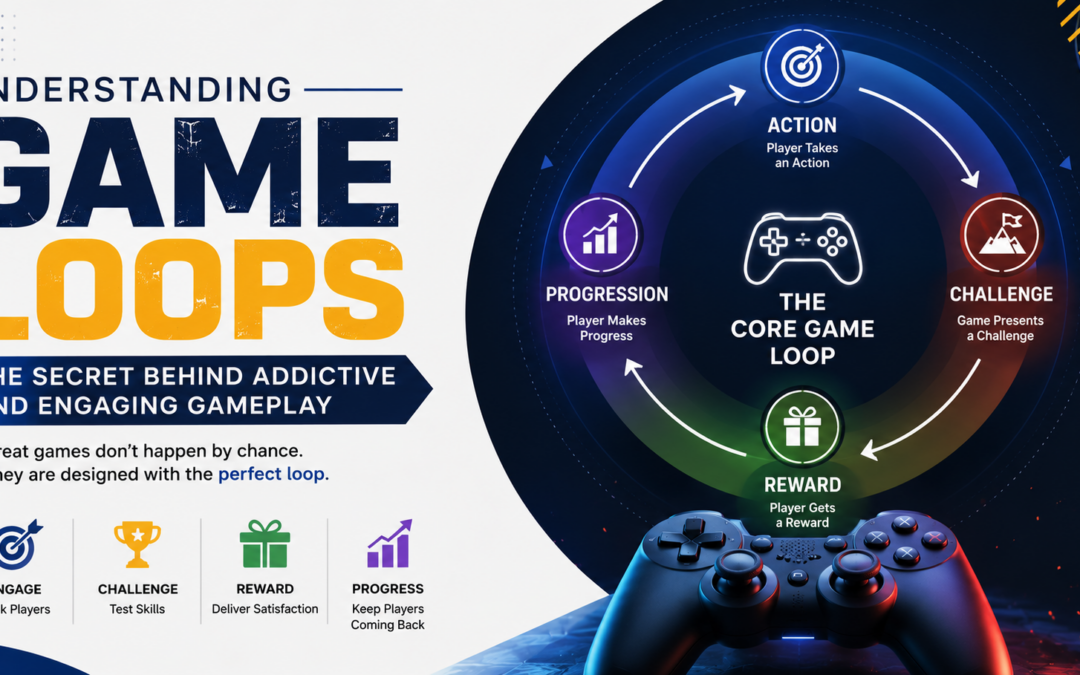
Action → Challenge → Reward → Progression → Repeat
This cycle creates a continuous gameplay experience that keeps players engaged.
For example, in a racing game, players may:
- Enter a race
- Compete against opponents
- Earn rewards
- Upgrade vehicles
- Enter another race
This repeating structure forms the Core Game Loop in Game Design.
The stronger and more enjoyable the loop, the more engaging the game becomes.
Why Are Game Loops Important?
Game loops are responsible for maintaining player interest and motivation.
Without a clear gameplay loop:
- Players may lose direction.
- Progress may feel meaningless.
- Challenges may become repetitive.
- Engagement may decline.
A well-designed Core Game Loop in Game Design helps players feel rewarded for their efforts while encouraging them to continue playing.
This balance between challenge and reward is one of the reasons successful games remain enjoyable over long periods.
Understanding the Core Game Loop
The core game loop represents the primary activity players perform most frequently.
It usually consists of four key stages:
Action
The player performs an activity.
Examples:
- Shooting
- Driving
- Jumping
- Building
- Exploring
Challenge
The game introduces obstacles or objectives.
Examples:
- Enemies
- Puzzles
- Time Limits
- Competition
Reward
The player receives something valuable.
Examples:
- Coins
- Experience Points
- New Equipment
- Achievements
Progression
The reward helps the player advance.
Examples:
- Unlocking Levels
- Improving Skills
- Accessing New Content
This cycle creates the Core Game Loop in Game Design that drives player engagement.
Core Loop vs Meta Loop
Professional game designers often discuss two different types of loops.
Core Loop
The primary gameplay activity repeated frequently.
Examples:
- Combat in action games
- Farming in simulation games
- Racing in driving games
Meta Loop
Long-term progression systems that extend player engagement.
Examples:
- Character Upgrades
- Skill Trees
- Seasonal Events
- Collection Systems
Together, these loops create deeper and more rewarding experiences.
How Game Loops Influence Player Behavior
A successful Core Game Loop in Game Design motivates players through a combination of psychology and rewards.
Players naturally enjoy:
- Achieving Goals
- Overcoming Challenges
- Unlocking New Content
- Earning Recognition
- Improving Performance
Game loops provide opportunities for these experiences repeatedly.
This creates a sense of accomplishment and encourages continued participation.
Examples of Game Loops in Popular Genres
Different genres use different gameplay loops.
Action Games
Loop:
Fight → Win → Upgrade → Fight Again
Racing Games
Loop:
Race → Earn Rewards → Upgrade Vehicle → Race Again
Strategy Games
Loop:
Gather Resources → Build → Expand → Gather More Resources
RPG Games
Loop:
Complete Quests → Gain Experience → Level Up → Unlock New Quests
Mobile Games
Loop:
Play → Earn Currency → Upgrade → Play Again
Despite their differences, all successful games rely on a strong Core Game Loop in Game Design.
The Role of Rewards in Game Loops
Rewards are one of the most important components of a game loop.
Rewards provide positive feedback and motivate players to continue playing.
Common reward types include:
Progression Rewards
Unlocking new levels or content.
Cosmetic Rewards
Character skins and visual customizations.
Achievement Rewards
Badges, trophies, and accomplishments.
Resource Rewards
Currency, materials, and collectibles.
Effective rewards help strengthen the Core Game Loop in Game Design by making player actions feel meaningful.
Player Engagement and Retention
Game designers aim to create experiences that players enjoy over time.
A strong game loop helps improve:
Engagement
How involved players feel while playing.
Retention
How likely players are to return.
Motivation
The desire to continue progressing.
Satisfaction
The sense of achievement after completing goals.
Without a compelling game loop, maintaining long-term player interest becomes difficult.
Balancing Challenge and Reward
One of the biggest challenges in game design is balancing difficulty.
If a game is too easy:
- Players may become bored.
If a game is too difficult:
- Players may become frustrated.
The best Core Game Loop in Game Design provides challenges that feel achievable while still requiring effort.
This balance keeps players engaged and motivated.
The Psychology Behind Addictive Gameplay
Game designers often use psychological principles to create engaging experiences.
These include:
Goal Setting
Players work toward clear objectives.
Feedback Systems
Immediate responses reinforce actions.
Progress Tracking
Visible growth encourages continued play.
Reward Anticipation
Players look forward to future rewards.
These psychological elements strengthen gameplay loops and improve player satisfaction.
Common Mistakes in Designing Game Loops
Beginners often make mistakes that reduce engagement.
Repetitive Gameplay
The same activity becomes boring over time.
Weak Rewards
Players feel their efforts are not worthwhile.
Slow Progression
Advancement feels too difficult.
Lack of Variety
The experience becomes predictable.
Poor Balance
Challenges feel unfair or inconsistent.
Understanding the Core Game Loop in Game Design helps designers avoid these issues.
How Game Designers Create Better Game Loops
Professional designers focus on several important principles.
Clear Objectives
Players should understand their goals.
Meaningful Rewards
Progress should feel valuable.
Consistent Feedback
Actions should produce visible results.
Increasing Complexity
New challenges should appear gradually.
Player Choice
Allowing different approaches increases engagement.
These principles help create stronger gameplay experiences.
Tools Used by Game Designers
Modern game designers use various tools to develop and test gameplay systems.
Popular tools include:
- Unreal Engine
- Unity
- Blender
- Autodesk Maya
- Adobe Photoshop
These tools help designers prototype, test, and refine game loops effectively.
Career Opportunities in Game Design
Understanding game loops is valuable for various gaming careers.
Popular roles include:
Game Designer
Creates gameplay systems and mechanics.
Level Designer
Designs player experiences and progression.
Systems Designer
Builds game economy and progression structures.
UX Designer
Improves player interactions and usability.
Creative Director
Guides overall game vision.
Knowledge of the Core Game Loop in Game Design is essential across these roles.
Why Students Should Learn Game Loop Design
Game loops are among the first concepts students should master when learning game design.
They help students understand:
- Player Motivation
- Game Systems
- Reward Structures
- Gameplay Balance
- Interactive Design
A strong understanding of game loops provides a solid foundation for more advanced game design concepts.
The Future of Game Loop Design
The gaming industry continues to evolve through technologies such as:
- Artificial Intelligence
- Virtual Reality
- Augmented Reality
- Cloud Gaming
- Live-Service Games
While technologies change, the importance of the Core Game Loop in Game Design remains constant.
Players will always seek meaningful challenges, rewarding progression, and enjoyable experiences.
Final Thoughts
Every successful game, from simple mobile titles to large-scale AAA productions, relies on a well-designed gameplay loop.
The Core Game Loop in Game Design serves as the engine that drives player engagement, motivation, progression, and enjoyment.
By understanding how actions, challenges, rewards, and progression work together, aspiring game designers can create experiences that keep players entertained and invested for hours.
For students interested in game design, mastering game loop design is one of the most important steps toward creating compelling and memorable games.
Recent Comments