
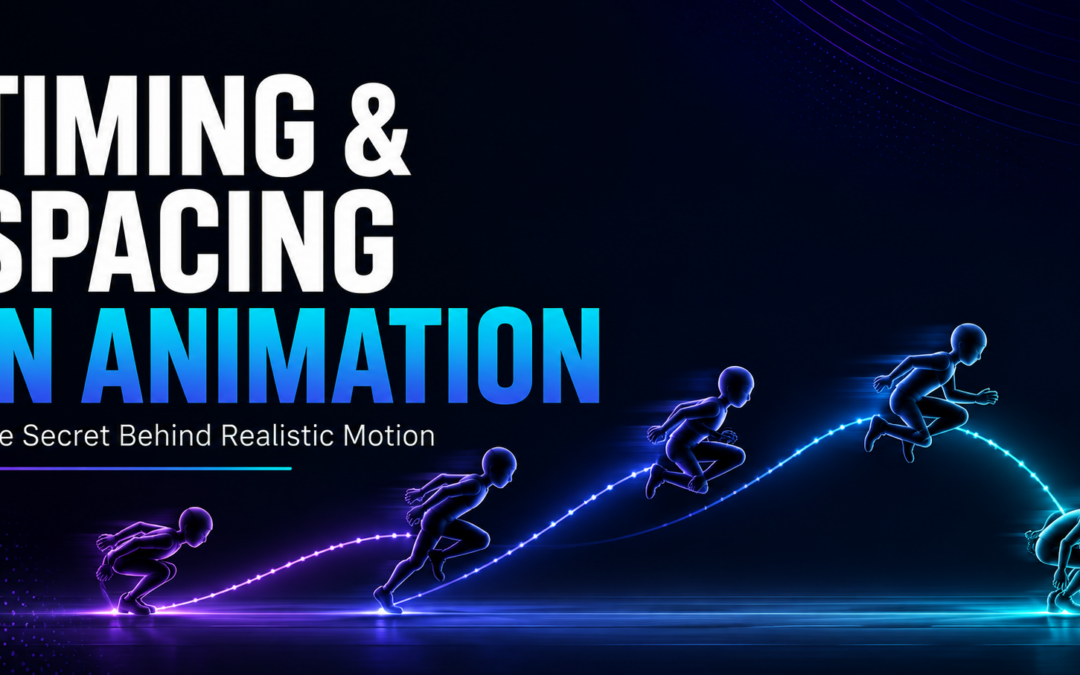
Understanding Timing and Spacing in Animation: The Secret Behind Realistic Motion
Introduction
Have you ever wondered why some animated characters feel alive while others appear stiff and unnatural?
The answer often lies in two of the most important principles of animation: Timing and Spacing in Animation.
Whether it’s a character walking across a room, a bouncing ball hitting the ground, or a superhero leaping into action, the realism of that movement depends on how timing and spacing are applied.
These principles help animators create motion that feels believable, expressive, and engaging. In fact, no matter how detailed a character model or animation software may be, poor timing and spacing can make the movement look robotic and unrealistic.
This is why Timing and Spacing in Animation are considered fundamental skills for every animator, from beginners learning the basics to professionals working on blockbuster films and video games.
In this blog, we’ll explore what timing and spacing mean, how they work together, and why mastering them is essential for creating realistic motion.
What Is Timing in Animation?
Timing refers to the number of frames used to complete an action.
In simple terms, timing determines how long an action takes to occur.
For example:
- A fast punch may take only a few frames.
- A slow walk may require many more frames.
- A heavy object may fall slowly at first before accelerating.
Good timing helps audiences understand:
- Speed
- Weight
- Emotion
- Energy
- Character Intent
Timing directly affects how viewers perceive movement and performance.
Without proper timing, actions can feel unnatural or confusing.
Why Timing Matters
Timing is one of the most powerful storytelling tools in animation.
Different timing choices can completely change how an action feels.
Fast Timing
Creates:
- Energy
- Excitement
- Urgency
- Action
Slow Timing
Creates:
- Drama
- Tension
- Weight
- Emotion
This ability to influence audience perception makes Timing and Spacing in Animation essential for visual storytelling.
What Is Spacing in Animation?
While timing determines how long an action takes, spacing determines how movement is distributed between frames.
Spacing refers to the distance an object travels from one frame to the next.
For example:
- Small spacing creates slow movement.
- Large spacing creates fast movement.
Spacing controls how motion appears visually.
Even if two animations have the same timing, different spacing can create completely different results.
This is one of the reasons why Timing and Spacing in Animation work together as complementary principles.
Understanding Timing and Spacing Together
Many beginners assume timing and spacing are the same thing.
They are closely related but serve different purposes.
Timing
Controls the duration of movement.
Spacing
Controls how movement appears between frames.
A character may take one second to move across a screen.
However:
- Even spacing creates constant motion.
- Increasing spacing creates acceleration.
- Decreasing spacing creates deceleration.
The combination of timing and spacing determines how natural movement feels.
Real-World Example: A Bouncing Ball
A bouncing ball is one of the most common exercises used to teach Timing and Spacing in Animation.
When the ball falls:
- Gravity causes acceleration.
- Spacing becomes larger as the ball gains speed.
When the ball reaches the ground:
- Impact occurs quickly.
When the ball rises:
- Speed decreases.
- Spacing becomes smaller.
This change in spacing helps create realistic motion.
Without proper timing and spacing, the bounce would feel artificial.
Why Timing and Spacing Create Realistic Motion
In real life, objects rarely move at a constant speed.
They:
- Accelerate
- Decelerate
- Change Direction
- React to Forces
Animators use Timing and Spacing in Animation to replicate these natural behaviors.
This helps create movement that feels believable and physically accurate.
When timing and spacing are used correctly, audiences often forget they are watching animation.
Timing and Spacing in Character Animation
Character animation relies heavily on these principles.
Every action requires careful control of timing and spacing.
Examples include:
Walking
Different timing creates different walking speeds.
Running
Larger spacing helps communicate speed and energy.
Jumping
Spacing changes throughout the jump arc.
Facial Expressions
Timing influences emotional impact.
Acting Performance
Subtle timing adjustments improve character believability.
This is why professional animators spend significant time refining Timing and Spacing in Animation.
How Timing Communicates Weight
Weight is one of the most important aspects of animation.
A feather and a bowling ball move differently because they have different weight characteristics.
Animators use timing to communicate this difference.
Light Objects
- Faster movement
- Quicker reactions
- Less resistance
Heavy Objects
- Slower acceleration
- Greater momentum
- Stronger impact
Effective timing helps audiences understand physical properties without explanation.
How Spacing Communicates Speed
Spacing is particularly important for showing speed.
Small Spacing
Creates slow movement.
Medium Spacing
Creates moderate movement.
Large Spacing
Creates fast movement.
By adjusting spacing, animators can control how quickly an object appears to move without changing the overall timing.
This flexibility makes Timing and Spacing in Animation powerful creative tools.
Timing and Spacing in Walk Cycle Animation
Walk cycles are excellent examples of these principles in action.
During a walk cycle:
- The body rises and falls.
- Legs move at different speeds.
- Weight shifts between feet.
Proper timing creates natural rhythm.
Proper spacing creates realistic movement.
Without them, a walk cycle can feel stiff and mechanical.
This is why animation students often study Timing and Spacing in Animation alongside walk cycle exercises.
Timing and Spacing in 3D Animation
Modern animation software provides advanced tools for controlling timing and spacing.
Animators can:
- Adjust Keyframes
- Modify Motion Curves
- Refine Animation Graphs
- Create Smooth Transitions
These tools help artists achieve realistic movement while maintaining creative control.
Mastering these tools is an important part of learning Timing and Spacing in Animation.
Common Beginner Mistakes
Students often struggle with timing and spacing when learning animation.
Common mistakes include:
Even Spacing Everywhere
Creates robotic movement.
Incorrect Timing
Actions feel rushed or sluggish.
Ignoring Physics
Movement lacks realism.
Lack of Observation
Real-world motion is not studied carefully.
Overly Mechanical Motion
Characters feel lifeless and artificial.
Understanding these mistakes helps students improve their animation skills faster.
Tips for Improving Timing and Spacing
Study Real Life
Observe how people and objects move.
Record Reference Videos
Analyze movement frame by frame.
Practice Bouncing Ball Exercises
Build understanding of acceleration and deceleration.
Animate Walk Cycles
Learn body mechanics and rhythm.
Use Animation Graph Editors
Refine movement curves and transitions.
Consistent practice is the key to mastering Timing and Spacing in Animation.
Software Used for Animation
Professional animators use various industry-standard tools.
Popular software includes:
- Autodesk Maya
- Blender
- Cinema 4D
- 3ds Max
- Toon Boom Harmony
These tools provide powerful animation controls that help artists manage timing and spacing effectively.
Why Every Animation Student Should Learn Timing and Spacing
Understanding Timing and Spacing in Animation provides a strong foundation for all forms of animation.
Students develop:
- Observation Skills
- Motion Analysis
- Character Performance Techniques
- Animation Principles Knowledge
- Industry-Relevant Expertise
These skills are valuable in animation, gaming, visual effects, motion graphics, and digital content creation.
Career Opportunities in Animation
Professionals who understand animation principles can pursue roles such as:
Character Animator
Creates character performances.
3D Animator
Works on films, games, and advertisements.
Gameplay Animator
Designs movement systems for video games.
VFX Animator
Creates realistic motion for visual effects projects.
Motion Graphics Artist
Develops animated content for media and marketing.
A strong understanding of Timing and Spacing in Animation is beneficial across all these career paths.
The Future of Animation
Technologies such as:
- Artificial Intelligence
- Real-Time Animation
- Motion Capture
- Virtual Production
- XR Experiences
are changing how animation is created.
However, the principles of movement remain the same.
Regardless of future technology, Timing and Spacing in Animation will continue to be essential for creating believable and engaging motion.
Final Thoughts
Animation is more than moving objects from one place to another.
The true magic comes from making those movements feel alive.
Timing and Spacing in Animation are the principles that allow animators to create realistic motion, believable character performances, and emotionally engaging stories.
From simple bouncing balls to complex animated films and video games, these principles influence every frame audiences see on screen.
For aspiring animators, mastering Timing and Spacing in Animation is one of the most important steps toward creating professional-quality work and building a successful career in the animation industry.
Recent Comments