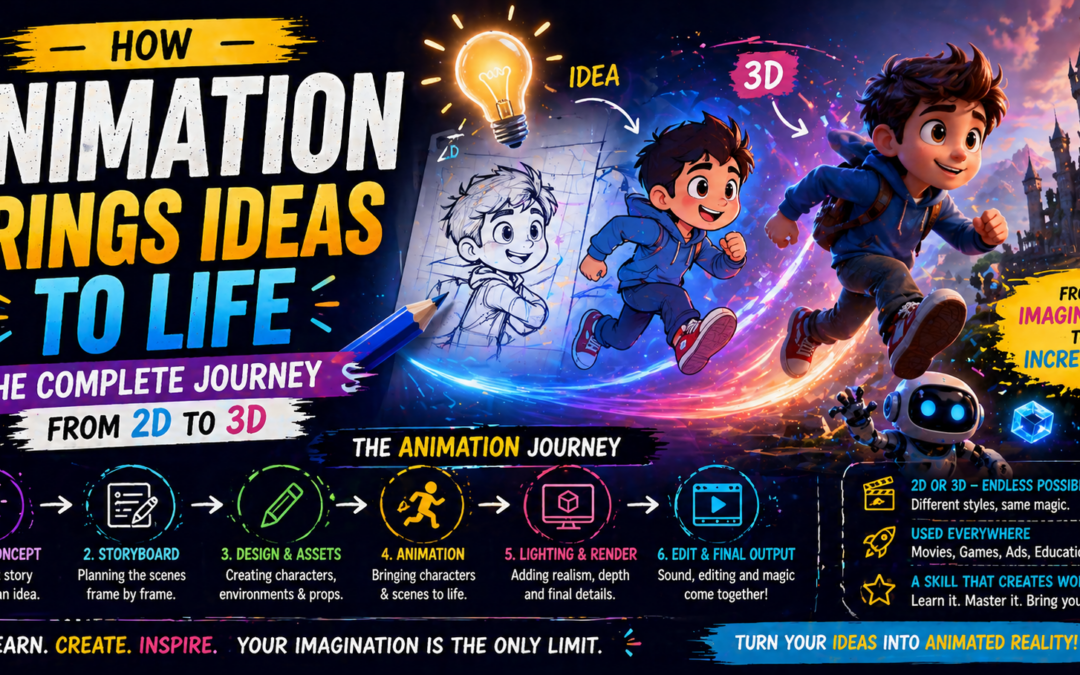
How Animation Brings Ideas to Life: The Complete Journey from 2D to 3D
Introduction
Animation is one of the most powerful ways to turn imagination into reality. From simple sketches to lifelike 3D worlds, animation helps creators tell stories, explain ideas, and create experiences that would be impossible in real life. The 2D and 3D Animation Process plays a key role in transforming ideas into visual content.
Today, animation is not limited to cartoons. It is used in movies, advertisements, games, education, and digital content. Whether it’s a short social media clip or a full-length animated film, everything follows a structured workflow.
In this blog, we will explore how animation brings ideas to life and understand the complete 2D and 3D Animation Process from concept to final output.
What Is the 2D and 3D Animation Process?
The 2D and 3D Animation Process is a step-by-step workflow used by artists to create animated content.
It includes:
- idea development
- storyboarding
- design
- animation
- editing and final output
While 2D and 3D animation use different techniques, the overall process is quite similar.
Idea and Concept Development
Every animation starts with an idea.
Creators decide:
- what story to tell
- who the audience is
- what message to communicate
A strong concept is the foundation of the 2D and 3D Animation Process.
Without a clear idea, even technically perfect animation can feel empty.
Scriptwriting and Storytelling
Once the idea is clear, the next step is writing a script.
The script defines:
- scenes
- dialogues
- actions
- emotions
Good storytelling keeps viewers engaged.
This stage is crucial in the 2D and 3D Animation Process because it shapes the entire project.
Storyboarding Visualizes the Idea
Storyboarding is like creating a blueprint.
Artists draw rough sketches of each scene to plan:
- camera angles
- character positions
- scene flow
This helps visualize how the animation will look before production starts.
Storyboarding is an important step in the 2D and 3D Animation Process.
Design and Asset Creation
In this stage, visual elements are created.
For 2D animation:
- characters
- backgrounds
- props
For 3D animation:
- models
- textures
- environments
Design defines the visual style of the project.
It plays a major role in the 2D and 3D Animation Process.
Animation Stage in 2D and 3D Animation Process
This is where everything comes to life.
In 2D animation:
- frame-by-frame drawing
- motion using keyframes
In 3D animation:
- rigging characters
- animating movements
- applying physics
This is the most time-consuming part of the 2D and 3D Animation Process.
Tools Used in Animation
Professionals use tools like:
- Adobe Animate
- Toon Boom Harmony
- Blender
- Autodesk Maya
These tools help execute the 2D and 3D Animation Process, but creativity is what makes the final output stand out.
Lighting and Rendering in 3D Animation
3D animation requires lighting to create realism.
Artists control:
- shadows
- reflections
- depth
Rendering converts 3D scenes into final images or videos.
This technical stage is essential in the 2D and 3D Animation Process for high-quality output.
Sound Design and Voice
Sound adds emotion and depth.
This includes:
- background music
- voiceovers
- sound effects
Without sound, animation feels incomplete.
Sound design enhances the impact of the 2D and 3D Animation Process.
Editing and Final Output
All elements are combined during editing.
Editors focus on:
- timing
- transitions
- pacing
- final corrections
This stage ensures the animation is smooth and engaging.
It is the final step of the 2D and 3D Animation Process.
Difference Between 2D and 3D Animation
While both follow a similar workflow, they differ in execution.
2D Animation:
- flat visuals
- hand-drawn style
- simpler tools
3D Animation:
- realistic depth
- advanced modeling
- more technical process
Understanding both helps in mastering the 2D and 3D Animation Process.
Real-World Applications of Animation
Animation is used in:
- movies and OTT content
- advertisements
- gaming
- education
- social media
The demand for professionals skilled in the 2D and 3D Animation Process is growing rapidly.
Skills Required for Animation
To succeed, students should focus on:
- creativity
- storytelling
- drawing fundamentals
- observation
- patience
- technical skills
Mastering the 2D and 3D Animation Process requires both artistic and technical abilities.
Why Animation Is a Powerful Creative Field
Animation allows creators to:
- visualize impossible ideas
- simplify complex concepts
- engage audiences emotionally
It is one of the most versatile creative fields today.
The 2D and 3D Animation Process makes it possible to turn imagination into reality.
Future of Animation
The animation industry is evolving with:
- AI tools
- real-time rendering
- virtual production
- interactive animation
These trends will make the 2D and 3D Animation Process faster and more innovative.
Final Thoughts
Animation is more than just moving visuals—it is storytelling, creativity, and technology combined.
From idea to final output, every stage plays a role in bringing concepts to life.
The 2D and 3D Animation Process helps creators transform imagination into impactful visuals that entertain, educate, and inspire.
For students and aspiring artists, learning this process opens doors to exciting career opportunities.
Recent Comments