
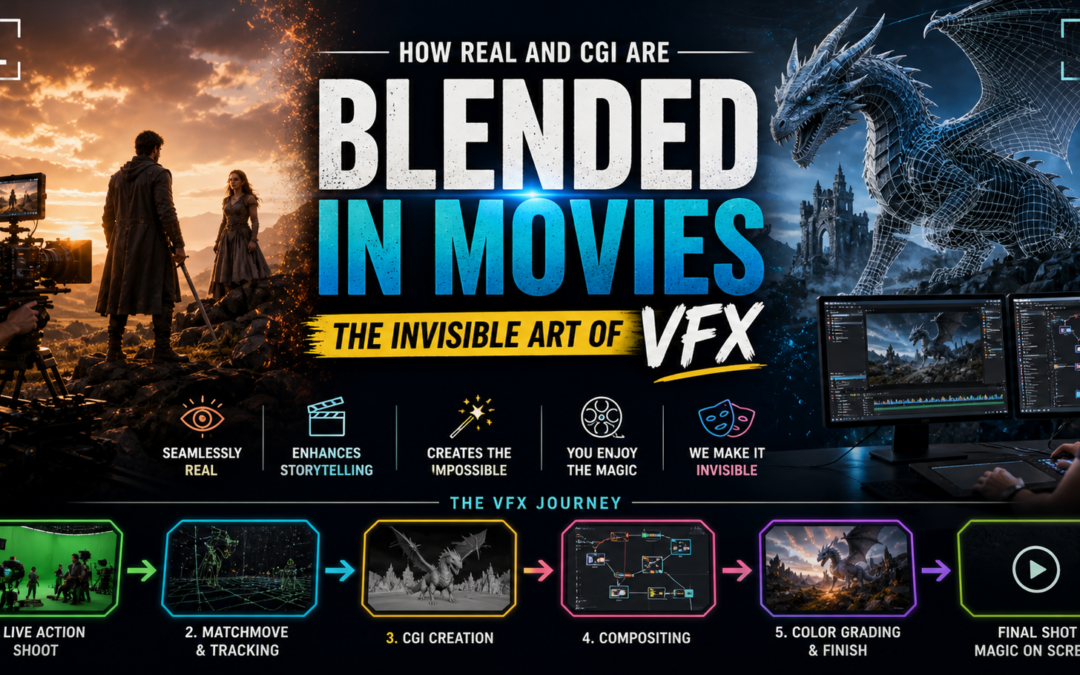
How Real and CGI Are Blended in Movies: The Invisible Art of VFX
Introduction
Have you ever watched a movie and wondered what is real and what is created digitally? Modern films are filled with scenes that look completely real but are actually a mix of live-action footage and computer-generated imagery (CGI). This seamless combination is known as VFX Blending in Movies.
Today, visual effects are not just about explosions or fantasy creatures. They are used in almost every film—even in simple scenes where you might not expect them. The goal is not to show off effects but to make them invisible.
In this blog, we will explore how real footage and CGI are combined and understand the techniques behind effective VFX Blending in Movies.
What Is VFX Blending in Movies?
VFX Blending in Movies is the process of combining real-world footage with digital elements in such a way that the audience cannot tell the difference.
This includes:
- adding environments
- inserting characters
- enhancing backgrounds
- modifying real scenes
The success of VFX lies in making everything look natural and believable.
Why Blending Matters More Than Creation
Creating CGI is only one part of VFX.
The real challenge is blending it with real footage.
Even highly detailed CGI can look fake if:
- lighting does not match
- shadows are missing
- motion feels unnatural
That is why VFX Blending in Movies is considered one of the most important aspects of visual effects.
Role of Green Screen in VFX Blending in Movies
Green screen (chroma keying) is widely used to separate actors from the background.
It allows filmmakers to:
- shoot actors in a controlled environment
- replace backgrounds digitally
- create impossible locations
However, simply removing the green background is not enough.
To achieve proper VFX Blending in Movies, artists must adjust edges, lighting, and colors carefully.
Matchmoving and Camera Tracking
To make CGI look real, it must follow the exact movement of the camera.
This is done through matchmoving (camera tracking).
It helps in:
- aligning digital objects with real footage
- maintaining perspective
- ensuring correct positioning
Without tracking, objects appear to float or slide unnaturally.
Accurate tracking is essential for VFX Blending in Movies.
Lighting and Shadow Matching
Lighting is one of the biggest factors in realism.
If lighting is inconsistent, the illusion breaks immediately.
Artists study:
- direction of light
- intensity
- color temperature
They also add:
- realistic shadows
- reflections
- highlights
Matching these elements is critical for successful VFX Blending in Movies.
CGI Integration and Rendering
CGI elements are created using 3D software and then rendered to match the scene.
Tools like Autodesk Maya, Blender, and Houdini are commonly used.
Artists focus on:
- textures
- materials
- lighting
- realism
Proper rendering ensures that digital elements fit naturally into the scene, improving VFX Blending in Movies.
Compositing: Where Everything Comes Together
Compositing is the final stage where all elements are combined.
This includes:
- live footage
- CGI elements
- effects
- color adjustments
Tools like Nuke and Adobe After Effects are used for this process.
Compositing ensures that all layers match perfectly, making VFX Blending in Movies seamless.
Color Grading for Consistency
Color grading unifies the entire scene.
Even if elements are technically correct, mismatched colors can make them look separate.
Artists adjust:
- tones
- contrast
- saturation
This creates a consistent look across all elements.
Color grading plays a major role in VFX Blending in Movies.
Real-World Examples of Invisible VFX
Many scenes that look real actually use VFX:
- background replacements
- crowd duplication
- weather effects
- set extensions
These effects are not meant to be noticed.
The best VFX Blending in Movies is when viewers cannot tell anything was added.
Why Some VFX Looks Fake
Not all VFX is successful.
Common mistakes include:
- poor lighting match
- incorrect shadows
- bad compositing
- unrealistic motion
These issues break immersion and reveal the illusion.
Understanding these mistakes helps improve VFX Blending in Movies.
Skills Required for VFX Blending in Movies
To master this field, artists need:
- strong observation skills
- understanding of light and physics
- attention to detail
- compositing knowledge
- creativity
Blending requires both artistic and technical expertise.
Why VFX Blending Is the Future of Filmmaking
Modern filmmaking relies heavily on VFX.
It allows creators to:
- reduce production costs
- create complex scenes
- shoot safely
- enhance storytelling
As technology evolves, VFX Blending in Movies will become even more advanced and realistic.
Tools Used in VFX Blending
Professionals use a combination of tools:
- Autodesk Maya for 3D creation
- Houdini for simulations
- Nuke for compositing
- Adobe After Effects for effects
However, tools alone are not enough—understanding the process is key.
Future of VFX Blending in Movies
The future includes:
- real-time rendering
- virtual production
- AI-assisted compositing
- advanced simulations
These innovations will make VFX Blending in Movies faster and more realistic.
Final Thoughts
Blending real footage with CGI is one of the most important and challenging parts of filmmaking.
From lighting and tracking to compositing and color grading, every detail matters.
The true art of VFX is not in creating effects but in hiding them.
When done correctly, VFX Blending in Movies becomes invisible—and that is what makes it powerful.
Recent Comments