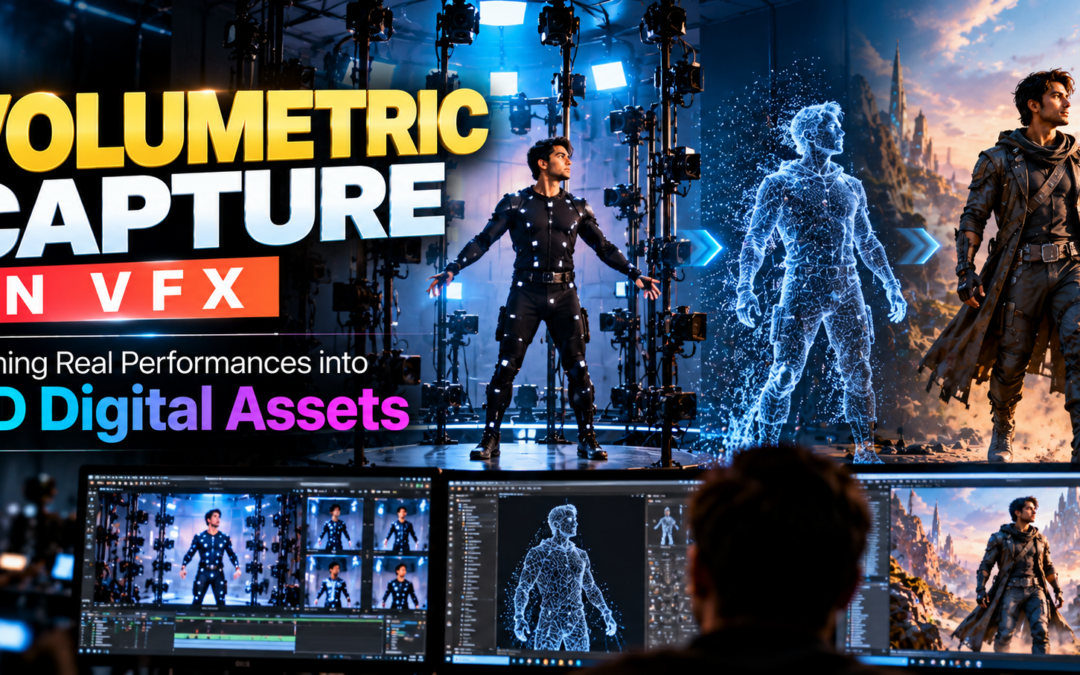
Volumetric Capture in VFX: Turning Real Performances into 3D Digital Assets
The visual effects industry is constantly developing new ways to bring realistic characters, environments, and performances into digital worlds. One emerging technology attracting attention is volumetric capture, which records real people and their movements in three dimensions rather than capturing them from just one camera angle.
Volumetric Capture in VFX allows artists to transform recorded performances into digital assets that can be integrated into films, virtual production environments, video games, immersive experiences, and other forms of digital content. By capturing appearance, movement, and spatial information, this technology offers new possibilities for creating realistic digital performances.
In 2026, developments in volumetric capture and 3D Gaussian Splatting are opening new possibilities for visual effects workflows. Production teams are exploring ways to turn captured performers into reusable digital assets for realistic crowd scenes and complex digital environments.
For aspiring VFX artists, understanding this technology provides insight into how real-world performances can become part of advanced digital production.
What Is Volumetric Capture in VFX?
Volumetric capture is a technology that records a person, object, or performance from multiple viewpoints to reconstruct its three-dimensional appearance and movement.
Traditional video records a two-dimensional image from a particular camera position. Volumetric capture collects information from multiple cameras or sensors, allowing specialised software to reconstruct the subject in 3D.
The resulting asset can preserve important details such as body movement, facial expressions, clothing, and the subject’s appearance. Depending on the capture method and processing pipeline, the output may take the form of a textured 3D mesh, a sequence of volumetric frames, or a point-based representation such as Gaussian splats.
In visual effects production, these assets can be used to populate digital environments, reproduce performances, create realistic crowds, and support immersive storytelling.
The main advantage of this technology is its ability to preserve aspects of a real performance that would otherwise require extensive manual modelling and animation. However, captured data still needs processing and may require cleanup, optimisation, relighting, or compositing before it is ready for final production.
How Does Volumetric Capture Work?
Creating a volumetric asset involves several connected stages. Each stage contributes to the quality, realism, and usability of the final digital representation.
Multi-Camera Recording
The process often begins in a specialised capture studio containing multiple cameras positioned around the subject.
These cameras record the performer simultaneously from different angles. Some systems also use controlled lighting, high-resolution sensors, and carefully calibrated camera positions to capture additional visual information.
When a performer walks, turns, gestures, or performs an action, the cameras record different views of the same moment. Synchronisation helps ensure that the collected images represent the same point in time.
The number of cameras, recording speed, lighting arrangement, and capture volume depend on the requirements of the production.
Data Processing and 3D Reconstruction
After recording, specialised software processes the captured images and reconstructs the subject’s appearance in three dimensions.
The workflow may involve camera calibration, image alignment, depth estimation, geometry reconstruction, texture generation, and temporal processing.
The objective is to combine the different camera views into a coherent digital representation of the performer.
Complex movements, loose clothing, fine hair, reflective surfaces, and rapid actions can make reconstruction difficult. Consequently, high-quality capture depends on both suitable recording conditions and effective processing methods.
Creating the Digital Asset
The reconstructed performance is converted into an asset that can be used within the production pipeline.
Depending on the technology, this may be a textured polygon mesh, a point cloud, a volumetric video sequence, or a representation based on Gaussian splats.
Traditional mesh-based assets can offer flexibility for rigging, deformation, and conventional animation workflows. Volumetric representations can preserve complex visual details that are difficult to reproduce using conventional geometry alone.
The appropriate representation depends on the intended use, available software, rendering requirements, and the degree of control needed by the VFX team.
Integration into Digital Environments
Once the asset has been processed, artists can integrate it into a virtual scene.
For example, a captured performer might appear inside a digitally created stadium, futuristic city, fantasy landscape, or cinematic environment.
The team may need to adjust lighting, colour, shadows, reflections, scale, and camera perspective to make the asset fit the scene.
This stage connects volumetric workflows with other essential production skills, including compositing, rendering, environment creation, and virtual production.
How Volumetric Capture Is Used to Build Digital Crowds
Large-scale crowd scenes are common in action films, historical dramas, stadium sequences, and fantasy productions. Creating realistic background performers for these scenes can require significant time, specialised artists, and complex animation workflows. Volumetric Capture in VFX offers another approach by allowing production teams to record real performers and transform their performances into digital assets.
Recording Multiple Performances
A capture studio can record performers walking, running, talking, cheering, or reacting to different situations. Capturing a range of movements gives artists a collection of performances that can be selected for suitable scenes.
Different clothing, body types, gestures, and movement patterns help create visual variety when the captured assets are used together.
Building a Reusable Digital Crowd Library
After reconstruction and processing, the captured performances can be organised into a digital asset library. Artists can select appropriate assets for crowd shots, arrange them within a scene, and combine them with digitally created environments.
Depending on the capture format, assets may need optimisation, lighting adjustments, and rendering preparation before they can be used effectively.
Integrating Crowds into Film Scenes
The VFX team positions captured performers within the environment and checks their scale, perspective, lighting, shadows, and interaction with the surrounding scene. The assets must look consistent with the camera angle and the visual style of the production.
For scenes requiring extensive movement or interaction, additional simulation, compositing, or conventional character animation may still be necessary.
Creating More Convincing Background Performances
Captured performers can preserve natural differences in posture, gestures, and body movement. These variations can help a digital crowd feel less repetitive than a scene populated with identical animated characters.
However, the final result depends on the quality of the capture, the available performances, and how effectively the assets are integrated.
By combining recorded performances with digital environments, Volumetric Capture in VFX gives artists another way to create detailed crowd sequences for films, virtual production, and immersive experiences.
The Role of 3D Gaussian Splatting in Volumetric Capture
One of the important developments in modern volumetric workflows is 3D Gaussian Splatting.
Gaussian Splatting represents a captured scene using numerous small, overlapping, Gaussian-shaped primitives. These elements work together to reconstruct the appearance of objects, environments, and, in newer workflows, moving performers.
Unlike a conventional polygon mesh, a Gaussian-splat representation does not rely on the same traditional surface geometry structure. It can preserve fine visual detail and produce convincing views of captured subjects.
Production teams are exploring relightable Gaussian-splat assets for visual effects and crowd work, creating new opportunities to incorporate captured performers into digital environments.
This development is significant because realistic digital crowds can require substantial modelling, texturing, animation, and lighting work. Capturing real performers may offer an alternative for suitable shots.
However, Gaussian Splatting also has limitations. Some assets can be difficult to edit like conventional geometry, and changing lighting, viewpoint, or motion may introduce technical challenges. Relightable workflows are helping address some of these limitations, but the technology does not eliminate every stage of traditional VFX production.
Applications of Volumetric Capture in VFX
Volumetric capture can support a variety of creative and technical applications across the entertainment industry.
Realistic Digital Crowds
Large crowd sequences are common in films featuring stadiums, concerts, battles, public gatherings, and city environments.
Creating every background character from scratch can require significant production resources. Volumetric capture can record groups of real performers and turn them into reusable digital assets.
These captured performances can then be arranged within suitable virtual environments. The technique can help preserve natural variations in body movement, clothing, and human appearance.
Film and Television Production
Filmmakers can use captured performances as digital elements in selected scenes. These assets may be placed within computer-generated environments or used to support shots requiring additional visual flexibility.
Volumetric capture can also complement digital doubles and other performance-reconstruction methods.
The final result depends on capture quality, camera requirements, lighting compatibility, and the level of integration needed for the scene.
Virtual Production
Virtual production combines live-action filmmaking with digital environments and real-time computer graphics.
Volumetric assets can provide realistic performers or environmental elements for suitable virtual scenes. They may also contribute to previsualisation, immersive presentations, and specialised production workflows.
The ability to reuse captured performances can give artists more options when planning digital scenes.
Video Games and Interactive Experiences
Captured performances can support immersive experiences, digital characters, interactive storytelling, and selected game cinematics.
For interactive applications, assets must meet the performance and rendering requirements of the target platform. This can require compression, optimisation, and adaptation to the engine or delivery system.
Advertising and Digital Content
Brands and content creators can use volumetric assets to develop realistic digital presentations, virtual experiences, and creative campaigns.
A captured performer may be integrated into a digital environment that would be difficult or expensive to construct physically.
As with other applications involving real people, consent and appropriate rights to use the recorded likeness are essential.
Benefits of Volumetric Capture for VFX Artists
Greater performance realism: Capturing real performers can preserve subtle movements, gestures, and appearance that may be challenging to reproduce manually.
Reusable digital assets: Suitable captures can be reused across selected shots or productions, subject to technical compatibility and usage rights.
Potential production efficiencies: For certain crowd and performance workflows, capture-based assets may reduce the need for extensive manual character creation. The actual time savings depend on processing requirements and final-shot complexity.
Creative flexibility: Digital performances can be integrated into virtual environments and reviewed from different viewpoints when the capture representation supports that workflow.
New storytelling opportunities: The technology can support immersive experiences, innovative camera perspectives, and new approaches to combining real performances with computer-generated worlds.
These benefits make volumetric capture an important technology for artists exploring advanced digital production methods.
Challenges and Limitations of Volumetric Capture
Despite its potential, volumetric capture introduces technical and practical challenges.
High Equipment and Processing Costs
Professional capture systems can require multiple cameras, synchronisation equipment, controlled lighting, specialised software, and significant computing resources.
The initial investment may be difficult for smaller production teams, although access to specialist capture facilities can provide an alternative to owning the equipment.
Large Data Requirements
High-resolution recordings from multiple cameras generate substantial amounts of data. Processing, storing, transferring, and backing up these files can create additional demands on production infrastructure.
Efficient compression and asset-management workflows are important when working with large capture datasets.
Difficult Materials and Movements
Hair, transparent objects, reflective clothing, fast movement, and complex interactions can make reconstruction more challenging.
The quality of the final asset depends on camera coverage, lighting, reconstruction methods, and the characteristics of the subject.
Limited Editing Flexibility
A captured performance is not always as easy to change as a conventionally rigged 3D character.
Changing a gesture, altering body proportions, modifying clothing, or completely redesigning the lighting may require additional processing or a different asset representation.
For this reason, volumetric capture is often best treated as part of a broader VFX toolkit rather than a complete replacement for modelling, rigging, and animation.
Consent and Digital Identity
Recording a person’s likeness and performance raises important questions about privacy, consent, ownership, and permitted reuse.
Production teams should establish clear agreements covering how captured data may be stored, modified, distributed, and used in future projects.
Responsible management of digital identity is an essential part of professional volumetric production.
Essential Skills for Aspiring Volumetric Capture Artists
Students interested in this field should develop a foundation in visual effects, 3D production, and digital asset management.
Important skills include:
- 3D modelling and reconstruction: Understanding digital geometry, topology, scanning, and asset preparation.
- Texturing and materials: Working with surface appearance, colour information, and realistic materials.
- Lighting and rendering: Understanding how captured assets interact with digital environments.
- Compositing: Integrating captured performances with live-action footage and CGI.
- Real-time engines: Learning how digital assets are imported, optimised, and presented in interactive environments.
- Data processing: Understanding image sequences, file formats, capture data, and technical quality checks.
- Problem-solving: Identifying reconstruction errors and resolving visual inconsistencies.
- Team collaboration: Working with capture operators, VFX supervisors, technical artists, and production teams.
Useful tools depend on the studio pipeline and may include Blender, Autodesk Maya, Unreal Engine, compositing software, photogrammetry applications, and specialised volumetric capture platforms.
Aspiring artists can begin by learning conventional 3D workflows and experimenting with accessible scanning or reconstruction tools. A portfolio demonstrating a reconstructed object, a captured performance, or the integration of a digital asset into a scene can help communicate technical understanding.
The Future of Volumetric Capture in VFX
The future of volumetric capture is likely to involve improvements in capture quality, processing speed, data compression, relighting, and integration with established production pipelines.
Developments in Gaussian Splatting are particularly interesting because they offer new ways to represent captured performers and environments. Industry research and production experiments are exploring how these representations can be used in digital crowds, virtual production, and immersive media.
AI-assisted processing may also help with selected reconstruction and optimisation tasks. However, the technology still faces challenges involving asset editing, consistent lighting, rendering performance, and efficient data delivery.
For VFX artists, these changes create opportunities to combine traditional creative skills with new capture-based workflows. Understanding how to prepare, evaluate, optimise, and integrate digital assets will remain valuable as the industry develops.
Conclusion
Volumetric Capture in VFX is expanding the ways filmmakers and digital artists preserve real performances and bring them into computer-generated environments. By combining multi-camera recording, 3D reconstruction, advanced rendering, and digital asset integration, the technology offers new possibilities for realistic crowds, virtual production, films, games, and immersive content.
Although equipment costs, data requirements, reconstruction challenges, and editing limitations remain important considerations, ongoing developments are making capture-based workflows increasingly relevant to professional visual effects.
For aspiring artists, learning 3D modelling, texturing, lighting, compositing, and real-time production provides a strong foundation for exploring this emerging field.
At MAAC Marathahalli, students interested in animation, VFX, and digital content creation can build their creative and technical foundations while exploring the technologies shaping the future of visual storytelling.
Recent Comments