
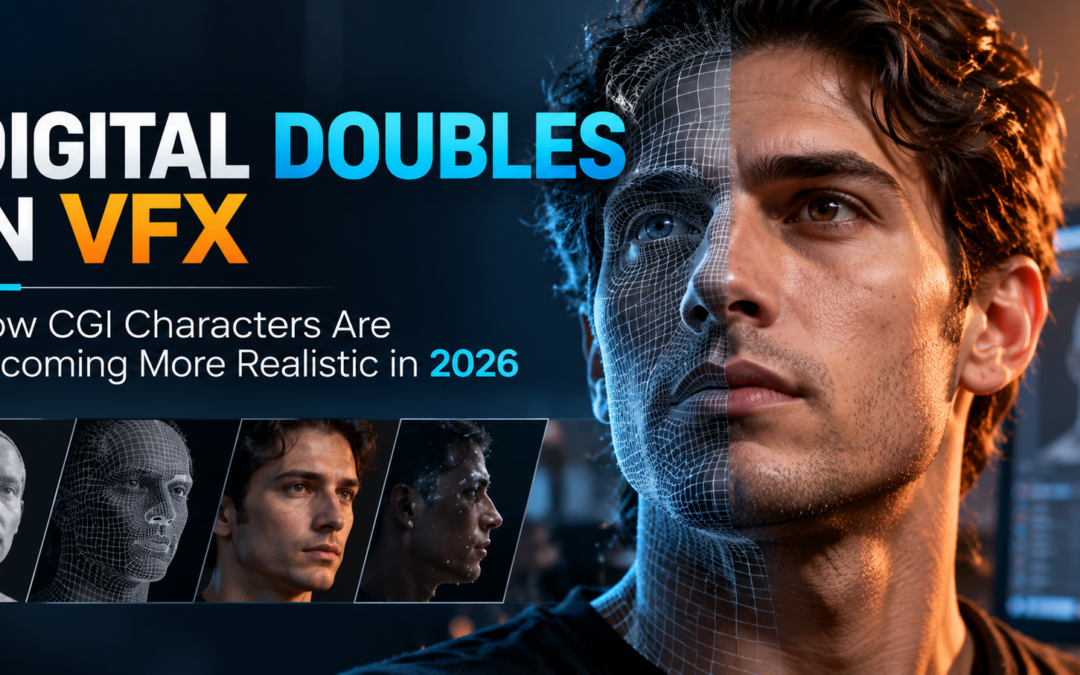
Digital Doubles in VFX: How CGI Characters Are Becoming More Realistic in 2026
The world of visual effects is evolving rapidly, and digital characters are becoming increasingly difficult to distinguish from real people. From digitally recreated actors in blockbuster movies to realistic stunt doubles and younger versions of familiar characters, modern filmmaking uses advanced computer-generated imagery to create convincing human performances. At the centre of this transformation is Digital Doubles in VFX, a technique that combines 3D modelling, facial scanning, performance capture, realistic texturing, and sophisticated rendering.
In 2026, digital doubles are becoming increasingly important in films, streaming productions, advertising, gaming cinematics, and virtual production. Improvements in scanning technology, facial animation, real-time rendering, and AI-assisted workflows are helping artists build digital humans with greater detail and more natural movement.
For aspiring VFX artists, understanding this technology offers an opportunity to explore one of the most technically demanding and creatively rewarding areas of digital production.
What Are Digital Doubles in VFX?
Digital Doubles in VFX are computer-generated digital replicas of real actors or people, designed to reproduce their appearance, movements, and expressions. Depending on the production requirements, a digital double may represent the entire body, the face, or selected parts of an actor.
Unlike a conventional animated character, a digital double is usually created to match a specific person’s physical characteristics as closely as possible. Artists reproduce details such as facial structure, skin texture, eye shape, hair, body proportions, and clothing.
These digital replicas can be used in situations where filming a real performer would be difficult, dangerous, expensive, or visually impractical.
For example, a film may use a digital double to show an actor performing a dangerous jump, flying through the air, appearing in a large-scale action sequence, or participating in a scene that requires a completely computer-generated environment.
Digital doubles can also support de-aging effects, face replacement, crowd duplication, and shots that combine live-action footage with computer-generated characters.
The objective is not simply to create a realistic-looking model. The digital character must also behave convincingly under different lighting conditions, camera angles, facial expressions, and movements.
Why Are Digital Doubles Becoming More Important in 2026?
The demand for realistic digital humans is growing as filmmakers and content creators look for new ways to tell stories. Audiences expect detailed visual effects, believable performances, and seamless integration between real footage and CGI.
Several developments are contributing to the growing importance of Digital Doubles in VFX.
Photorealistic character creation: Modern modelling, scanning, texturing, and rendering workflows allow artists to reproduce extremely fine details, including skin pores, wrinkles, subtle facial asymmetry, and realistic eyes.
Advanced facial performance capture: Modern capture systems help translate an actor’s expressions into digital character animation. Industrial Light & Magic describes specialised facial-capture approaches designed to capture detailed geometry and facial performance.
Real-time rendering: Modern rendering engines allow artists to preview digital characters under different lighting conditions and evaluate their appearance more interactively.
AI-assisted workflows: AI and machine-learning techniques can support selected production tasks, including processing captured data and assisting with parts of facial-animation workflows. Human artists remain essential for performance interpretation, visual quality, and creative decisions.
Demand across industries: Digital humans are relevant to cinema, streaming platforms, video games, virtual production, advertising, and immersive experiences.
Together, these developments are making realistic digital character creation a significant area of modern visual effects production.
How Are Digital Doubles Created?
Creating a believable digital human involves multiple production stages. Each stage contributes to the final result, and weaknesses in one area can reduce the realism of the entire character.
3D Scanning and Photogrammetry
The process often begins with capturing the actor’s appearance using specialised scanning equipment or photogrammetry. Photogrammetry reconstructs three-dimensional surfaces from multiple photographs taken from different angles.
Depending on the project, artists may capture the actor’s head, full body, facial expressions, and other physical details.
The resulting data provides a starting point for building a digital replica. Scans can capture complex facial geometry and surface information that would otherwise require extensive manual modelling.
However, raw scan data is rarely ready for final production. Artists may need to clean the geometry, remove scanning artefacts, reconstruct missing areas, and prepare the model for animation.
3D Modelling and Retopology
Once scanning is complete, the geometry must be prepared for production.
Artists refine the model’s shape, correct imperfections, and create an organised polygon structure through a process known as retopology. Good topology is particularly important around the eyes, mouth, cheeks, and other areas that deform during facial animation.
The model must maintain its shape when the character speaks, smiles, blinks, or performs complex movements.
For close-up shots, even small inaccuracies around the eyelids, lips, or jaw can make a digital human look artificial.
Realistic Texturing and Skin Shading
Skin is one of the most challenging aspects of digital-human creation. Human skin contains subtle colour variations, pores, fine lines, and different levels of light absorption and reflection.
Artists use high-resolution textures, normal maps, displacement maps, and physically based materials to reproduce these characteristics.
Subsurface scattering is particularly important because light penetrates the outer layers of skin before scattering back out. This effect contributes to the natural appearance of areas such as ears, cheeks, and noses.
Epic Games’ digital-human documentation highlights the role of detailed textures, skin shading, geometry, and facial features in creating believable characters.
The goal is to make the character look convincing under changing lighting conditions rather than only in one carefully designed render.
Facial Performance Capture
A realistic model is only one part of a believable digital performance. The character must also reproduce the actor’s expressions and emotional nuances.
Facial performance capture records movements such as eyebrow raises, lip movements, eye direction, cheek movement, and changes in facial expression. This information is then processed and used to animate the digital character.
Different systems use marker-based, markerless, or camera-assisted approaches. The appropriate technique depends on the production, required accuracy, and available equipment.
Artists may still need to refine the captured animation manually. A technically accurate capture does not automatically produce an emotionally convincing performance.
Rigging and Character Animation
Rigging creates the digital skeleton and controls used to move a character. For digital humans, this includes body joints, facial controls, eye movement, and the systems required to deform the skin naturally.
Facial rigs may use blend shapes, muscle-inspired deformation, or other techniques to reproduce a wide range of expressions.
Animators then refine body movement, timing, posture, and gestures to preserve the actor’s performance.
This stage is especially important for action sequences, where body mechanics, balance, momentum, and contact with the environment must feel believable.
Hair, Clothing, and Final Rendering
Hair and clothing introduce additional challenges because they respond dynamically to movement, wind, gravity, and contact.
Artists use grooming tools and simulation systems to reproduce the movement of individual strands, fabric folds, and other fine details. The character is then integrated into the scene using appropriate lighting, shadows, reflections, and compositing.
The final image must match the live-action footage in colour, exposure, camera perspective, depth of field, and motion blur.
When every element works together, Digital Doubles in VFX can blend into live-action sequences without distracting the audience from the story.
Real-World Applications of Digital Doubles
Digital doubles are useful across several areas of entertainment and digital content production.
Action movies and stunt sequences: Digital replicas can support dangerous falls, aerial movements, complex fight sequences, and shots that cannot be performed safely by an actor.
De-aging and digital face replacement: Visual effects teams may recreate or modify a performer’s appearance for particular scenes. These techniques require careful attention to facial structure, expressions, lighting, and continuity.
Fantasy and science-fiction films: Digital doubles can help actors interact with digital environments, perform physically impossible movements, or appear in sequences requiring extensive CGI.
Crowd simulation: Digital characters can populate stadiums, battle scenes, and large-scale environments where filming every individual would be impractical.
Video games and cinematics: Realistic digital humans can support story-driven games, cinematic sequences, and interactive entertainment.
Advertising and virtual experiences: Brands can use digital characters in visual campaigns, virtual presentations, and immersive content, subject to appropriate rights and consent.
These applications demonstrate how Digital Doubles in VFX can support both creative storytelling and practical production requirements.
The Role of AI in Digital Human Creation
Artificial intelligence is influencing several stages of digital character production. Machine-learning techniques can assist with processing facial data, cleaning motion capture, tracking expressions, and automating selected repetitive tasks.
AI-assisted workflows may also help artists organise reference material, generate preliminary assets, or accelerate parts of a production pipeline.
However, generating a convincing digital human remains a complex challenge. A realistic character must maintain consistent identity, anatomy, lighting response, facial movement, and emotional continuity across multiple shots.
Human artists are still essential for evaluating these details, correcting errors, and making creative decisions.
There are also important ethical considerations. Recreating a real person’s likeness requires attention to consent, contractual rights, privacy, and the permitted use of facial and performance data.
In 2026, the most effective approach is to use AI as a supporting technology while retaining human oversight over artistic quality and the responsible use of digital likenesses.
Major Challenges in Creating Realistic Digital Doubles
Despite advances in technology, producing believable digital humans remains difficult.
The uncanny valley: A character may look almost human but still feel unnatural because of subtle problems with the eyes, facial movement, or expressions.
Accurate skin and eye details: Incorrect reflections, overly smooth skin, unnatural eye movement, or inconsistent texture can reduce realism.
Facial performance: Small differences in lip movement, blinking, and emotional expression can become noticeable during close-up shots.
Lighting and compositing: A digital character may look convincing in isolation but appear disconnected when inserted into real footage with different lighting or camera characteristics.
Production time and cost: High-quality digital humans often require specialised artists, capture facilities, substantial computing resources, and extensive quality control.
Consistency between shots: The character’s appearance, textures, proportions, and animation must remain consistent throughout the production.
Solving these challenges requires a combination of technical knowledge, artistic judgement, observation, and collaboration between departments.
Essential Skills for Aspiring Digital Double Artists
Students interested in this field should develop a strong foundation in 3D production and visual storytelling.
Important skills include:
- 3D modelling: Understanding human anatomy, proportions, facial structure, and clean geometry.
- Texturing and shading: Creating realistic skin, eyes, hair, and clothing materials.
- Rigging and animation: Building character controls and producing natural movement.
- Facial animation: Understanding expressions, lip synchronisation, and emotional performance.
- Lighting and rendering: Matching digital characters to live-action environments.
- Compositing: Integrating CGI elements into footage with consistent colour, shadows, and perspective.
- Observation and anatomy: Studying how real people move, react, and express emotions.
- Problem-solving: Identifying visual inconsistencies and refining complex shots.
Depending on the production pipeline, useful software may include Autodesk Maya, Blender, ZBrush, Substance 3D Painter, Unreal Engine, and compositing tools such as Nuke or Adobe After Effects.
Students should begin with foundational modelling and texturing before progressing to advanced facial rigs, performance capture, simulation, and photorealistic rendering.
A strong portfolio can include a realistic digital head, a textured character bust, a facial-expression study, a short animation, or a breakdown showing the model, wireframe, textures, lighting, and final render.
The Future of Digital Doubles in VFX
The future of digital humans is likely to involve more integrated workflows combining scanning, performance capture, advanced rendering, procedural tools, and AI-assisted production.
Real-time technologies may help artists review characters earlier in production, while improved capture methods can provide more detailed information about facial expressions and physical appearance.
Digital doubles may also become more reusable across films, games, and virtual experiences, provided that assets are adapted to each platform’s technical requirements and the relevant rights are secured.
Nevertheless, technological progress alone will not guarantee convincing results. Artistic judgement, performance understanding, visual consistency, and responsible use of a person’s likeness will remain central to professional work.
For aspiring artists, learning the fundamentals of 3D modelling, texturing, animation, lighting, and compositing provides a strong starting point for exploring this evolving specialisation.
Conclusion
Digital Doubles in VFX represent an exciting intersection of digital artistry, performance capture, computer-generated imagery, and advanced rendering. From recreating actors for demanding action sequences to building realistic digital humans for games and virtual production, the technology is expanding the possibilities of visual storytelling.
As production workflows continue to evolve in 2026, artists who understand both the technical process and the principles of realistic human performance will be better prepared to contribute to complex visual effects projects.
For students passionate about animation, CGI, and filmmaking, digital-human creation offers a compelling direction for developing specialised skills and building a portfolio for the VFX industry.
At MAAC Marathahalli, aspiring creators can explore the broader foundations of animation and visual effects, develop their creative abilities, and work towards understanding the techniques used to bring digital characters and cinematic worlds to life.
Recent Comments