
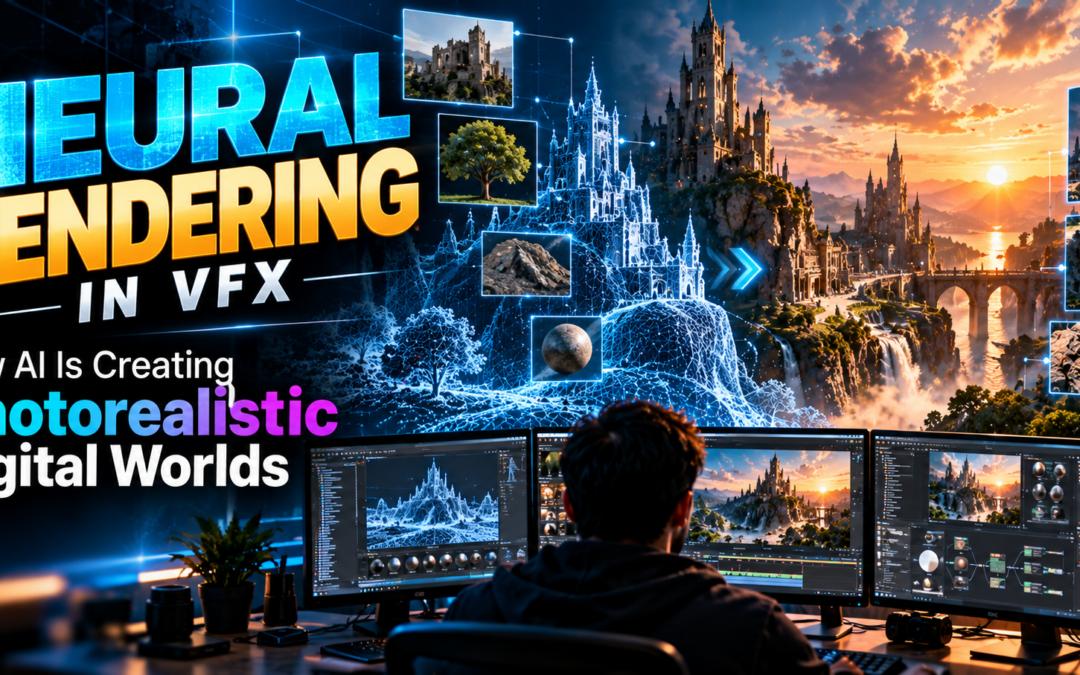
Neural Rendering in VFX: How AI Is Creating Photorealistic Digital Worlds
The visual effects industry is entering a new era in which artificial intelligence is changing how digital environments, realistic characters, and cinematic scenes are created. From lifelike digital landscapes to interactive virtual production environments, artists are exploring new ways to achieve realistic visuals while reducing the time required for complex rendering tasks.
Neural Rendering in VFX is an emerging technology that combines artificial intelligence, machine learning, and computer graphics to produce or enhance realistic images from digital scenes. Instead of relying exclusively on traditional rendering calculations, neural rendering uses trained AI models to estimate visual details such as lighting, textures, reflections, and material appearance.
This technology is attracting attention across filmmaking, animation, gaming, advertising, and virtual production. It can help creative teams experiment with complex scenes, improve visual quality, and explore new production workflows. However, it is not a complete replacement for conventional rendering. Its effectiveness depends on the project, available data, hardware, artistic requirements, and level of control needed.
Understanding how this technology works can help aspiring VFX artists and digital creators prepare for the changing demands of the industry.
What Is Neural Rendering in VFX?
Neural rendering is a computer graphics approach that uses neural networks to generate, reconstruct, or enhance visual information. It combines traditional 3D graphics techniques with AI-based processing to create realistic images or interactive digital scenes.
In conventional rendering, a computer calculates how light interacts with objects, materials, and environments. Depending on the technique, these calculations may involve ray tracing, global illumination, shadows, reflections, and other complex processes.
With Neural Rendering in VFX, trained AI models can learn patterns from visual data and use that knowledge to predict or reconstruct aspects of an image. Some systems enhance traditionally rendered frames, while others help reconstruct 3D scenes from photographs or video footage.
For example, an artist might capture a real location and use AI-assisted reconstruction to create a navigable digital environment. Another workflow might use a conventional 3D scene as input and a neural model to improve lighting or visual detail.
The goal is not simply to make an image look attractive. It is to create convincing visuals while maintaining the artistic direction and production control required for professional work.
How Does Neural Rendering Work?
The exact process depends on the technology being used, but most workflows combine visual data, a trained neural model, and conventional graphics tools.
Capturing and preparing visual data
The process may begin with photographs, video footage, 3D assets, motion-capture data, or an existing digital scene. The quality and consistency of this input can significantly affect the final output.
For instance, a production team may capture a building from multiple angles to help reconstruct its shape, surfaces, and spatial appearance.
Training or selecting an AI model
A neural network learns patterns from training data or uses a previously trained model designed for a specific task. Depending on the system, the model may estimate surface appearance, reconstruct missing information, enhance image quality, or represent a scene in a more efficient form.
Some approaches use neural radiance fields, while others use 3D Gaussian splatting, neural textures, or AI-based image reconstruction.
Generating the visual result
Once the scene or model is prepared, the system generates or enhances the visual output. It may help reproduce lighting, reflections, fine details, or complex environmental appearances.
In Neural Rendering in VFX, the neural component can work alongside traditional 3D geometry, physically based materials, animation systems, and rendering engines. This hybrid approach allows artists to combine AI-assisted visual generation with familiar production controls.
Reviewing and refining the output
The resulting images must be reviewed for visual consistency, temporal stability, unwanted artifacts, and continuity between frames. Artists may adjust the source scene, improve training data, refine lighting, or combine neural outputs with conventional compositing techniques.
This review stage remains essential because a realistic single frame does not automatically guarantee a convincing animation or film sequence.
Neural Rendering vs. Traditional Rendering
Traditional rendering and neural rendering have different strengths. Understanding their differences helps production teams choose the appropriate technique for each project.
|
Feature |
Traditional Rendering |
Neural Rendering |
|
Core approach |
Graphics calculations and scene data |
AI-based visual prediction or reconstruction |
|
Scene control |
Often highly explicit and predictable |
Depends on the model and workflow |
|
Lighting |
Calculated using rendering algorithms |
May be estimated, reconstructed, or enhanced |
|
Data requirements |
Requires scene geometry, materials, and lighting setup |
May also require training data or captured imagery |
|
Best applications |
Controlled CGI, animation, and complex simulations |
Scene reconstruction, image enhancement, and selected real-time workflows |
|
Common limitations |
Can require substantial computing time |
Can produce artifacts or inconsistent results |
Neither approach is universally superior. Traditional rendering remains important when artists need precise control over geometry, materials, lighting, and animation. Neural methods can be valuable when reconstruction, visual enhancement, or faster interactive feedback is a priority.
Many production workflows will combine both approaches rather than rely entirely on one.
Major Applications of Neural Rendering in VFX
The technology has potential across several stages of digital production. Its practical value depends on how well it integrates with existing creative pipelines.
Creating photorealistic digital environments
Building a realistic environment from scratch can require extensive modelling, texturing, lighting, and set dressing. Neural reconstruction methods can help artists create digital representations of real-world locations from captured images or video.
This can be useful for architectural environments, city streets, natural landscapes, historical locations, and complex background scenes.
For example, a filmmaker could capture a real location and reconstruct parts of it for a virtual production environment. Artists could then combine the reconstructed scene with additional digital elements.
Neural methods can accelerate certain reconstruction tasks, although detailed geometry, accurate camera tracking, and artistic cleanup may still be necessary.
Improving lighting and material appearance
Lighting plays a major role in making computer-generated objects look believable. Even carefully modelled assets can appear artificial when their shadows, reflections, or surface materials do not match the surrounding environment.
Some neural rendering systems can assist with relighting, image reconstruction, and material appearance estimation. This may help artists explore lighting variations or create more convincing visual results.
In Neural Rendering in VFX, AI-assisted relighting can be particularly useful when a production needs to adapt a digital scene to changing conditions or match the appearance of live-action footage.
However, results must be checked for consistency. A lighting solution that looks correct in one frame may not behave appropriately as a camera or object moves.
Enhancing digital characters
Digital humans require detailed facial features, realistic skin shading, convincing eyes, and natural interaction with light. Neural techniques can contribute to facial reconstruction, appearance enhancement, and the processing of captured performance data.
These capabilities can support realistic digital characters in films, games, commercials, and cinematic sequences.
Nevertheless, convincing characters require more than photorealistic skin. Facial expressions, body movement, emotional performance, and accurate lip synchronisation are equally important. Artists must evaluate the complete performance rather than judge realism from a still image alone.
Supporting virtual production
Virtual production combines real-time graphics, camera tracking, digital environments, and physical filmmaking techniques. Neural methods may help reconstruct locations, improve digital imagery, and support more responsive visual workflows.
When used appropriately, Neural Rendering in VFX can contribute to faster scene exploration and more realistic digital environments.
For example, a production team could use a reconstructed environment as a starting point for a virtual set, then refine its geometry, lighting, and assets in a real-time engine.
The technology does not eliminate the need for production design or technical preparation. Camera tracking, colour matching, screen performance, and environmental continuity still require careful attention.
Improving real-time visual experiences
Real-time rendering is increasingly important in interactive entertainment, virtual production, and cinematic previews. Neural techniques can help certain systems improve image quality or approximate visual effects that would otherwise require more expensive calculations.
In games, AI-assisted rendering may contribute to realistic lighting and detailed visual presentation while maintaining responsive performance.
For VFX artists, this development highlights the growing importance of understanding both conventional rendering pipelines and newer AI-assisted graphics methods.
Benefits of Neural Rendering in VFX
The technology offers several potential advantages when applied to suitable production tasks.
Faster iteration: Artists may be able to test visual ideas, lighting variations, or reconstructed scenes more quickly in supported workflows.
Improved visual realism: AI-based reconstruction and enhancement can help reproduce complex appearances and fine visual details.
Efficient scene reconstruction: Captured imagery can provide a foundation for creating digital environments without manually modelling every visible detail from the beginning.
Better interactive workflows: Some neural techniques can support responsive visual previews and real-time applications.
Expanded creative possibilities: Artists can explore combinations of captured reality, conventional 3D assets, and AI-assisted visual generation.
The benefits are not automatic. Performance depends on the method, data quality, computing resources, and the amount of manual refinement required.
Challenges and Limitations
Despite its potential, neural rendering introduces technical and creative challenges that production teams must understand.
Visual consistency
A sequence must remain convincing across multiple frames. Flickering, changing details, unstable reflections, or inconsistent textures can become noticeable when the camera moves.
Limited artistic control
Some AI-based methods do not expose every visual property as directly as a conventional 3D scene. Artists may need additional controls, masks, geometry, or conventional rendering passes to achieve the desired result.
High-quality data requirements
Reconstruction workflows can struggle when source images contain motion blur, missing viewpoints, reflections, transparent surfaces, or inconsistent lighting.
Computing and integration costs
Some systems require specialised hardware, large datasets, or complex software integration. Production teams must evaluate whether the time saved justifies the cost of implementation.
Intellectual property and production reliability
Studios must also consider the permissions associated with source footage and training data, along with security, reproducibility, and delivery requirements. Professional projects need predictable results, not just visually impressive demonstrations.
These challenges mean that Neural Rendering in VFX is best approached as a specialised addition to an artist’s toolkit rather than a universal shortcut.
Skills VFX Artists Should Learn
As AI-assisted graphics continue to develop, aspiring artists can benefit from building strong foundations before specialising in advanced techniques.
- 3D modelling and texturing: Understand geometry, UV mapping, materials, and asset preparation.
- Lighting and rendering: Learn how light, shadows, reflections, and surface properties affect realism.
- Compositing: Develop skills in integrating CGI with live-action footage and matching colour, contrast, and atmosphere.
- Real-time engines: Explore Unreal Engine or other suitable tools for interactive environments and virtual production.
- AI and machine learning fundamentals: Learn the basic concepts behind neural networks, image reconstruction, and AI-assisted graphics.
- Photography and scanning: Understand camera settings, image capture, reference gathering, and the limitations of reconstruction data.
- Problem-solving and artistic judgement: Learn to identify visual artifacts and decide when a traditional technique is more reliable.
Students interested in this field should also develop a portfolio showing their ability to create realistic environments, manage lighting, and refine visual details. A well-documented project that explains the workflow and artistic decisions can be more valuable than simply demonstrating an AI-generated image.
The Future of Neural Rendering in VFX
Research and commercial development are moving towards closer integration between AI models and established graphics pipelines. Researchers are exploring faster neural rendering, improved relighting, scene reconstruction, and more interactive methods for creating detailed digital worlds.
These developments could make certain production tasks more efficient and expand what small creative teams can achieve. They may also allow artists to spend less time on repetitive technical work and more time refining storytelling, composition, and visual direction.
However, the future will likely involve hybrid workflows. Conventional rendering provides important control and reliability, while neural methods offer new ways to reconstruct, enhance, and represent visual information.
For students and professionals, the most useful strategy is to understand the underlying principles of computer graphics and then learn how AI tools can complement those skills. Keeping up with emerging workflows while practising core artistic techniques will help artists adapt as the industry evolves.
Conclusion
Neural Rendering in VFX represents an important development in the relationship between artificial intelligence and computer graphics. By combining neural models with traditional rendering techniques, artists can explore new ways to reconstruct real-world environments, enhance visual details, support virtual production, and improve selected real-time workflows.
The technology still faces challenges involving consistency, artistic control, data quality, and production integration. Understanding these limitations is essential for using it effectively.
For aspiring VFX artists, this is an opportunity to strengthen traditional skills while exploring emerging AI-assisted techniques. A solid understanding of modelling, lighting, texturing, compositing, and rendering provides the foundation for adapting to new technologies.
At MAAC Marathahalli, students interested in animation and visual effects can focus on developing practical creative skills, understanding modern production workflows, and building portfolios that demonstrate both technical knowledge and artistic ability.
As digital production continues to evolve, the combination of creative judgement, computer graphics expertise, and responsible AI adoption will help shape the next generation of visual storytelling.
Recent Comments