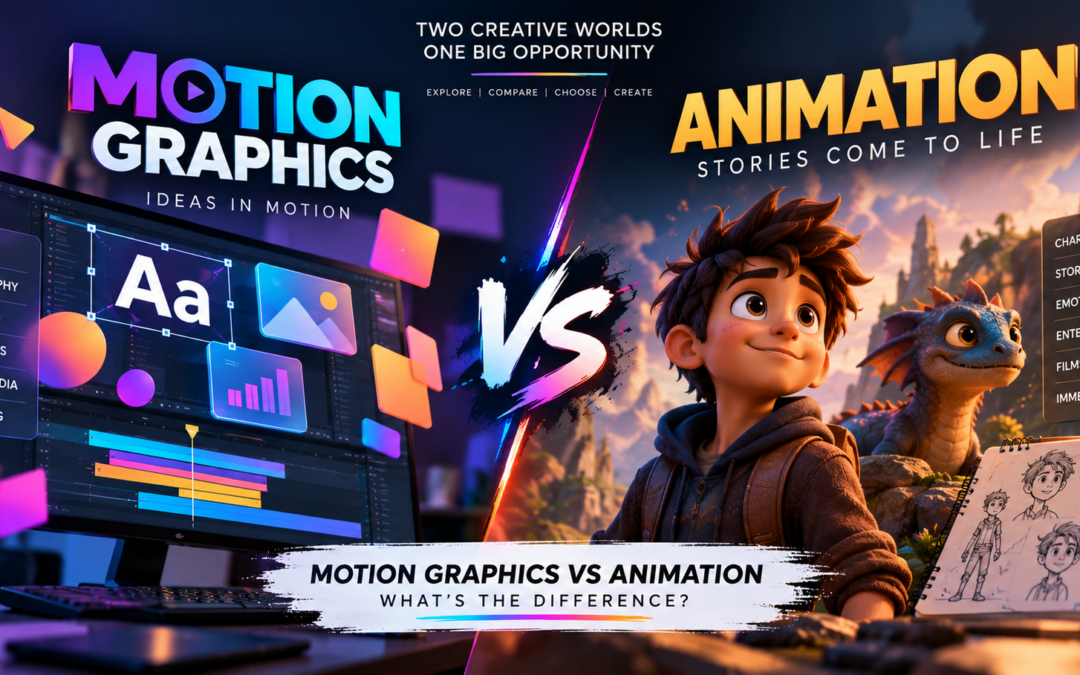
Motion Graphics vs Animation: What’s the Difference?
Introduction
If you’re exploring careers in animation, graphic design, video production, or digital media, you’ve probably encountered the terms Motion Graphics and Animation. While both involve creating movement on screen, they are not the same thing. Many beginners often use these terms interchangeably, but understanding the difference between them is essential for choosing the right career path and developing the right skills.
The discussion around Motion Graphics vs Animation has become increasingly important as the demand for digital content continues to grow. Businesses, brands, content creators, filmmakers, and game developers all rely on animated visuals, but they use Motion Graphics and Animation in different ways.
Motion Graphics is commonly used to communicate information, explain concepts, promote products, and strengthen branding. Animation, on the other hand, is primarily focused on storytelling, character performance, and creating immersive visual experiences.
Whether you’re a student considering a career in the creative industry or someone curious about digital content creation, understanding Motion Graphics vs Animation will help you make informed decisions about your future.
In this blog, we’ll explore what Motion Graphics and Animation are, their key differences, where they are used, the software involved, career opportunities, and how to decide which path is right for you.
What Is Motion Graphics?
Before comparing Motion Graphics vs Animation, it’s important to understand what Motion Graphics actually means.
Motion Graphics is the process of animating graphic design elements to create engaging visual content. These elements may include:
- Text
- Logos
- Icons
- Shapes
- Illustrations
- Charts
- Infographics
The primary purpose of Motion Graphics is communication.
Rather than telling a story through characters, Motion Graphics focuses on presenting information in a visually appealing and easy-to-understand way.
You encounter Motion Graphics every day in:
- Social Media Advertisements
- YouTube Intros
- Product Videos
- Corporate Presentations
- Explainer Videos
- News Graphics
- Mobile Applications
Motion Graphics helps simplify complex ideas and capture audience attention quickly.
What Is Animation?
To fully understand Motion Graphics vs Animation, we must also understand Animation.
Animation is the art of creating the illusion of movement through a sequence of images. It involves bringing characters, objects, and environments to life.
Animation is often centered around:
- Storytelling
- Character Development
- Acting
- Emotions
- Narrative Experiences
Animation is commonly used in:
- Animated Movies
- Television Series
- Video Games
- Short Films
- Visual Effects
- Educational Content
Unlike Motion Graphics, Animation usually focuses on creating emotional connections with audiences through stories and characters.
When you watch a Pixar film, anime series, or video game cinematic, you’re experiencing Animation rather than Motion Graphics.
Motion Graphics vs Animation: The Core Difference
The biggest difference in the Motion Graphics vs Animation debate is purpose.
Motion Graphics
Motion Graphics exists primarily to communicate information.
Its goal is to:
- Explain Concepts
- Promote Products
- Support Branding
- Deliver Messages
Animation
Animation exists primarily to tell stories.
Its goal is to:
- Entertain Audiences
- Create Emotional Connections
- Develop Characters
- Build Narratives
While both use movement, their objectives are fundamentally different.
Visual Style Differences
Another important aspect of Motion Graphics vs Animation is visual style.
Motion Graphics Style
Motion Graphics often features:
- Animated Typography
- Geometric Shapes
- Icons
- Graphical Elements
- Minimalist Design
The visuals are usually clean, modern, and information-focused.
Animation Style
Animation often features:
- Characters
- Creatures
- Environments
- Facial Expressions
- Acting and Emotions
The visuals are designed to support storytelling and audience engagement.
Storytelling in Motion Graphics vs Animation
Storytelling plays different roles in Motion Graphics and Animation.
Motion Graphics
Storytelling is often secondary.
The main focus is delivering information clearly and effectively.
For example:
- Explainer Videos
- Product Demonstrations
- Marketing Campaigns
Animation
Storytelling is the primary objective.
Characters drive the narrative, and emotions play a major role.
Examples include:
- Animated Films
- Television Shows
- Video Game Cutscenes
This distinction is one of the most significant differences in Motion Graphics vs Animation.
Where Is Motion Graphics Used?
Motion Graphics has become an essential part of modern digital communication.
Common applications include:
Advertising
Brands use Motion Graphics to create engaging promotional content.
Social Media
Platforms like Instagram, YouTube, and LinkedIn are filled with Motion Graphics content.
Corporate Presentations
Businesses use animated visuals to improve communication.
Product Marketing
Motion Graphics helps explain product features and benefits.
Educational Videos
Complex topics can be simplified using animated graphics.
News and Media
Television networks frequently use Motion Graphics for headlines and data visualization.
Where Is Animation Used?
Animation is widely used across entertainment and interactive media.
Films
Animated feature films continue to attract global audiences.
Television
Cartoons and animated series remain highly popular.
Gaming
Character animation is essential for immersive gaming experiences.
Visual Effects
Animation is used to create creatures, digital humans, and cinematic sequences.
Educational Content
Animation helps explain concepts through storytelling.
Virtual Reality
Animated environments are becoming increasingly important in immersive experiences.
Software Used in Motion Graphics
Professionals working in Motion Graphics typically use specialized software.
Popular tools include:
- Adobe After Effects
- Adobe Illustrator
- Adobe Premiere Pro
- Cinema 4D
- Blender
- Adobe Photoshop
These tools help create professional-quality motion design projects.
Adobe After Effects is often considered the industry standard for Motion Graphics.
Software Used in Animation
Animation professionals use different tools depending on the project type.
Popular animation software includes:
- Autodesk Maya
- Blender
- Toon Boom Harmony
- Adobe Animate
- Unreal Engine
- Houdini
These applications support character animation, rigging, simulation, and storytelling workflows.
Skills Required for Motion Graphics
To succeed in Motion Graphics, professionals need a strong understanding of design principles.
Important skills include:
Graphic Design
Understanding layouts, composition, and visual hierarchy.
Typography
Creating effective animated text.
Color Theory
Using colors to enhance communication.
Motion Design
Understanding movement and transitions.
Video Editing
Combining visuals, sound, and animation.
Branding Knowledge
Creating content that aligns with brand identities.
These skills are essential for Motion Graphics Designers.
Skills Required for Animation
Animation requires a different set of creative and technical abilities.
Key skills include:
Drawing Fundamentals
Understanding form, shape, and structure.
Character Design
Creating appealing and believable characters.
Acting Through Animation
Expressing emotions and personality through movement.
Anatomy
Understanding how humans and animals move.
Storytelling
Building compelling narratives.
Animation Principles
Mastering timing, spacing, squash and stretch, anticipation, and follow-through.
These skills form the foundation of successful animation careers.
Career Opportunities in Motion Graphics
The demand for Motion Graphics professionals continues to grow.
Popular career paths include:
- Motion Graphics Designer
- Motion Designer
- Visual Designer
- Broadcast Designer
- Advertising Designer
- Social Media Designer
- Digital Content Creator
- Marketing Designer
Many Motion Graphics Designers work in advertising agencies, marketing firms, media companies, and corporate organizations.
Career Opportunities in Animation
Animation also offers a wide range of exciting career opportunities.
Popular roles include:
- 2D Animator
- 3D Animator
- Character Animator
- Game Animator
- VFX Animator
- Animation Artist
- Storyboard Artist
- Animation Director
Animation professionals often work in film studios, gaming companies, VFX studios, and entertainment organizations.
Which Career Path Should You Choose?
The answer to the Motion Graphics vs Animation question depends on your interests.
Choose Motion Graphics if you enjoy:
- Graphic Design
- Typography
- Marketing
- Branding
- Visual Communication
Choose Animation if you enjoy:
- Storytelling
- Character Creation
- Acting
- Films
- Games
Neither option is better than the other. Both offer exciting opportunities and creative satisfaction.
Can You Learn Both?
Absolutely.
In fact, many successful professionals learn both Motion Graphics and Animation.
Combining skills in:
- Design
- Animation
- Storytelling
- Video Production
can make you more versatile and valuable in the job market.
Many studios today prefer artists who can handle multiple creative responsibilities.
Learning both disciplines can significantly expand your career opportunities.
The Future of Motion Graphics and Animation
The future looks bright for both Motion Graphics and Animation.
Emerging trends include:
- AI-Assisted Content Creation
- Real-Time Rendering
- Virtual Production
- Interactive Media
- Augmented Reality
- Virtual Reality
- 3D Motion Design
As digital content consumption continues to grow, skilled professionals in both fields will remain in high demand.
Businesses need Motion Graphics to communicate effectively, while entertainment industries need Animation to tell engaging stories.
Final Thoughts
When comparing Motion Graphics vs Animation, it’s important to remember that both disciplines are valuable and exciting. Motion Graphics focuses on visual communication through animated design elements, while Animation focuses on storytelling, characters, and emotional experiences.
Both fields offer excellent career opportunities and play important roles in today’s digital world. Whether you’re interested in advertising, marketing, social media, films, games, or visual effects, there is a creative path that aligns with your interests.
For students entering the creative industry, the best approach is to explore both disciplines, learn the fundamentals, and discover which type of work inspires you the most. With the continued growth of digital media, Motion Graphics and Animation will remain among the most in-demand creative skills for years to come.
By understanding the differences between Motion Graphics and Animation, you’ll be better prepared to choose the right learning path and build a successful career in the creative industry.
Recent Comments