
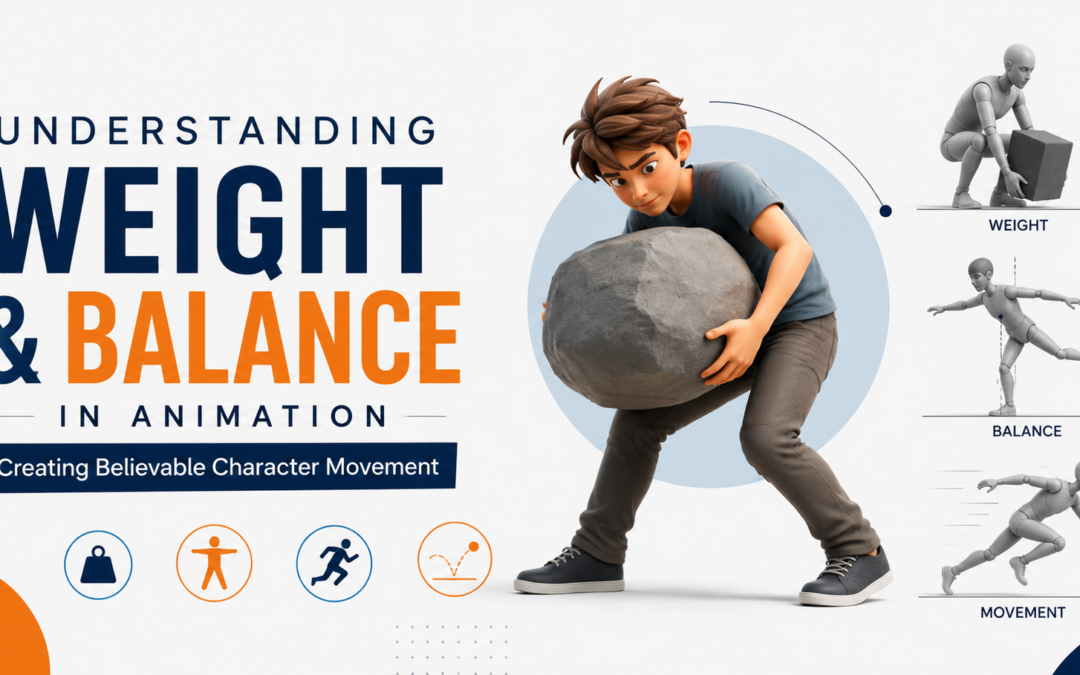
Understanding Weight and Balance in Animation: Creating Believable Character Movement
Introduction
Have you ever watched an animated character jump, run, lift a heavy object, or simply walk across a scene and thought, “That looks real”?
One of the biggest reasons animation feels believable is because of Weight and Balance in Animation.
Whether it’s a superhero landing after a massive jump, a cartoon character carrying a heavy box, or a game character running across uneven terrain, audiences instantly recognize when movement feels natural and when it doesn’t.
Creating convincing movement is about much more than moving a character from one position to another. Professional animators must understand how gravity, momentum, body mechanics, and balance affect movement in the real world and then apply those principles to animation.
This is why Weight and Balance in Animation are considered fundamental skills for animators working in films, games, television, advertising, and digital media.
In this blog, we’ll explore what weight and balance mean in animation, why they are important, and how animators use them to create believable character performances.
What Is Weight and Balance in Animation?
Weight and Balance in Animation refers to the ability to make characters appear as though they are affected by physical forces such as gravity, mass, momentum, and equilibrium.
Even though animated characters are digital creations, audiences expect them to behave according to familiar physical rules.
For example:
- A heavy object should move differently from a light object.
- A large character should feel heavier than a small character.
- A character carrying extra weight should adjust their posture.
- A jump should reflect gravity and momentum.
When these principles are applied correctly, animation feels believable and immersive.
Why Weight Is Important in Animation
Weight helps audiences understand the physical properties of a character or object.
Imagine two balls:
- A bowling ball
- A ping-pong ball
If both bounce exactly the same way, the animation would feel unrealistic.
The bowling ball should:
- Fall faster visually
- Bounce less
- Create stronger impact
The ping-pong ball should:
- Bounce more
- React quickly
- Feel lighter
This difference is achieved through Weight and Balance in Animation.
Animators communicate weight through timing, spacing, motion, and character reactions.
Understanding Balance in Character Animation
Balance refers to a character’s ability to maintain stability while moving or standing.
In real life, people constantly adjust their posture to stay balanced.
Examples include:
- Leaning forward while running
- Shifting weight while carrying a bag
- Extending arms for stability
- Adjusting posture while walking on uneven surfaces
Animators must observe and recreate these subtle movements.
Without proper balance, characters can appear to float, slide, or move unnaturally.
The Role of Gravity in Animation
Gravity influences every movement we make.
Understanding gravity is essential for mastering Weight and Balance in Animation.
Characters are constantly affected by:
- Falling
- Jumping
- Landing
- Running
- Lifting Objects
When gravity is ignored, animation immediately feels unrealistic.
For example, a character landing from a jump should absorb impact through their legs and body rather than stopping instantly.
Body Mechanics and Character Movement
Body mechanics refers to how different parts of the body work together during movement.
Professional animators study:
- Walking
- Running
- Jumping
- Lifting
- Throwing
- Climbing
These actions depend heavily on Weight and Balance in Animation.
A character lifting a heavy object should:
- Bend their knees
- Shift their center of gravity
- Engage their entire body
Small details like these create believable movement.
Understanding the Center of Gravity
Every object and character has a center of gravity.
The center of gravity is the point where weight is balanced.
In animation:
- Standing characters keep their center of gravity above their feet.
- Running characters shift it forward.
- Leaning characters compensate with posture adjustments.
Professional animators constantly monitor the center of gravity to ensure characters remain believable.
How Timing Helps Communicate Weight
Timing plays a major role in Weight and Balance in Animation.
Heavy objects typically:
- Accelerate slowly
- Move with more force
- Require more effort to stop
Light objects typically:
- Accelerate quickly
- Change direction easily
- React more rapidly
The difference in timing helps audiences perceive weight naturally.
The Importance of Spacing
Spacing refers to the distance between positions in an animation.
Proper spacing helps communicate:
- Speed
- Force
- Weight
- Momentum
For example:
A heavy object may show tighter spacing during acceleration and slower movement overall.
A light object may display wider spacing and faster reactions.
Combining timing and spacing effectively strengthens Weight and Balance in Animation.
Using Reference Videos
Professional animators rarely rely solely on imagination.
They study real-world references to understand movement accurately.
Reference videos help animators analyze:
- Human movement
- Animal movement
- Athletic actions
- Physical reactions
- Weight distribution
Observing real-world motion improves animation quality significantly.
Common Mistakes Beginners Make
Many new animators struggle with weight and balance because they focus only on movement.
Common mistakes include:
Floating Characters
Characters appear weightless.
Unrealistic Landings
Characters stop abruptly without absorbing impact.
Incorrect Posture
Body positions fail to support movement.
Lack of Follow-Through
Movement feels rigid and mechanical.
Ignoring Gravity
Actions feel disconnected from physical reality.
Understanding Weight and Balance in Animation helps avoid these issues.
How Weight and Balance Improve Character Performance
Great animation is not just about movement—it is about performance.
Characters communicate emotions through their physical actions.
For example:
- A tired character may move slowly and lean heavily.
- A confident character may stand upright and balanced.
- A frightened character may shift weight nervously.
These details make characters feel alive and relatable.
Applications in Films, Games, and VFX
Weight and balance are essential across creative industries.
Animation Films
Believable character performances improve storytelling.
Video Games
Realistic movement enhances player immersion.
VFX
Digital characters must match live-action environments.
Advertising
Convincing animation increases audience engagement.
This makes Weight and Balance in Animation valuable across multiple career paths.
Skills Students Should Develop
To master this concept, students should focus on:
- Observation Skills
- Anatomy Basics
- Body Mechanics
- Timing and Spacing
- Character Acting
- Motion Analysis
- Reference Study
These skills form the foundation of professional animation.
Career Opportunities for Skilled Animators
Animators with strong knowledge of Weight and Balance in Animation can pursue careers such as:
- 3D Animator
- Character Animator
- Game Animator
- Motion Graphics Artist
- VFX Animator
- Animation Director
These roles require a strong understanding of realistic movement and character performance.
The Future of Character Animation
As animation technology evolves, audiences continue to expect higher levels of realism and immersion.
Advanced tools may improve workflows, but the fundamental principles of animation remain unchanged.
Understanding Weight and Balance in Animation will continue to be essential for creating believable characters across films, games, virtual production, and interactive experiences.
Final Thoughts
One of the defining characteristics of great animation is believable movement.
When characters move with proper weight, balance, and body mechanics, audiences connect with them more naturally and emotionally.
This is why Weight and Balance in Animation remain among the most important principles every animator must learn.
Whether you aspire to work in films, gaming, VFX, or digital media, mastering these concepts will help you create characters that feel realistic, expressive, and truly alive.
Recent Comments