
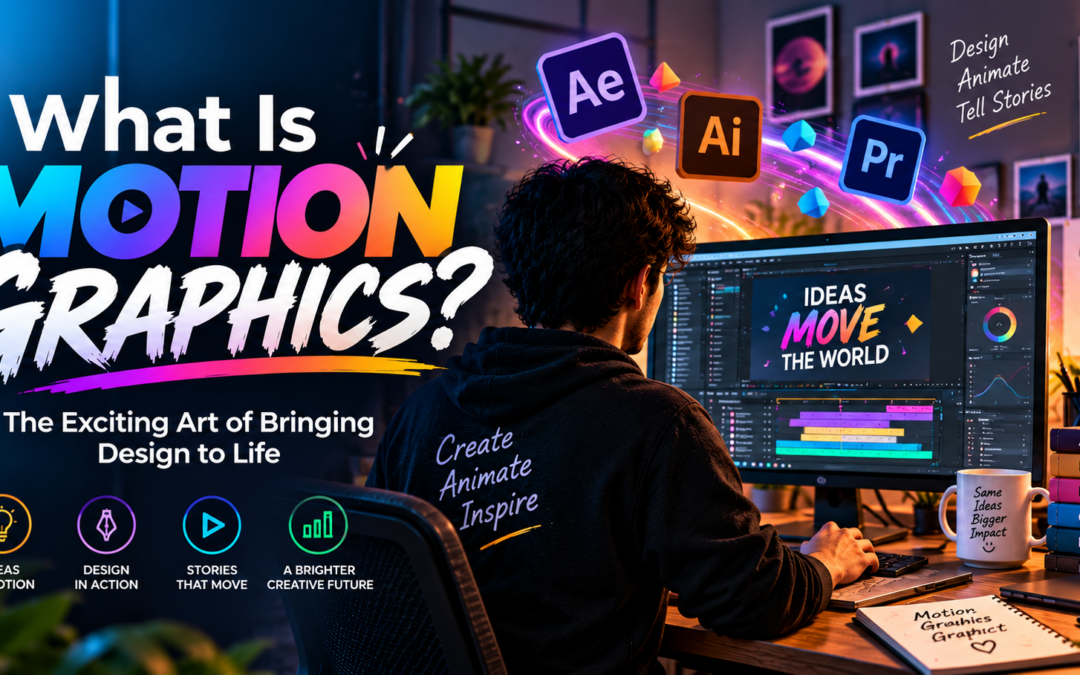
What Is Motion Graphics? A Complete Beginner’s Guide to Motion Design
Introduction
In today’s digital world, visual content is everywhere. From social media advertisements and YouTube videos to movie title sequences and brand promotions, animated visuals play a major role in capturing audience attention. One of the most popular forms of visual communication used across industries is Motion Graphics.
As businesses and content creators compete for attention online, Motion Graphics has become an essential creative skill. It combines graphic design, animation, typography, and storytelling to create engaging content that informs, entertains, and inspires viewers.
Many students interested in animation, graphic design, video editing, and digital media often ask, “What Is Motion Graphics?” Understanding What Is Motion Graphics is important because it serves as a foundation for many creative careers in today’s digital landscape.
In this blog, we’ll explore what motion graphics are, how they work, where they are used, the tools professionals use, and the exciting career opportunities available in this growing field.
What Is Motion Graphics?
Motion Graphics is the process of adding movement to graphic design elements such as text, shapes, icons, illustrations, logos, and visual assets to create animated content.
In simple terms, Motion Graphics brings static designs to life through animation.
When designers animate:
- Text
- Logos
- Shapes
- Icons
- Infographics
- Illustrations
they create visually engaging content that communicates information more effectively.
This is the simplest answer to the question: What Is Motion Graphics?
Unlike traditional animation, which often focuses on characters and storytelling, Motion Graphics focuses on visual communication through animated design elements.
Why Is Motion Graphics Important?
Understanding What Is Motion Graphics also means understanding why it has become such an important part of modern communication.
Today’s audiences consume vast amounts of content every day. Motion Graphics helps businesses and creators stand out by making content more engaging and memorable.
Motion Graphics helps:
- Capture Attention Quickly
- Improve Brand Recognition
- Simplify Complex Concepts
- Increase Viewer Engagement
- Enhance Visual Storytelling
- Improve Information Retention
Because moving visuals attract more attention than static graphics, Motion Graphics has become a powerful tool for communication.
How Motion Graphics Works
Motion Graphics combines design principles with animation techniques.
The process usually involves:
Concept Development
Designers first identify the objective of the project and determine the message that needs to be communicated.
Design Creation
Visual assets such as illustrations, icons, typography, and graphics are created.
Animation
These elements are animated using motion principles such as:
- Timing
- Spacing
- Movement
- Scale
- Rotation
- Opacity
Sound Integration
Music, sound effects, and voiceovers are often added to enhance the viewer experience.
Final Export
The completed animation is exported and prepared for its intended platform.
This workflow helps transform static visuals into dynamic content.
Key Elements of Motion Graphics
To fully understand What Is Motion Graphics, it is important to know the main components used in motion design.
Typography
Animated text is one of the most common elements in Motion Graphics.
Typography helps:
- Highlight Key Messages
- Improve Communication
- Guide Viewer Attention
Kinetic typography, where text moves creatively on screen, is widely used in advertisements and explainer videos.
Shapes
Shapes are frequently animated to create movement and visual interest.
Common examples include:
- Circles
- Squares
- Lines
- Geometric Patterns
Shape animation is often used in modern digital marketing content.
Icons
Icons help simplify information and make content easier to understand.
Motion Graphics Designers animate icons to improve engagement and communication.
Illustrations
Custom illustrations can be animated to create visually appealing content.
Illustrated Motion Graphics are often used in:
- Explainer Videos
- Educational Content
- Marketing Campaigns
Visual Effects
Effects such as motion blur, glow, transitions, and particle effects help enhance animations and improve production quality.
Types of Motion Graphics
Motion Graphics is used in many different formats.
Explainer Videos
Explainer videos use animated graphics to simplify complex topics and educate audiences.
Social Media Content
Brands and creators use Motion Graphics to create:
- Instagram Reels
- YouTube Shorts
- Facebook Ads
- LinkedIn Videos
These animations help increase audience engagement.
Logo Animation
Animated logos help strengthen brand identity and create a more professional appearance.
Title Sequences
Movies, television shows, and streaming content often use Motion Graphics for opening title sequences.
Infographic Animation
Motion Graphics can transform data into engaging visual stories through animated charts and graphics.
Product Promotions
Businesses use Motion Graphics to showcase products, explain features, and drive customer interest.
Motion Graphics vs Animation
Many beginners confuse Motion Graphics with traditional animation.
While both involve movement, they serve different purposes.
Motion Graphics
- Focuses on design elements
- Often used for communication and marketing
- Uses text, icons, shapes, and graphics
Traditional Animation
- Focuses on characters and storytelling
- Includes acting, emotions, and narratives
- Commonly used in films and animated series
Understanding this distinction helps answer the question: What Is Motion Graphics and how is it different from animation?
Where Is Motion Graphics Used?
Motion Graphics is used across numerous industries.
Advertising
Brands use Motion Graphics to create engaging advertisements and promotional campaigns.
Digital Marketing
Motion Graphics improves social media content and online marketing performance.
Corporate Communications
Companies use animated presentations and training videos to communicate information effectively.
Education
Educational institutions use Motion Graphics to create interactive learning content.
Entertainment
Motion Graphics appears in:
- Film Titles
- Television Graphics
- Streaming Content
- Promotional Material
Technology
Technology companies use Motion Graphics to explain products, software features, and services.
Software Used in Motion Graphics
Professional Motion Graphics Designers rely on industry-standard software.
Popular tools include:
- Adobe After Effects
- Adobe Illustrator
- Adobe Premiere Pro
- Cinema 4D
- Blender
- Adobe Photoshop
These tools help designers create professional-quality animations and visual content.
Learning these applications is often the first step toward a career in Motion Graphics.
Skills Required for Motion Graphics
Success in Motion Graphics requires a combination of creative and technical skills.
Important skills include:
Graphic Design
Understanding layouts, typography, color theory, and visual hierarchy.
Animation Principles
Learning timing, spacing, easing, and movement.
Storytelling
Communicating messages effectively through visuals.
Creativity
Developing original concepts and ideas.
Software Proficiency
Mastering industry-standard design and animation tools.
Communication
Collaborating effectively with clients and creative teams.
These skills help professionals create impactful and engaging visual content.
Career Opportunities in Motion Graphics
The demand for Motion Graphics professionals continues to grow.
Popular career paths include:
- Motion Graphics Designer
- Motion Designer
- Video Editor
- Visual Designer
- Broadcast Designer
- Content Creator
- Digital Media Specialist
- Advertising Designer
These roles are available across industries such as advertising, entertainment, education, technology, and marketing.
Why Students Should Learn Motion Graphics
Many students choose Motion Graphics because it combines:
- Creativity
- Design
- Animation
- Technology
- Storytelling
It is one of the most versatile skills in the creative industry.
Professionals can work on:
- Social Media Campaigns
- Brand Promotions
- Films
- OTT Content
- Marketing Videos
- Educational Media
This versatility makes Motion Graphics an attractive career choice.
Future of Motion Graphics
The future of Motion Graphics looks extremely promising.
Emerging trends include:
- AI-Assisted Motion Design
- 3D Motion Graphics
- Virtual Reality Experiences
- Augmented Reality Content
- Interactive Media
- Real-Time Animation
- Virtual Production
As video content continues to dominate digital communication, the demand for Motion Graphics professionals is expected to increase significantly.
Final Thoughts
If you’ve ever wondered What Is Motion Graphics, the answer is simple: it is the art of bringing graphic design elements to life through movement. Motion Graphics combines creativity, animation, typography, and visual storytelling to create engaging content that captures attention and communicates messages effectively.
Today, Motion Graphics is used in advertising, social media, education, entertainment, and digital marketing. As businesses increasingly rely on video content, the need for skilled Motion Graphics professionals continues to grow.
For students interested in animation, graphic design, video editing, and digital media, learning Motion Graphics can open the door to exciting career opportunities and a successful future in the creative industry. By mastering design principles, animation techniques, and industry-standard software, aspiring designers can build rewarding careers creating the engaging visual content that powers today’s digital world.
Recent Comments