
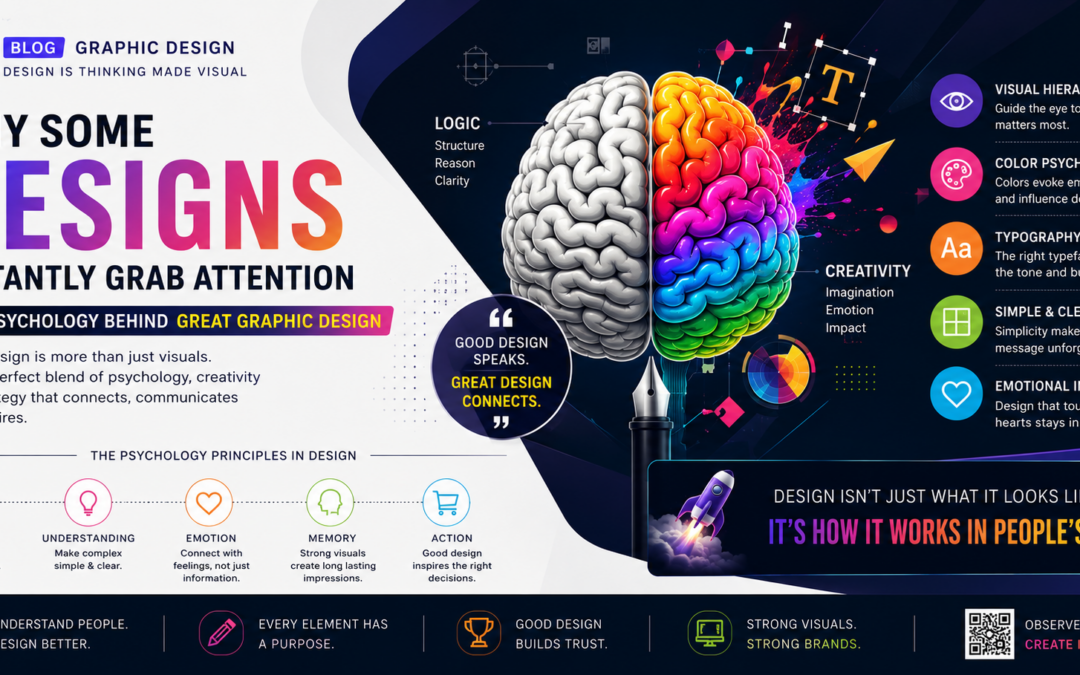
Why Some Designs Instantly Grab Attention: The Psychology Behind Great Graphic Design
Introduction
Every day, people scroll through thousands of images, advertisements, social media posts, websites, posters, and videos. Yet only a few designs manage to instantly grab attention and stay memorable. Some visuals make people stop scrolling, explore a product, or emotionally connect with a brand within seconds. This is not luck—it is the result of understanding the Psychology Behind Graphic Design.
Great graphic design is much more than making things look attractive. It is about communication, emotion, behavior, and human perception. Designers carefully use colors, typography, spacing, shapes, and visual hierarchy to influence how people think and react.
Today, brands compete heavily for audience attention. Whether it is a movie poster, Instagram ad, YouTube thumbnail, website banner, or product packaging, strong visuals play a major role in attracting viewers and building trust.
In this blog, we will explore why some designs instantly grab attention and understand the psychology behind great graphic design.
What Is the Psychology Behind Graphic Design?
The Psychology Behind Graphic Design refers to understanding how people respond emotionally and visually to design elements.
Graphic designers study:
- human attention
- emotions
- color reactions
- visual perception
- reading patterns
This helps them create visuals that feel engaging and memorable.
Good design is not random. Every element is planned to guide audience behavior and improve communication.
Why First Impressions Matter
People form opinions about visuals within seconds.
A design that looks professional immediately creates trust, while a cluttered or poorly designed visual can push people away.
This is why first impressions are extremely important in the Psychology Behind Graphic Design.
Strong first impressions are created through:
- balanced layouts
- clear typography
- attractive colors
- visual simplicity
Professional designers know that audiences decide very quickly whether something feels worth their attention.
Color Psychology in Graphic Design
Colors strongly influence emotions and decision-making.
Different colors create different psychological reactions:
- blue creates trust and calmness
- red creates urgency and excitement
- black feels luxurious and premium
- yellow feels energetic and cheerful
- green feels natural and positive
Brands carefully choose colors depending on their message and audience.
Color strategy is one of the most powerful parts of the Psychology Behind Graphic Design because emotions are often connected to color perception.
Typography Influences Attention
Typography is not just about choosing fonts.
The style, spacing, size, and weight of text affect how people experience information.
For example:
- bold fonts create strong impact
- elegant fonts feel premium
- clean fonts improve readability
Good typography helps viewers quickly understand the message.
Typography plays a huge role in the Psychology Behind Graphic Design because text presentation influences user engagement and emotional response.
Visual Hierarchy Guides the Eye
People do not look at every part of a design equally.
Designers use visual hierarchy to guide viewers toward the most important elements first.
This is achieved through:
- size contrast
- spacing
- positioning
- brightness
- color emphasis
For example, headlines are usually larger than body text because they need immediate attention.
Visual hierarchy is one of the core principles in the Psychology Behind Graphic Design.
Simplicity Makes Designs More Effective
Many beginners believe adding more elements makes a design better.
In reality, clutter often confuses viewers.
Modern professional design focuses on simplicity because audiences prefer visuals that are easy to understand quickly.
Simple designs improve:
- readability
- focus
- user experience
- emotional clarity
Minimalism is widely used in the Psychology Behind Graphic Design because simplicity reduces mental effort.
Why Balance and Spacing Matter
Good design feels visually comfortable.
Spacing helps separate information and prevents designs from feeling crowded.
Professional designers carefully use:
- margins
- alignment
- whitespace
- composition balance
Whitespace does not mean “empty space.” It improves readability and creates elegance.
Balance is essential in the Psychology Behind Graphic Design because viewers naturally prefer organized visuals.
Emotional Design Creates Stronger Connections
People emotionally connect with visuals more than they realize.
Designs that trigger emotion become more memorable.
For example:
- cinematic posters create excitement
- luxury branding creates aspiration
- playful visuals create happiness
Emotional storytelling is a major part of the Psychology Behind Graphic Design because emotions strongly influence memory and behavior.
Branding and Recognition
Graphic design helps brands become recognizable.
Consistent visuals create familiarity through:
- logos
- typography
- colors
- design style
Strong branding makes companies easier to remember.
This is why the Psychology Behind Graphic Design is important in marketing and advertising industries.
Why Some Social Media Posts Go Viral
Many viral visuals follow strong design psychology principles.
Successful posts often include:
- bold headlines
- high contrast
- emotional visuals
- clean layouts
- clear focus points
Designs that quickly communicate value are more likely to capture attention online.
Social media heavily relies on the Psychology Behind Graphic Design because audiences scroll very quickly.
Motion and Dynamic Design
Modern graphic design increasingly includes motion graphics and animated visuals.
Movement naturally attracts human attention.
This is why designers use:
- animated text
- transitions
- motion graphics
- kinetic typography
Motion-based visuals improve engagement and storytelling.
Dynamic visuals are becoming an important part of the Psychology Behind Graphic Design in digital media.
Common Graphic Design Mistakes
Many beginner designers struggle because of:
- poor typography
- excessive colors
- cluttered layouts
- weak hierarchy
- inconsistent styles
These mistakes reduce clarity and visual appeal.
Avoiding these issues is essential for improving understanding of the Psychology Behind Graphic Design.
Tools Used by Graphic Designers
Professional designers use tools like:
- Adobe Photoshop
- Adobe Illustrator
- Figma
- Canva
These tools help create professional visual content.
However, tools alone do not create strong design. Understanding psychology and communication is equally important.
Why Graphic Design Matters in Modern Businesses
Graphic design influences how people perceive brands and products.
Good visuals help businesses:
- attract customers
- build trust
- improve marketing
- increase engagement
Today, almost every industry depends on visual communication.
This is why the Psychology Behind Graphic Design has become more important than ever.
Graphic Design in Entertainment and Media
Graphic design is everywhere in entertainment industries.
It is used in:
- movie posters
- gaming visuals
- YouTube thumbnails
- OTT promotions
- broadcast graphics
Strong visuals improve audience excitement and emotional connection.
This makes the Psychology Behind Graphic Design highly valuable in modern media industries.
Future of Graphic Design
The future of graphic design includes:
- AI-assisted design
- immersive visuals
- motion-based interfaces
- interactive experiences
- personalized content
As digital media grows, visual competition will continue increasing.
Understanding the Psychology Behind Graphic Design will remain essential for creating impactful experiences.
Skills Needed to Become a Better Graphic Designer
To improve as a designer, students should focus on:
- observation skills
- composition
- typography
- storytelling
- color theory
- creativity
Software knowledge is important, but understanding people is even more valuable.
The best designers combine technical skills with psychology and communication.
Final Thoughts
Some designs instantly grab attention because they are carefully built around human psychology and visual behavior.
From colors and typography to spacing and emotional storytelling, every design element influences how people react.
The power of the Psychology Behind Graphic Design lies in its ability to communicate messages quickly while creating emotional connections.
For students and aspiring designers, learning graphic design is not just about creating visuals—it is about understanding how people see, feel, and respond to creative communication.
Recent Comments