
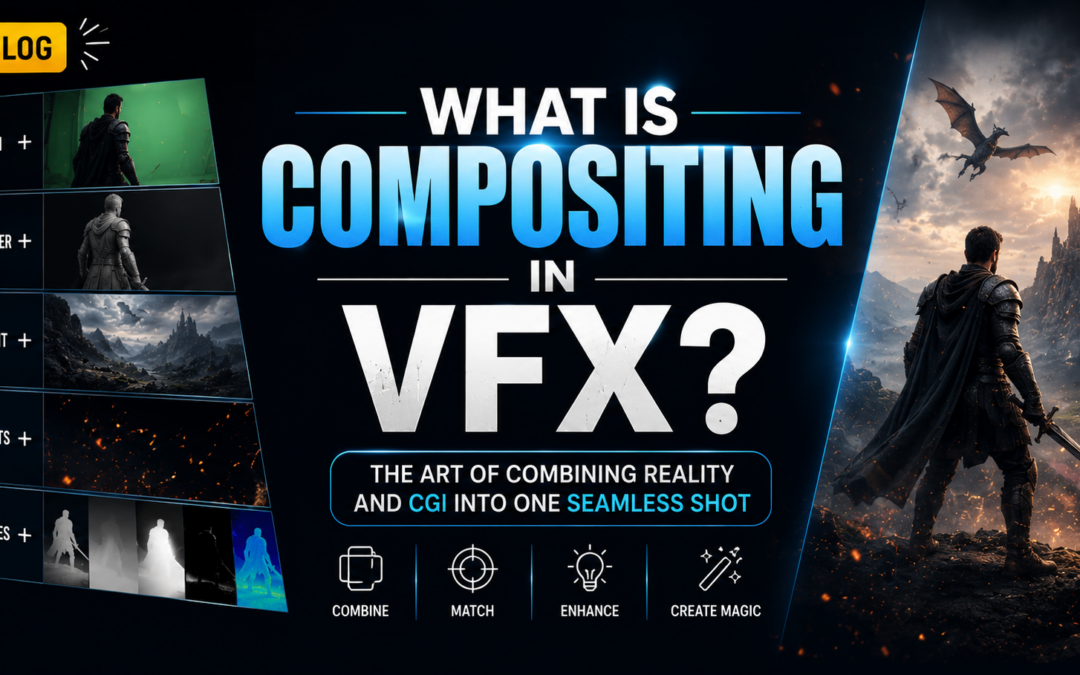
What Is Compositing in VFX? The Art of Combining Reality and CGI into One Seamless Shot
Introduction
When watching a blockbuster movie, fantasy series, superhero film, or high-end commercial, audiences often see incredible visuals without realizing how many elements were combined to create a single shot. A giant creature walking through a city, a spaceship flying through space, or a superhero standing in a completely digital environment may look effortless on screen, but behind the scenes, dozens of visual elements have been carefully merged together.
This process is called Compositing in VFX.
Compositing is one of the most important stages of the visual effects pipeline. It is where live-action footage, CGI elements, simulations, matte paintings, render passes, and visual effects are combined into a single final image.
Even the most realistic CGI can look fake if compositing is done poorly. On the other hand, excellent compositing can make digital elements appear completely natural and believable.
In this blog, we’ll explore what compositing is, how it works, why it’s essential in modern filmmaking, and how professional artists use it to create seamless visual effects.
What Is Compositing?
Compositing in VFX is the process of combining multiple visual elements into one final shot.
These elements may include:
- live-action footage
- CGI characters
- digital environments
- explosions
- smoke effects
- lighting adjustments
- render passes
The goal is to make all elements appear as though they were captured together naturally.
A compositor acts like the final visual artist who brings every piece of the puzzle together.
Why Is Compositing Important?
Visual effects production involves multiple departments.
Artists may create:
- 3D models
- animations
- simulations
- lighting setups
- rendered images
However, these elements remain separate until compositing.
Compositing helps:
- blend CGI with reality
- improve realism
- adjust lighting
- match colors
- add atmosphere
- create final visual polish
Without Compositing in VFX, modern visual effects would not look believable.
How Compositing Works
The compositing process begins after rendering.
Artists receive:
- rendered CGI
- live-action footage
- effects simulations
- background plates
- render passes
These elements are imported into compositing software and combined carefully.
The compositor ensures everything matches perfectly in terms of:
- lighting
- perspective
- color
- shadows
- depth
- atmosphere
The final result appears as a single seamless image.
Combining Live-Action and CGI
One of the primary purposes of compositing is combining real footage with digital assets.
Examples include:
- digital creatures
- futuristic cities
- fantasy environments
- vehicles
- visual effects
A CGI object may look realistic on its own, but it must match the real footage perfectly.
Compositors help achieve this integration.
This is one of the core functions of Compositing in VFX.
Green Screen Compositing
Green screen technology is widely used in filmmaking.
Actors perform in front of a green background, which is later removed during compositing.
The green background is replaced with:
- digital environments
- cityscapes
- outer space
- fantasy worlds
- virtual sets
This process is known as chroma keying.
Many scenes that appear impossible to film are created using green screen compositing.
What Is Chroma Keying?
Chroma keying is the technique used to remove a specific color from footage.
Most productions use:
- green screens
- blue screens
After removing the background, compositors insert new environments behind the subjects.
This technique is used extensively in movies, television, advertising, and digital content creation.
Render Pass Compositing
Modern VFX production rarely renders everything as a single image.
Instead, artists generate multiple render passes such as:
- beauty pass
- shadow pass
- reflection pass
- diffuse pass
- Z-depth pass
- ambient occlusion pass
These passes provide greater control during compositing.
Compositors can modify individual elements without re-rendering the entire scene.
Render passes are an important part of Compositing in VFX.
Color Correction and Color Matching
A common challenge in compositing is ensuring all elements share the same visual appearance.
CGI must match the color characteristics of live-action footage.
Artists perform:
- color correction
- brightness adjustments
- contrast balancing
- color matching
Proper color correction helps make digital elements appear natural.
Rotoscoping
Sometimes green screens cannot be used.
In such cases, artists isolate subjects manually using a process called rotoscoping.
Rotoscoping involves creating masks around:
- actors
- objects
- moving elements
These masks allow compositors to separate subjects from backgrounds.
Rotoscoping is one of the most time-consuming tasks in Compositing in VFX.
Matchmoving and Camera Tracking
CGI elements must follow the movement of the real camera.
To achieve this, artists use camera tracking and matchmoving.
This process recreates:
- camera position
- movement
- perspective
Once tracking is complete, CGI can be integrated accurately into live-action footage.
Without proper tracking, digital objects appear disconnected from the scene.
Adding Atmospheric Effects
Compositors often enhance scenes with atmospheric elements.
Examples include:
- fog
- dust
- rain
- smoke
- light rays
- haze
These effects help unify all visual components.
Atmospheric details play a major role in achieving realism.
Creating Depth and Focus
Compositing also helps create cinematic depth.
Artists may add:
- depth of field
- lens blur
- focus effects
- atmospheric perspective
These techniques help guide viewer attention.
They also improve the overall cinematic quality of the image.
Compositing in Movies
Nearly every modern blockbuster relies on Compositing in VFX.
Examples include:
- superhero films
- fantasy adventures
- science fiction movies
- historical recreations
- disaster films
Many scenes audiences assume are real actually contain multiple digital elements combined through compositing.
Compositing in Advertising
Commercial productions frequently use compositing.
Applications include:
- product visualization
- cosmetic advertisements
- automotive commercials
- technology campaigns
Compositing allows brands to create visuals that would be difficult or expensive to film practically.
Compositing in Animation
Even fully animated productions use compositing.
Artists combine:
- character renders
- environment layers
- effects passes
- lighting adjustments
This stage adds final polish before delivery.
Software Used for Compositing
Professional compositors rely on specialized software.
Popular tools include:
- Nuke
- Adobe After Effects
- Blackmagic Fusion
- Autodesk Flame
Each software offers unique features depending on project requirements.
Common Beginner Mistakes
Many beginners encounter problems because they:
- ignore color matching
- use poor keying techniques
- forget shadow integration
- overlook depth cues
- create unrealistic lighting
Successful compositing requires attention to detail.
Small mistakes can make CGI appear artificial.
Skills Needed to Become a Compositor
A professional compositor should understand:
- color theory
- lighting
- photography
- camera movement
- visual storytelling
- image manipulation
Technical knowledge and artistic judgment are equally important.
Career Opportunities in Compositing
Learning Compositing in VFX can lead to careers such as:
- Compositor
- VFX Artist
- Roto Artist
- Matchmove Artist
- Compositing Supervisor
- Post-Production Artist
As visual effects continue growing, demand for skilled compositors remains strong.
Future of Compositing
Modern compositing continues evolving through:
- AI-assisted workflows
- real-time rendering
- virtual production
- machine learning tools
- cloud-based pipelines
Despite technological advances, compositing remains a critical artistic discipline.
Because every visual element still needs to be integrated convincingly.
Final Thoughts
Compositing is often called the final stage of visual effects production, but its importance goes far beyond simply combining images.
It is the process that transforms separate pieces into a believable final shot.
Whether integrating CGI creatures into live-action footage, replacing green screens with digital worlds, or enhancing scenes with atmospheric effects, Compositing in VFX plays a vital role in modern filmmaking.
For aspiring VFX artists, understanding compositing is essential because it sits at the intersection of creativity, technology, and storytelling.
Behind every seamless visual effect is a skilled compositor ensuring that reality and CGI blend together perfectly.
Recent Comments