
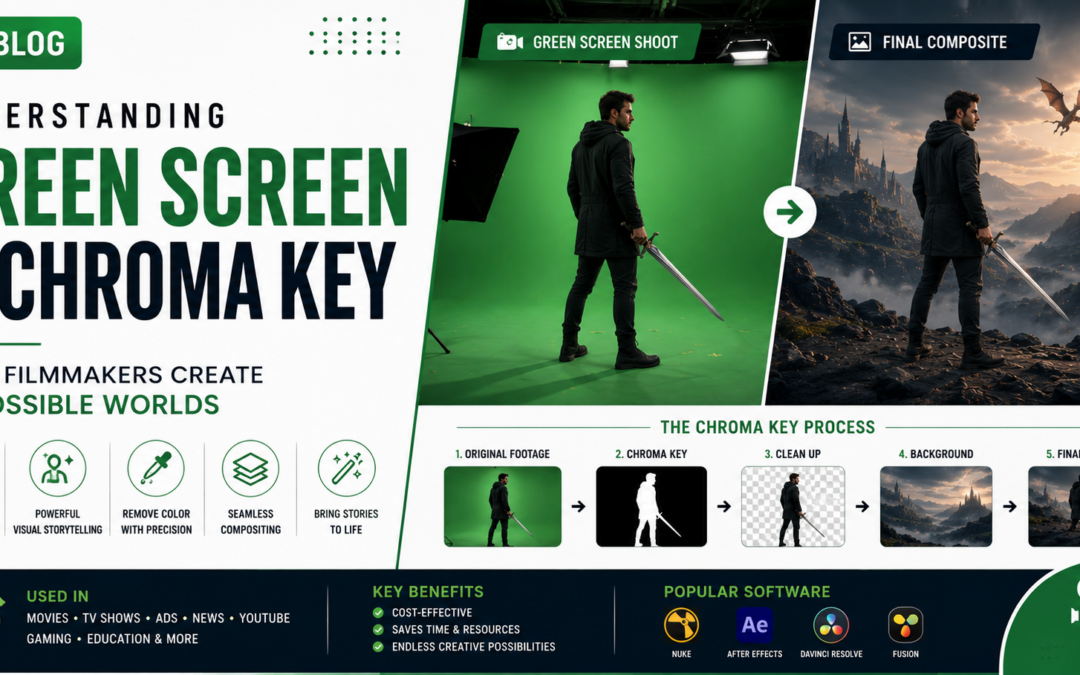
Understanding Green Screen and Chroma Key: How Filmmakers Create Impossible Worlds
Introduction
Have you ever wondered how actors appear to fly through space, stand in futuristic cities, battle giant creatures, or perform in magical fantasy worlds that don’t exist in real life? The answer often lies in one of the most powerful techniques used in visual effects and filmmaking: Green Screen and Chroma Key.
From Hollywood blockbusters and OTT series to television broadcasts, YouTube videos, advertisements, and weather reports, green screen technology has become an essential part of modern content creation.
While audiences only see the final result, filmmakers use green screens to replace backgrounds, create impossible environments, and seamlessly combine real footage with computer-generated imagery (CGI).
In this blog, we’ll explore what green screens are, how chroma keying works, why green is used, and how this technology helps filmmakers bring their creative visions to life.
What Is a Green Screen?
A green screen is a large green-colored background used during filming.
Actors, presenters, or objects are recorded in front of this green backdrop.
During post-production, the green color is removed digitally and replaced with another image or video.
This allows filmmakers to place subjects in environments that may be:
- impossible to build
- too expensive to create
- dangerous to film
- completely fictional
Green screen technology is one of the most common applications of Green Screen and Chroma Key techniques.
What Is Chroma Key?
Chroma key is the process of removing a specific color from an image or video.
In most cases, that color is green.
The software identifies the selected color and makes it transparent.
Artists can then replace it with:
- digital environments
- videos
- animations
- visual effects
- CGI worlds
Simply put:
- Green Screen = The filming background
- Chroma Key = The technique used to remove it
Together, they form the foundation of many modern visual effects workflows.
Why Is Green Used?
Many people wonder why filmmakers use green instead of other colors.
There are several reasons.
Better Camera Sensitivity
Digital cameras capture green information very efficiently.
This produces cleaner results during keying.
Rare in Human Skin Tones
Human skin contains very little green.
This makes it easier to separate actors from the background.
Cleaner Keying
Green provides strong contrast against most clothing and skin colors.
This helps software identify and remove the background more accurately.
These advantages make green the preferred choice for Green Screen and Chroma Key production.
How Does Green Screen Technology Work?
The process typically involves several steps.
Step 1: Filming
Actors perform in front of a green screen.
Step 2: Chroma Keying
The green color is removed using specialized software.
Step 3: Background Replacement
A new environment is added behind the subject.
Step 4: Compositing
The final shot is blended and refined.
Step 5: Final Output
The audience sees a realistic scene without noticing the green screen.
This workflow is used across the film, television, and VFX industries.
Blue Screen vs Green Screen
Although green screens are common, blue screens are also used.
Green Screen
Advantages:
- Brighter color
- Easier digital separation
- Requires less lighting
Best used for:
- television
- movies
- online content
- VFX production
Blue Screen
Advantages:
- Better for reflective objects
- Less color spill in some situations
Best used for:
- scenes with green costumes
- specific visual effects requirements
Both techniques rely on chroma keying.
The choice depends on production needs.
Applications of Green Screen Technology
Green screen technology is used in countless industries.
Movies
Filmmakers create:
- fantasy worlds
- alien planets
- futuristic cities
- large-scale battles
Television
TV productions use green screens for:
- virtual sets
- news broadcasts
- entertainment programs
Weather Forecasting
Weather presenters stand in front of green screens while digital maps are added later.
Advertising
Brands create visually engaging campaigns using virtual environments.
YouTube and Content Creation
Creators use green screens to:
- replace backgrounds
- create educational content
- improve production quality
This wide range of applications highlights the importance of Green Screen and Chroma Key.
Green Screen in Hollywood Movies
Many blockbuster films rely heavily on green screen technology.
Scenes involving:
- outer space
- magical kingdoms
- giant creatures
- impossible landscapes
often combine live-action performances with digital environments.
Actors may perform in front of a simple green backdrop while the final scene becomes an elaborate cinematic world.
How CGI and Green Screen Work Together
Green screens are often used alongside CGI.
The process typically includes:
- filming actors
- removing the green background
- adding CGI elements
- compositing everything together
This integration allows filmmakers to create scenes that would otherwise be impossible to capture.
Common Challenges in Green Screen Production
Although green screen technology is powerful, it requires careful execution.
Green Spill
Green light reflects onto actors or objects.
This can create unwanted color contamination.
Uneven Lighting
Poor lighting makes keying difficult.
Motion Blur
Fast movement can create edge problems.
Hair Details
Fine hair strands are challenging to separate accurately.
Shadows
Improper shadows can reduce realism.
These challenges require skilled artists and proper production planning.
Importance of Proper Lighting
Lighting is one of the most important factors in successful keying.
A professional green screen setup requires:
- even background lighting
- proper subject lighting
- minimal shadows
- consistent exposure
Good lighting significantly improves the quality of the final composite.
Green Screen in the VFX Pipeline
Green screen work is part of a larger visual effects workflow.
The pipeline may include:
Keying
Removing the green background.
Rotoscoping
Cleaning difficult areas manually.
Tracking
Matching camera movement.
Compositing
Combining all visual elements.
Color Correction
Ensuring visual consistency.
Every stage contributes to creating a believable final image.
Software Used for Chroma Keying
Professional artists use specialized software for keying and compositing.
Popular tools include:
- Nuke
- Adobe After Effects
- Blackmagic Fusion
- DaVinci Resolve
These applications provide advanced keying tools used in professional productions worldwide.
Green Screen vs Virtual Production
Modern filmmaking is evolving with virtual production technologies.
Instead of green screens, some productions now use large LED walls displaying digital environments in real time.
However, green screen technology remains widely used because it is:
- cost-effective
- flexible
- reliable
- accessible
Both approaches continue to coexist within the industry.
Career Opportunities
Learning Green Screen and Chroma Key techniques can lead to careers such as:
- VFX Artist
- Compositor
- Keying Artist
- Roto Artist
- Matchmove Artist
- Compositing Supervisor
These roles play a vital part in modern visual effects production.
Future of Green Screen Technology
The future of green screen workflows includes:
- AI-assisted keying
- real-time compositing
- machine learning enhancements
- virtual production integration
While technology continues evolving, chroma keying remains a fundamental skill for visual effects professionals.
Why Every VFX Student Should Learn Green Screen Techniques
Understanding green screen workflows helps students learn:
- compositing fundamentals
- color separation
- keying techniques
- visual integration
- production pipelines
It also provides insight into how many of today’s most impressive visual effects are created.
For aspiring VFX artists, mastering Green Screen and Chroma Key is an essential step toward understanding professional visual effects production.
Final Thoughts
Green screen technology may appear simple, but it has transformed the way films, television shows, advertisements, and digital content are created.
By combining Green Screen and Chroma Key techniques, filmmakers can place actors in locations that don’t exist, create impossible worlds, and bring extraordinary stories to life.
From blockbuster movies and television broadcasts to YouTube videos and advertising campaigns, this technology continues to be one of the most important tools in modern visual storytelling.
For anyone interested in VFX, filmmaking, or digital content creation, understanding green screen workflows is a valuable skill that opens the door to countless creative possibilities.
Recent Comments