LED Wall Technology in Filmmaking: The Future of Virtual Production
Imagine filming a scene set on an alien planet without travelling to another planet, or shooting a sunset scene without waiting for the perfect weather. Modern filmmaking can achieve these results using large LED screens, digital environments, and real-time rendering technology.
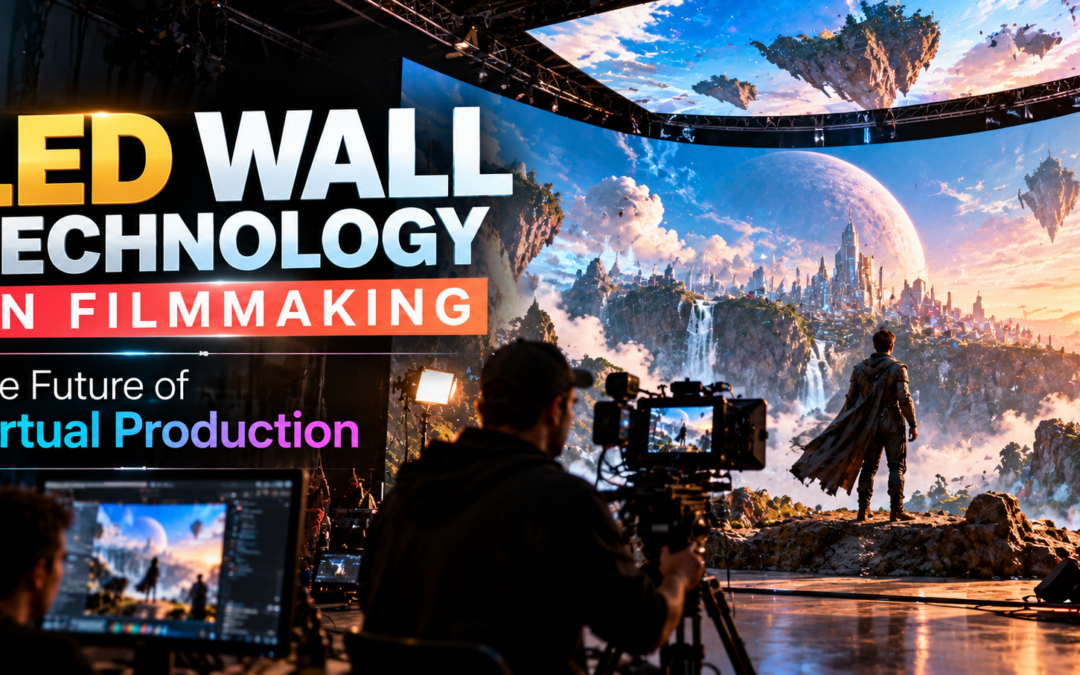
LED Wall Technology in Filmmaking is transforming how directors, cinematographers, and visual effects artists create cinematic environments. Instead of relying entirely on green screens and replacing backgrounds during post-production, filmmakers can display detailed virtual worlds on LED walls while actors perform in front of them.
This approach is a major part of virtual production, a filmmaking method that combines physical sets, digital environments, camera tracking, and real-time computer graphics. It gives production teams more opportunities to visualise scenes during filming and make creative decisions earlier in the process.
Unreal Engine
In 2026, virtual production continues to evolve through improvements in rendering, display systems, camera tracking, and collaborative production workflows. Understanding these technologies can help aspiring filmmakers, 3D artists, and VFX students prepare for new opportunities in digital content creation.
What Is LED Wall Technology in Filmmaking?
LED wall technology uses interconnected light-emitting diode panels to create a large display surface. In filmmaking, these panels show digital environments, backgrounds, landscapes, cityscapes, or other visual elements behind the actors.
Unlike an ordinary background screen, a professional virtual production setup can connect the LED display to a real-time rendering engine and a camera-tracking system. The displayed environment can then respond to the camera’s position and movement.
For example, if an actor is standing inside a virtual spaceship, the LED wall can display the spaceship’s interior or the stars outside its windows. When the camera moves, the perspective of the digital environment changes accordingly, creating a more convincing sense of depth.
This technique is closely associated with in-camera visual effects (ICVFX), where digital environments and live-action performances are combined during filming. Depending on the shot, the camera may capture the final composite directly, or the footage may still require additional VFX work afterward.
Epic Developer Community
The technology does not eliminate every traditional VFX technique. Instead, it provides another way to combine real-world filmmaking with computer-generated imagery.
How Does an LED Virtual Production Stage Work?
An LED stage brings together several technologies that must work in coordination. The display alone is not enough to create a convincing virtual environment.
LED Volume and Display Panels
An LED volume is a production space surrounded by large LED panels. Some stages use a curved wall behind the actors, while more advanced setups include surrounding walls and an LED ceiling.
The layout depends on the production’s requirements, budget, available space, and the amount of the environment that needs to appear in the camera frame.
These displays show the digital background and can also provide light and reflections on actors, props, and physical set pieces. This helps the foreground elements feel more naturally connected to their surroundings.
Real-Time Rendering with a Game Engine
The virtual environment is created using 3D assets, digital materials, lighting, and other computer graphics elements. A real-time engine such as Unreal Engine can render the scene and send its output to the LED display.
Artists can create environments such as futuristic cities, forests, deserts, mountains, interiors, and imaginary worlds.
Unlike a pre-rendered background video, a properly configured real-time environment can respond to camera movement and allow adjustments to the scene during production.
Camera Tracking and Perspective
Camera tracking is one of the most important components of virtual production. Tracking systems measure the physical camera’s position and orientation so the virtual environment can update its perspective.
This produces a parallax effect: nearby objects appear to move differently from distant objects as the camera changes position. That behaviour is an important visual cue for depth.
Without correct tracking and perspective, the environment can look like a flat image rather than a real three-dimensional space.
Synchronisation and In-Camera VFX
The camera, rendering system, and LED panels must operate in sync. Production teams also need to manage display brightness, colour accuracy, frame rates, camera shutter settings, and other technical factors.
Epic Games documents the use of camera tracking, real-time rendering, LED volumes, and coordinated display systems in its in-camera VFX workflow.
Epic Developer Community
When the systems work together, filmmakers can capture shots in which real performers and digital environments appear to occupy the same space.
How LED Walls Are Changing the Filmmaking Process
LED walls are changing more than the backgrounds visible on camera. They are influencing how film crews plan shots, design environments, coordinate departments, and make creative decisions before and during production.
Previsualisation Before Filming
Before a scene is filmed, virtual production teams can build digital environments and test camera angles, compositions, and movements. Directors and cinematographers can review how a scene might look before committing to the final shoot.
This process helps identify potential problems early and gives artists a clearer understanding of the visual requirements.
Real-Time Changes on Set
One of the major advantages of LED Wall Technology in Filmmaking is the ability to make selected changes to digital environments during production. Artists can adjust backgrounds, reposition virtual objects, modify colours, and explore different environmental conditions without rebuilding an entire physical set.
These adjustments allow directors and cinematographers to evaluate creative options more efficiently, although complex changes may still require additional preparation.
Better Collaboration Between Departments
Virtual production brings together environment artists, lighting specialists, cinematographers, VFX supervisors, and technical operators. Each department contributes to creating an environment that works both visually and technically.
For example, an environment artist may create a digital city, while the cinematographer determines the camera framing and the lighting team ensures that the actors and physical props match the displayed environment.
This collaborative workflow helps align creative decisions earlier in production.
More Immersive Storytelling
LED stages allow actors to see the digital world surrounding them. Whether the scene takes place in a futuristic city, a snowy landscape, or a spacecraft, the displayed environment can provide useful visual context during a performance.
This can help performers respond more naturally to their surroundings and help directors communicate the intended atmosphere of a scene.
A More Connected Production Pipeline
Modern virtual production connects environment creation, real-time rendering, camera tracking, lighting, and final image capture. Digital assets can be prepared before filming and refined as the production develops.
However, successful results depend on careful planning, suitable hardware, accurate tracking, and skilled artists who understand both filmmaking and computer graphics.
By connecting these stages, LED Wall Technology in Filmmaking gives production teams greater control over how digital environments are developed, reviewed, and captured on camera.
LED walls can give actors and directors a better understanding of the scene while it is being filmed. Green screens, however, remain valuable for shots that require extensive visual transformations, large-scale environments, or backgrounds that are impractical to display on an LED stage.
The best choice depends on the scene, creative goals, technical requirements, and budget. Many productions combine both techniques rather than relying exclusively on one.
Major Benefits of LED Wall Technology in Filmmaking
Greater Creative Control
One of the biggest advantages of LED Wall Technology in Filmmaking is the ability to control the environment. Filmmakers can change the background, adjust the virtual time of day, and explore different visual approaches without physically travelling to another location.
A scene that would normally require a remote location can sometimes be filmed inside a controlled studio.
More Natural Lighting and Reflections
LED displays can illuminate actors and physical objects with colours and light patterns that match the virtual environment. For example, a blue virtual ocean can contribute cool reflections, while a warm sunset background can help establish the atmosphere of the scene.
Additional lighting equipment is still important, especially for strong directional lighting and precise cinematographic control.
Better Actor Performance
When actors can see their surroundings, they have more visual context for their performances. An actor playing a pilot can look towards the displayed spacecraft exterior rather than an empty green wall.
Directors, cinematographers, and production designers can also evaluate framing and composition while filming.
Improved Production Planning
Virtual environments can be developed and reviewed before the shoot. This allows teams to plan camera positions, lighting, physical set elements, and shot composition earlier.
Some shots may require less background replacement and compositing work, although complex environments and demanding camera movements can still require substantial post-production.
Greater Control Over Continuity
Virtual environments can be saved and reused across different shots. Lighting conditions, backgrounds, and environmental details can be reproduced more consistently than some outdoor locations affected by changing weather or sunlight.
This can be particularly useful for productions that film scenes out of chronological order.
How Unreal Engine Is Transforming Virtual Production
Real-time rendering is a core component of modern LED stages. Unreal Engine is widely associated with virtual production because it allows artists to build interactive 3D environments and render them for use during filming.
With LED Wall Technology in Filmmaking, a real-time engine can display a digital world on the stage while tracking information helps maintain the correct perspective from the physical camera.
Artists can develop environments, adjust materials, modify lighting, and preview different compositions. Production teams can also use collaborative tools to review scenes and prepare assets before filming.
Epic Games provides dedicated in-camera VFX documentation and workflows covering LED volumes, camera tracking, display synchronisation, and virtual production setup.
Epic Developer Community
Other technologies may also be used in virtual production, depending on the pipeline. These include 3D modelling and texturing software, camera-tracking hardware, colour-management systems, compositing tools, and specialised LED processing equipment.
For aspiring artists, learning a real-time engine alongside traditional 3D and VFX fundamentals can be a useful way to understand how digital environments move from concept to screen.
Where Is LED Wall Technology Used?
LED-based virtual production can support several types of visual content.
Films and web series: Productions can create controlled environments for science fiction, fantasy, action, and dramatic scenes.
Television and broadcast studios: Virtual backgrounds can support news programmes, interviews, sports analysis, and other studio productions.
Automotive advertising: Digital environments can simulate roads, landscapes, and architectural settings while vehicles are filmed in a controlled space.
Music videos and commercials: Creators can change the environment to suit a particular visual style without building a complete physical location.
Virtual production for games and cinematics: Real-time 3D environments can support cinematic storytelling and the development of interactive content.
Education and corporate content: Virtual studios can create immersive presentations, demonstrations, and training environments.
The suitability of LED stages varies by project. Scenes with controlled camera movement and carefully planned backgrounds may benefit significantly, while scenes requiring unrestricted interaction with complex environments may need additional physical sets or traditional VFX.
Challenges and Limitations of LED Wall Production
Despite its advantages, LED Wall Technology in Filmmaking is not a universal replacement for green screens or conventional visual effects.
High Initial Investment
A professional LED volume requires display panels, processing systems, tracking equipment, rendering hardware, studio space, and experienced technical teams. These requirements can make large-scale stages expensive to establish and operate.
Smaller productions may find green-screen techniques or simpler virtual production setups more practical.
Moiré Patterns and Display Limitations
When a camera records an LED display, interactions between the camera sensor and the panel’s pixel structure can produce unwanted patterns known as moiré. Visible pixel structure, brightness differences, or display artefacts may also affect the captured image.
Careful selection of camera settings, viewing distances, display specifications, and framing helps manage these issues. Testing the actual camera and display combination before filming is essential.
Refresh Rate and Synchronisation
LED panels and cameras must be configured to work together. Incorrect settings can cause flicker, scan lines, or inconsistent exposure.
High-frame-rate filming and fast camera movements can introduce additional technical challenges, making testing and calibration important parts of the workflow.
Limits of Real-Time Rendering
Highly detailed environments, complex reflections, dynamic effects, and demanding camera movements require substantial computing power. The environment must be optimised to maintain the performance needed for filming.
Some visual effects may still be completed or refined during post-production rather than rendered entirely in real time.
Creative and Technical Coordination
Virtual production requires close collaboration between directors, cinematographers, environment artists, VFX supervisors, lighting teams, and technical operators.
A visually impressive digital environment is not necessarily ready for filming. It must also satisfy camera, lighting, composition, and performance requirements.
Essential Skills for a Career in Virtual Production
Students interested in this growing area should build a combination of artistic and technical skills.
- 3D modelling and environment design: Creating believable locations, buildings, landscapes, and digital sets.
- Texturing and materials: Developing realistic surfaces that respond appropriately to light.
- Lighting and rendering: Understanding exposure, reflections, shadows, colour, and cinematic lighting.
- Unreal Engine: Building and optimising real-time environments for visualisation and production.
- Camera tracking: Understanding how physical camera movement connects with a virtual camera.
- Compositing: Combining live-action footage and CGI elements to create seamless images.
- Cinematography fundamentals: Learning camera framing, lenses, movement, exposure, and shot composition.
- Problem-solving and teamwork: Coordinating assets and resolving technical issues across production departments.
Useful tools may include Unreal Engine, Blender, Autodesk Maya, Adobe After Effects, and professional compositing software such as Nuke. The exact software depends on the studio and its production pipeline.
Aspiring artists can begin by building a simple environment in a real-time engine, creating a camera move, testing lighting, and producing a short virtual-production demonstration. A portfolio that explains both the visual result and the workflow can help demonstrate practical understanding.
The Future of LED Wall Technology in Filmmaking in 2026 and Beyond
The future of virtual production will depend on improvements across displays, real-time graphics, tracking, and production workflows.
Higher-quality LED displays and more sophisticated colour-management systems can help improve the accuracy of captured imagery. Real-time rendering continues to give artists more ways to review digital environments during production.
Advances in collaborative workflows can also help directors, environment artists, cinematographers, and VFX teams work together earlier in the filmmaking process. Research and industry work in 2026 continues to examine the technical requirements of LED volumes, multi-camera production, and real-time rendering systems.
EBU Technology & Innovation
However, the technology’s future is not simply about replacing physical sets. Many productions will continue to combine practical environments, real locations, LED stages, green screens, and traditional CGI according to the needs of each scene.
For students, this means a strong foundation in visual effects remains valuable. Learning modelling, lighting, compositing, camera principles, and real-time rendering can provide flexibility as production methods evolve.
Conclusion
LED Wall Technology in Filmmaking is changing how production teams plan and capture digital environments. By combining LED displays, real-time rendering, camera tracking, and in-camera visual effects, filmmakers can bring virtual worlds onto the set and make more creative decisions while shooting.
Although the technology requires specialised equipment and careful technical coordination, it offers significant possibilities for controlled lighting, immersive performances, and more efficient workflows on suitable projects.
For aspiring VFX artists and filmmakers, virtual production presents an exciting opportunity to combine traditional visual storytelling with modern digital tools. Developing strong foundations in 3D design, Unreal Engine, lighting, compositing, and cinematography can help students prepare for the changing needs of the entertainment industry.
At MAAC Marathahalli, students interested in animation, VFX, and digital content creation can explore the creative and technical foundations needed to understand these evolving production techniques and build their skills for the future.
Recent Comments