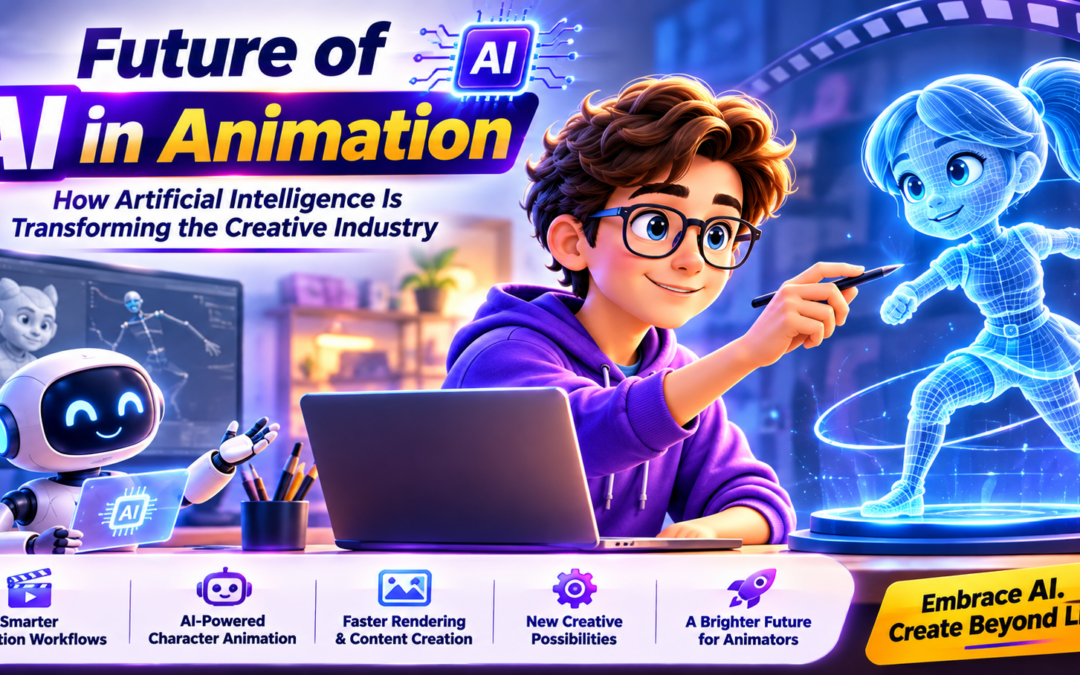
Future of AI in Animation: How Artificial Intelligence Is Transforming the Creative Industry
Introduction
Artificial Intelligence (AI) is rapidly transforming industries across the world, and animation is no exception. From automating repetitive tasks to assisting artists with creative workflows, AI is reshaping how animated content is created, edited, and delivered.
For decades, animation relied heavily on manual processes that required significant time, effort, and technical expertise. Today, AI-powered tools are helping studios and creators streamline production while opening new possibilities for creativity and innovation.
As technologies continue to evolve, many students and professionals are asking an important question: What does the Future of AI in Animation look like?
Will AI replace animators? Will it create animations automatically? Or will it become a powerful assistant that helps artists work more efficiently?
The reality is that AI is not replacing creativity—it is changing how creative professionals work. Understanding these changes is essential for students planning a career in animation and digital content creation.
In this blog, we’ll explore the Future of AI in Animation, how AI is currently being used, its impact on creative workflows, career opportunities, and what aspiring animators should expect in the years ahead.
What Is AI in Animation?
Artificial Intelligence in animation refers to the use of machine learning, automation, and intelligent software systems to assist various stages of animation production.
AI can help with:
- Character Animation
- Motion Generation
- Lip Syncing
- Facial Animation
- Motion Capture Processing
- Scene Generation
- Rendering Optimization
- Content Personalization
Rather than replacing artists, AI often acts as a production assistant that accelerates workflows.
This growing integration is a major part of the Future of AI in Animation.
Why AI Is Becoming Important in Animation
Modern audiences demand more content than ever before.
The growth of:
- Streaming Platforms
- Social Media Content
- Gaming
- Virtual Production
- Digital Marketing
- Online Education
has significantly increased content production requirements.
Studios are looking for ways to create high-quality content faster while maintaining creative standards.
AI helps achieve this by:
- Reducing repetitive work
- Increasing production efficiency
- Improving workflow speed
- Assisting creative decision-making
This is one reason the Future of AI in Animation is becoming such an important topic within the industry.
How AI Is Used in Animation Today
AI is already influencing various aspects of animation production.
Automated Inbetweening
Traditionally, animators created key poses and in-between frames manually.
AI can assist by generating intermediate frames between key poses, helping speed up production.
Facial Animation
AI can analyze speech and automatically generate realistic facial movements.
This helps create more natural character performances.
Lip Sync Automation
AI-powered tools can synchronize character mouth movements with dialogue much faster than traditional methods.
Motion Capture Enhancement
AI improves motion capture data by cleaning and refining recorded movements.
These advancements demonstrate how the Future of AI in Animation is already taking shape.
AI and Character Animation
Character animation is one of the most important aspects of storytelling.
AI can assist animators by:
- Generating movement suggestions
- Creating procedural animations
- Predicting natural motion patterns
- Improving motion transitions
However, emotional performance, acting, and storytelling still require human creativity.
The most successful animation projects combine AI assistance with artistic expertise.
AI in 3D Animation Production
The impact of AI is particularly noticeable in 3D animation workflows.
AI helps optimize:
Rigging
Automated rig creation for characters.
Skinning
Assigning character controls more efficiently.
Animation Cleanup
Removing errors and inconsistencies.
Simulation
Improving cloth, hair, and physics simulations.
These improvements allow artists to focus more on creative work rather than repetitive technical tasks.
AI-Powered Rendering and Production Efficiency
Rendering is often one of the most time-consuming stages of animation production.
AI-powered rendering technologies can:
- Reduce render times
- Improve image quality
- Predict missing visual information
- Optimize system performance
Faster rendering means shorter production schedules and greater creative flexibility.
This efficiency is expected to play a major role in the Future of AI in Animation.
AI and Motion Capture Technology
Motion capture has become a popular method for creating realistic character movement.
AI enhances motion capture by:
- Cleaning noisy data
- Improving accuracy
- Filling missing movement information
- Generating realistic transitions
This allows studios to produce more believable animations while reducing manual correction work.
AI in Storyboarding and Pre-Production
Pre-production is another area benefiting from AI technology.
AI tools can assist with:
- Concept Generation
- Storyboarding Support
- Visual References
- Scene Planning
- Shot Suggestions
While human artists remain responsible for creative direction, AI can help accelerate early-stage production planning.
Will AI Replace Animators?
This is one of the most common concerns among students.
The simple answer is no.
Animation is more than movement.
It involves:
- Storytelling
- Emotion
- Acting
- Creativity
- Design Thinking
- Artistic Judgment
AI can automate repetitive tasks, but it cannot fully replicate human imagination and creative decision-making.
Instead, the Future of AI in Animation will likely involve collaboration between artists and intelligent tools.
Animators who understand both creativity and technology will remain highly valuable.
Benefits of AI in Animation
AI offers several advantages to animation professionals.
Increased Productivity
Artists can complete projects faster.
Reduced Repetitive Work
Automation handles routine production tasks.
Faster Iteration
Teams can test ideas more quickly.
Improved Accessibility
Independent creators gain access to advanced tools.
Enhanced Workflow Efficiency
Production pipelines become more streamlined.
These benefits explain why AI adoption continues to grow throughout the animation industry.
Challenges of AI in Animation
Despite its advantages, AI also presents challenges.
Ethical Concerns
Questions about ownership and originality continue to emerge.
Quality Control
AI-generated outputs still require human review.
Creative Limitations
AI lacks genuine artistic intent and emotional understanding.
Industry Adaptation
Professionals must continuously update their skills.
Understanding these challenges is important when discussing the Future of AI in Animation.
Skills Students Should Learn in the AI Era
As AI becomes more integrated into creative workflows, students should focus on developing skills that complement technology.
Animation Principles
Understanding movement fundamentals remains essential.
Storytelling
Strong narratives will always require human creativity.
Character Performance
Emotional acting remains a uniquely human skill.
Design Thinking
Creative problem-solving remains valuable.
AI Tool Awareness
Understanding emerging technologies improves adaptability.
The future belongs to artists who can effectively work alongside AI-powered tools.
Career Opportunities in the AI-Driven Animation Industry
The evolution of AI is creating new career opportunities.
Potential roles include:
AI-Assisted Animator
Combines traditional animation with AI workflows.
Character Animator
Creates performances using advanced tools.
Motion Graphics Designer
Uses AI-enhanced production pipelines.
Technical Animator
Bridges creative and technical processes.
Virtual Production Artist
Works with real-time and AI-driven content creation systems.
The Future of AI in Animation is expected to generate entirely new roles as technology continues to evolve.
How AI Will Shape the Future of Animation
Several emerging trends are likely to influence the future.
Real-Time Animation
Faster content creation and iteration.
Personalized Content
Tailored experiences for different audiences.
Virtual Production
AI-assisted production environments.
Intelligent Character Systems
More responsive and dynamic digital characters.
Advanced Creative Collaboration
Artists and AI working together throughout production.
These innovations will continue transforming how animation is produced and experienced.
Why Human Creativity Will Always Matter
No matter how advanced technology becomes, audiences connect with stories, emotions, and meaningful experiences.
Human artists bring:
- Imagination
- Empathy
- Cultural Understanding
- Emotional Expression
- Creative Vision
These qualities remain difficult for AI to replicate.
The future of animation is not about humans versus AI—it is about humans using AI to unlock new creative possibilities.
Final Thoughts
The Future of AI in Animation is filled with exciting opportunities and transformative technologies.
AI is helping streamline production, automate repetitive tasks, and improve efficiency across animation pipelines. However, creativity, storytelling, and emotional expression remain firmly in the hands of human artists.
For students pursuing animation careers, the best approach is to embrace both artistic skills and emerging technologies. Those who understand animation fundamentals while adapting to AI-powered workflows will be well-positioned for success in the evolving creative industry.
Rather than replacing animators, AI is becoming a powerful tool that helps artists focus on what they do best—creating memorable stories, characters, and experiences that inspire audiences around the world.
Recent Comments