
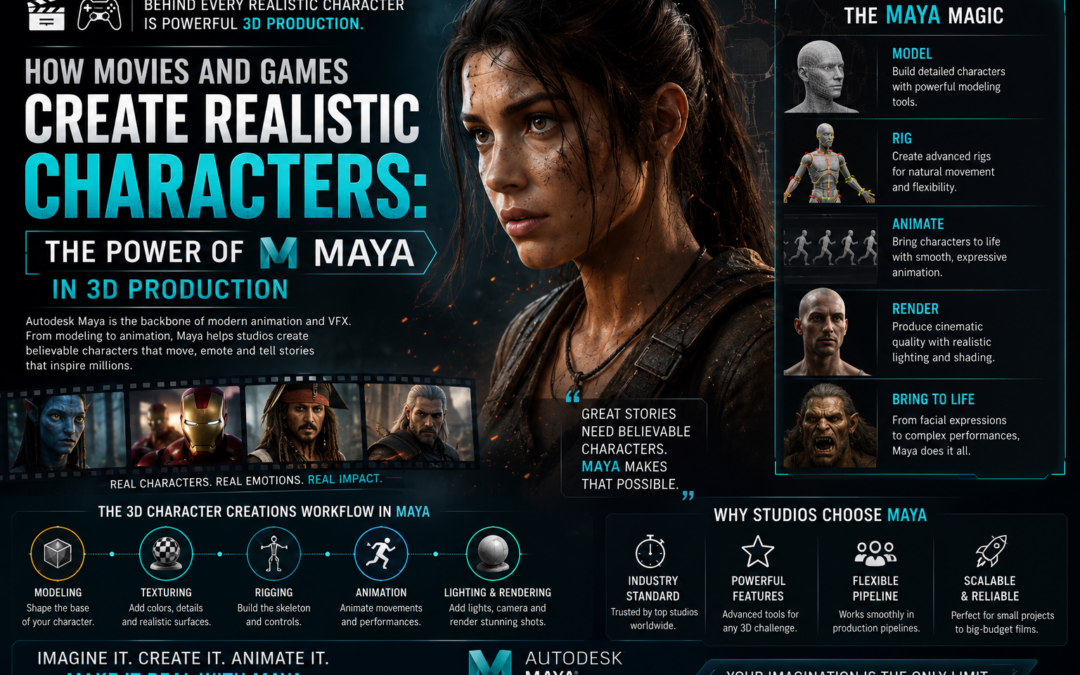
How Movies and Games Create Realistic Characters: The Power of Maya in 3D Production
Introduction
Modern movies and video games are filled with characters that look incredibly realistic. From detailed facial expressions and natural movements to cinematic environments and emotional storytelling, digital characters have become more lifelike than ever before. Behind many of these creations is one of the most powerful tools in the entertainment industry — Autodesk Maya.
Today, major animation studios, VFX companies, and game developers rely on Maya to create believable characters and immersive worlds. Whether it is a superhero in a blockbuster movie or a detailed game protagonist, Maya helps artists transform imagination into reality.
The strength of Maya in 3D Production lies in its ability to combine modeling, animation, rigging, lighting, and rendering within a professional production pipeline. It is not just software—it is a creative platform that powers some of the most visually stunning experiences in entertainment.
In this blog, we will explore how movies and games create realistic characters and understand the role of Maya in modern 3D production.
What Is Maya in 3D Production?
Autodesk Maya is a professional 3D software widely used in:
- animation
- VFX
- gaming
- cinematic production
- character creation
It provides artists with tools for:
- 3D modeling
- rigging
- animation
- simulations
- rendering
- lighting
Because of its advanced workflow and flexibility, Maya in 3D Production has become an industry standard for professional studios.
Why Realistic Characters Matter
Audiences connect emotionally with believable characters.
Whether in movies or games, realism helps viewers:
- feel emotions
- understand storytelling
- stay immersed in the experience
Realistic characters improve:
- visual quality
- emotional depth
- cinematic impact
That is why creating believable digital humans is one of the biggest goals of Maya in 3D Production.
Character Modeling: Building the Foundation
Every realistic character starts with modeling.
Artists use Maya to create:
- body structure
- facial details
- clothing
- accessories
This process involves shaping digital geometry into lifelike forms.
Professional character modeling focuses on:
- anatomy
- proportions
- surface details
Modeling is the first major step in Maya in 3D Production because it creates the visual foundation of the character.
Sculpting Realistic Details
Modern characters require high levels of detail.
Artists add:
- skin pores
- wrinkles
- scars
- fabric textures
- hair details
These tiny details make characters feel believable.
Realism in Maya in 3D Production depends heavily on observation and attention to detail.
Texturing and Materials
Once modeling is complete, artists apply textures and materials.
Textures define:
- skin appearance
- clothing surfaces
- roughness
- reflections
Good texturing adds realism and personality.
For example:
- metallic armor reflects light differently
- skin has natural imperfections
- fabric reacts softly to lighting
This stage is essential in Maya in 3D Production because textures help digital characters look alive.
Rigging: Giving Characters a Digital Skeleton
A character cannot move without a rig.
Rigging is the process of creating a digital skeleton and control system for animation.
Rigging includes:
- joints
- controllers
- facial rigs
- movement systems
Good rigs allow animators to create smooth and natural motion.
Rigging is one of the most technical parts of Maya in 3D Production, but it is critical for realistic animation.
Animation Brings Characters to Life
Animation transforms static models into living characters.
Animators create:
- walking cycles
- facial expressions
- emotional acting
- combat movements
The goal is to make movement feel believable.
Professionals study:
- body mechanics
- weight distribution
- timing and spacing
Animation is one of the most creative aspects of Maya in 3D Production because it gives personality and emotion to digital characters.
Facial Expressions and Emotional Realism
Human emotion is complex.
Small facial movements can completely change how audiences feel about a character.
Artists animate:
- eyes
- lips
- eyebrows
- subtle muscle movement
Realistic facial animation helps characters feel emotionally connected to viewers.
This emotional depth is one of the reasons Maya in 3D Production is so important in filmmaking and gaming.
Lighting Makes Characters Feel Cinematic
Lighting plays a massive role in realism.
Good lighting creates:
- depth
- atmosphere
- mood
- cinematic quality
Artists use:
- key lights
- rim lights
- soft shadows
- volumetric lighting
Professional lighting enhances the visual quality of Maya in 3D Production and makes characters feel part of a believable environment.
Rendering: Turning Scenes Into Final Visuals
Rendering converts 3D scenes into final images or animations.
This process calculates:
- lighting
- shadows
- reflections
- textures
High-quality rendering creates cinematic realism.
Modern rendering engines produce visuals that are almost impossible to distinguish from real footage.
Rendering is one of the most powerful stages of Maya in 3D Production.
Maya in Movies
Many blockbuster films use Maya for:
- CGI characters
- creatures
- environments
- action sequences
Studios rely on Maya because it supports large-scale production pipelines and advanced workflows.
From fantasy creatures to digital humans, Maya in 3D Production helps filmmakers create visually stunning experiences.
Maya in Gaming Industry
Game studios also use Maya extensively.
Artists create:
- game characters
- weapons
- vehicles
- cinematic cutscenes
Games require characters that not only look realistic but also perform efficiently in real-time engines.
This makes Maya in 3D Production highly valuable for modern game development.
Simulations and Advanced Effects
Maya also supports advanced simulations such as:
- cloth movement
- hair systems
- destruction effects
- particles
These simulations add realism to scenes and character interactions.
Advanced simulations make Maya in 3D Production more dynamic and immersive.
Why Studios Prefer Maya
Professional studios choose Maya because of:
- advanced animation tools
- strong rigging systems
- production flexibility
- industry-standard workflow
It integrates well with VFX and game pipelines, making it ideal for large projects.
This is why Maya in 3D Production remains one of the most trusted tools in entertainment industries.
Common Challenges Beginners Face
Beginners often struggle with:
- understanding 3D workflows
- character anatomy
- animation timing
- lighting techniques
- rendering optimization
Learning Maya requires patience and consistent practice.
However, mastering these skills helps creators improve their understanding of Maya in 3D Production.
Skills Needed to Succeed in Maya
To become successful in this field, artists should focus on:
- creativity
- storytelling
- observation skills
- anatomy understanding
- animation principles
- lighting and composition
Software knowledge alone is not enough.
The real strength of Maya in 3D Production comes from combining technical and artistic skills.
Future of Maya in 3D Production
The future of 3D production is evolving rapidly with:
- AI-assisted workflows
- virtual production
- real-time rendering
- advanced facial capture
As technology improves, digital characters will become even more realistic.
This means Maya in 3D Production will continue playing a major role in movies, games, and digital entertainment.
Career Opportunities in Maya
Learning Maya can open opportunities in:
- animation studios
- VFX companies
- gaming studios
- advertising agencies
- cinematic production houses
Professionals skilled in Maya in 3D Production are in demand across multiple creative industries.
Final Thoughts
Realistic digital characters are the result of creativity, technology, and storytelling working together.
From modeling and rigging to animation and rendering, every stage contributes to making characters feel believable.
The power of Maya in 3D Production lies in its ability to help artists create emotional, cinematic, and visually stunning experiences.
For students and aspiring creators, learning Maya is more than learning software—it is learning how to bring imagination to life through professional 3D production.
Recent Comments