
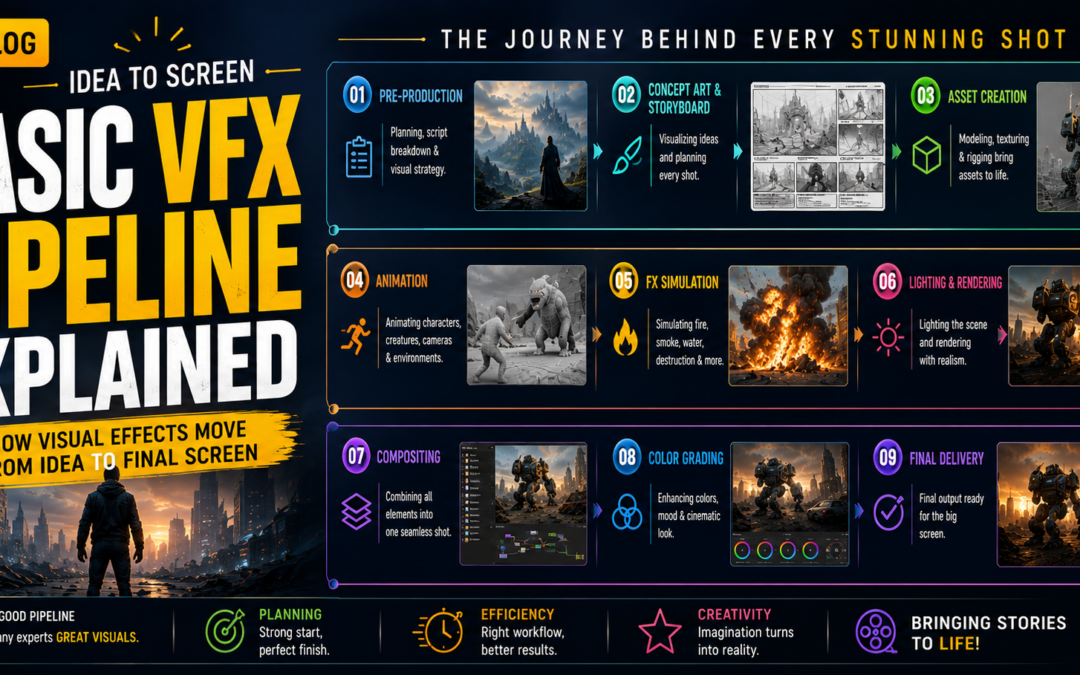
Basic VFX Pipeline Explained: How Visual Effects Move from Idea to Final Screen
Introduction
When audiences watch a blockbuster movie, a fantasy web series, or a visually stunning advertisement, they usually see only the final polished result. Giant creatures, futuristic cities, magical effects, explosions, and impossible environments appear seamlessly on screen. However, behind every impressive visual effect is a carefully planned workflow known as the Basic VFX Pipeline.
A VFX pipeline is the structured process that takes a creative idea and transforms it into a finished visual effect shot. It helps artists, animators, modelers, compositors, and supervisors work together efficiently while maintaining quality and consistency throughout production.
Modern visual effects projects can involve hundreds of artists working across multiple departments. Without a proper pipeline, managing these complex productions would be extremely difficult.
Whether it’s a Hollywood film, an OTT series, a gaming cinematic, or a commercial advertisement, every successful project follows a VFX pipeline.
In this blog, we will explore the Basic VFX Pipeline, understand each stage involved, and see how visual effects move from concept to the final screen.
What Is a VFX Pipeline?
A Basic VFX Pipeline is a step-by-step workflow that guides the creation of visual effects from initial planning to final delivery.
It ensures that every department works in coordination and that assets move smoothly through production.
The pipeline helps teams:
- organize production
- improve efficiency
- maintain consistency
- reduce errors
- meet deadlines
- manage large projects
Every VFX studio follows a pipeline, although the exact workflow may vary depending on the project.
Why Is a VFX Pipeline Important?
Visual effects involve multiple departments.
Artists working on one stage often depend on work completed by another team.
For example:
- Animators need completed character rigs.
- Lighting artists need finished models and textures.
- Compositors need rendered layers.
A Basic VFX Pipeline ensures every department receives the correct assets at the right time.
Without a pipeline, projects would become chaotic and inefficient.
Stage 1: Pre-Production
Every successful VFX project begins with planning.
Pre-production helps define the visual direction before production starts.
This stage includes:
- script analysis
- creative planning
- concept development
- technical discussions
- project breakdown
Strong planning reduces production challenges later.
Pre-production forms the foundation of the Basic VFX Pipeline.
Stage 2: Concept Art
Before creating 3D assets, artists visualize ideas through concept art.
Concept artists design:
- characters
- environments
- vehicles
- props
- visual styles
Concept art helps directors and teams align their vision.
It acts as a visual blueprint for production.
Stage 3: Storyboarding
Storyboards convert written scenes into visual sequences.
Artists create panels showing:
- camera angles
- scene composition
- action flow
- transitions
Storyboards help teams understand how shots will be executed.
This step plays an important role in the Basic VFX Pipeline because it improves communication between departments.
Stage 4: Asset Creation
Assets are the building blocks of VFX production.
Assets include:
- characters
- environments
- props
- vehicles
- buildings
Every visual element that appears on screen must first be created as an asset.
Asset creation begins the actual production phase.
Stage 5: 3D Modeling
Modeling is the process of creating three-dimensional objects.
Artists use software such as:
- Autodesk Maya
- Blender
- 3ds Max
Modelers create:
- creatures
- characters
- architecture
- environments
- props
Modeling gives shape to the project’s visual elements.
Stage 6: Texturing
Models initially appear plain and unrealistic.
Texturing adds surface detail such as:
- colors
- materials
- scratches
- dirt
- fabric patterns
Texturing helps objects feel realistic and visually appealing.
It is a critical stage in the Basic VFX Pipeline.
Stage 7: Rigging
Characters and objects need controls before animation.
Rigging creates digital skeletons and control systems.
Rigging allows artists to:
- move characters
- bend limbs
- create facial expressions
- animate objects
Without rigging, animation would not be possible.
Stage 8: Animation
Animation brings digital assets to life.
Animators create movement for:
- characters
- creatures
- vehicles
- cameras
- environmental elements
Good animation focuses on:
- timing
- weight
- emotion
- realism
Animation transforms static models into believable performances.
Stage 9: FX Simulation
Many scenes require dynamic effects.
FX artists create simulations such as:
- explosions
- fire
- smoke
- water
- dust
- destruction
Simulation helps create realistic physical behavior.
This stage adds excitement and realism to the Basic VFX Pipeline.
Stage 10: Matchmoving and Tracking
Sometimes digital elements need to match real camera movement.
Matchmoving helps artists recreate camera motion in 3D space.
This ensures CGI elements align perfectly with live-action footage.
Tracking is commonly used for:
- creature integration
- environment extensions
- digital objects
It is an essential step in visual effects production.
Stage 11: Lighting
Lighting plays a huge role in realism.
Lighting artists create:
- shadows
- highlights
- reflections
- atmosphere
Proper lighting helps digital assets blend naturally into scenes.
Even the best models can appear unrealistic if lighting is incorrect.
Stage 12: Rendering
Rendering converts 3D scenes into final images or image sequences.
Rendering processes:
- lighting
- materials
- shadows
- reflections
- effects
Popular rendering solutions include:
- Arnold Renderer
- V-Ray
- Redshift
Rendering is one of the most resource-intensive stages of the Basic VFX Pipeline.
Stage 13: Compositing
Compositing combines all visual elements into a final shot.
Artists merge:
- rendered images
- live-action footage
- simulations
- matte paintings
- color corrections
Software commonly used includes:
- Nuke
- Adobe After Effects
Compositing is where everything comes together.
Stage 14: Color Grading
Color grading improves visual consistency and mood.
Artists adjust:
- contrast
- brightness
- color balance
- cinematic tone
Color grading helps establish emotional impact and visual style.
Stage 15: Quality Control
Before delivery, shots undergo review and quality checks.
Supervisors verify:
- technical accuracy
- visual consistency
- creative requirements
- rendering quality
Issues are fixed before final approval.
This stage ensures professional results.
Stage 16: Final Delivery
After approval, the project is exported in the required format.
Deliverables may include:
- movie sequences
- television content
- OTT productions
- advertisements
- gaming cinematics
The completed visuals are then integrated into the final production.
How Different Departments Work Together
The strength of a Basic VFX Pipeline lies in collaboration.
A single VFX shot may involve:
- concept artists
- modelers
- texture artists
- riggers
- animators
- FX artists
- lighting artists
- compositors
Each department contributes to the final result.
This teamwork makes complex visual effects possible.
Career Opportunities in the VFX Pipeline
Understanding the pipeline helps students choose career paths such as:
- 3D Modeler
- Texture Artist
- Rigging Artist
- Animator
- FX Artist
- Lighting Artist
- Render Artist
- Compositor
- Matchmove Artist
- VFX Supervisor
Every role is an important part of the production process.
Future of VFX Pipelines
Modern pipelines continue evolving with:
- AI-assisted workflows
- cloud rendering
- virtual production
- real-time rendering
- LED volume technology
These advancements improve efficiency while expanding creative possibilities.
Final Thoughts
The Basic VFX Pipeline is the backbone of every successful visual effects project.
From concept art and modeling to animation, rendering, and compositing, each stage contributes to transforming creative ideas into stunning visuals.
Understanding the pipeline helps students appreciate how professional productions are made and prepares them for careers in VFX, animation, filmmaking, and digital content creation.
While audiences only see the final shot, the journey behind that shot involves planning, collaboration, creativity, and technical expertise working together through a well-structured VFX pipeline.
Recent Comments